A Mother Told Me to Stand on My Injured Ankle So Her Son Could Have My Wheelchair
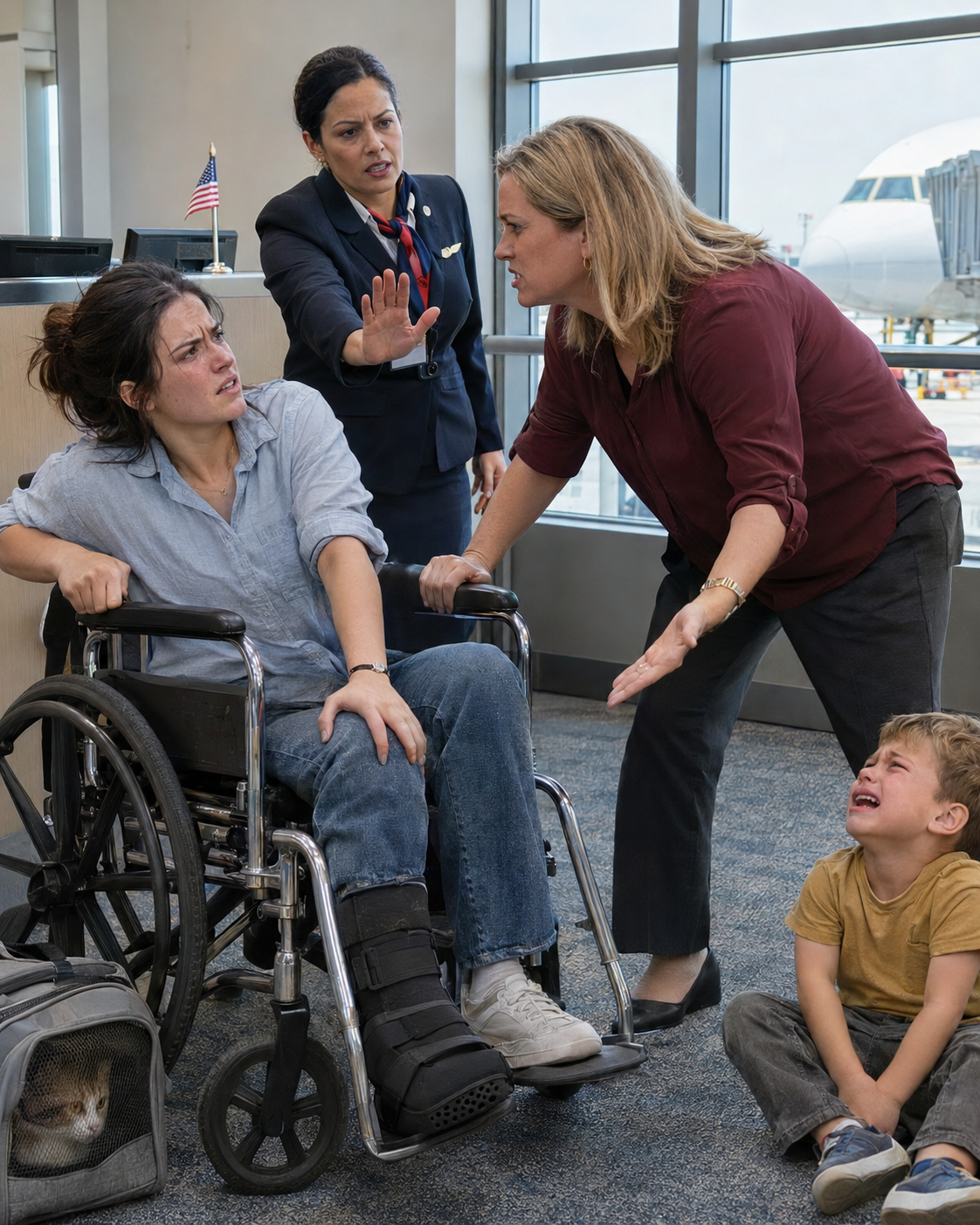
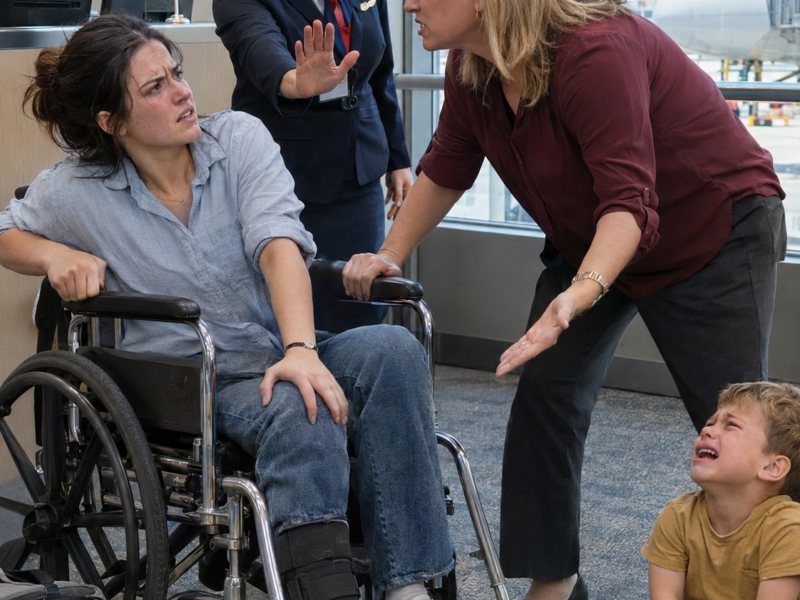
The woman tapped the arm of my wheelchair and waited for me to take off my headphones.
“I need you to get up,” she said. “My son needs somewhere to sit.”
Her little boy stood beside her, rubbing one eye with his fist. He looked about five. I glanced at the rows of occupied seats behind him, then down at the walking boot on my right leg, wondering which part of the situation I had misunderstood.
“I’m sorry. What?”
“He’s tired.” She spoke more slowly this time. “I need the chair.”
My cat was in his carrier on the floor beside me. He had finally settled down after security, and I had finally found a position that didn’t make my ankle throb quite so much. We were close enough to boarding that I had started putting away everything I wouldn’t need on the plane. Until that moment, getting home had seemed like the only difficult thing left to do.
I was twenty-five, accustomed to traveling, and thoroughly tired of that boot. A few weeks earlier, I had injured my ankle while filming. The instructions afterward had been simple: wear the boot, stay off the ankle as much as possible, and give it time.
I had followed those instructions less gracefully than I wanted to admit. I could take a few steps. I could get from a chair to a doorway. That made it easy to tell myself I ought to be doing more, until I did more and spent the evening regretting it.
That morning, by the time I reached the airport, my foot already hurt. I asked for wheelchair assistance instead of pretending that getting through a large terminal was the same as getting across my kitchen.
Check-in and security went smoothly. I held my cat while his carrier was checked, and he tucked his face against me with the solemn resignation he reserved for travel. Several people smiled at him. While an employee checked my hands, I noticed a small boy nudging his mother and pointing our way. The boy now standing in front of me.
After security, I had taken the short, awkward steps back to the wheelchair, gathered my things, and settled the carrier on my lap. The man helping me brought us to the gate, set the brakes, and made sure I was all right before leaving.
The seating area was crowded. I put the carrier on the floor beside my right wheel, where I could see through its mesh panel. My bag went beside the other wheel. Everything was close enough to reach without getting up. It was a small arrangement, but after a morning of needing help, I had been pleased with it. Now this woman was waiting for me to dismantle it.
“I need the wheelchair,” I said. “I’ve hurt my ankle.”
I moved my hand toward the boot. It wasn’t subtle. The thing came well up my calf, with broad straps and a thick sole. My pant leg was gathered above it because it wouldn’t fit over the top. She looked at it, then back at my face.
“I know. But my son has been on his feet all morning.”
There was a little pause while she waited for that to settle the matter.
“I’m sorry he’s tired.”
“Then you understand.”
“I understand he’s tired. I still need to stay here.”
She shifted her purse higher on her shoulder. Up close, she looked worn out herself. Her hair had slipped loose around her face, and she kept glancing toward the counter, where the gate agents were busy with other travelers. I could believe she’d had a long morning. So had most of the people waiting around us.
For another second, I thought she might simply have approached me badly and would recover once she realized what she was asking.
“Maybe ask at the desk,” I said. “They might be able to help you find somewhere for him to sit.”
“The desk is busy.”
The boy bent toward my cat’s carrier. My cat lifted his head, and the child smiled. He seemed more interested in the face behind the mesh than in the discussion about seating.
“He can look,” I said, keeping an eye on the carrier. “Please don’t open anything.”
“He knows how to behave around animals.”
“Okay.”
I hadn’t intended it as a criticism. I would have said the same thing to anyone reaching toward the carrier. Airports were exactly where I wanted every zipper firmly closed. The woman put her hand on the back of her son’s neck and drew him upright.
“My name is Karen,” she said. “I’m trying to ask you nicely.”
“I understand, Karen, but—”
“Ma’am.”
I looked at her.
“You can call me ma’am. Or Miss Karen.”
For a moment, I couldn’t work out whether she was serious. She had just introduced herself by her first name. I was a grown woman traveling on my own, but the correction had the crisp, practiced sound of an adult speaking to a child who had interrupted dinner.
“All right,” I said. “I’m not trying to be rude. I just can’t give you this chair.”
“Can’t, or won’t?”
I gave a small, uncomfortable laugh. It escaped before I could stop it, the sort of laugh I sometimes used when a conversation had gone so far off course that I didn’t know how to steer it back. Her expression hardened.
“You think it’s funny that my child is hurting?”
“No. That’s not why I laughed.”
“Because he’s little, his feelings don’t matter?”
“That’s not what I said.”
The boy pulled at the hem of her shirt. She placed a hand over his without looking down.
I could feel the conversation becoming something other people might notice. A woman in the nearest row glanced up from her book. At the counter, a printer ran, and someone announced a boarding update for another flight. Ordinary airport business continued around us, which somehow made the exchange feel stranger. I wanted very badly to return to being an ordinary traveler waiting quietly for her plane.
“There may be seats between the gates,” I said. “I saw some farther back.”
“There’s nothing until the food court.”
“Then maybe you could wait there until boarding.”
“I’m not walking all that way with him. He’s already tired.”
She said it as though I had suggested something unreasonable.
“It would be too far for me, too,” I said. “And then I’d have to come back.”
Her eyes dropped to my boot again. I hoped she was finally considering the distance from my side of the conversation. Instead, she said, “We saw you standing in security.”
That was when I understood why she kept looking at me as if I were holding something back. She had seen me take those few steps. She had watched me stand while holding my cat. Whatever explanation I offered now would be measured against the handful of seconds when I had been upright.
“Yes,” I said. “For a little while. That doesn’t mean I can stand here until boarding.”
“You have somewhere to lean.”
She slapped her palm against the wall beside the wheelchair. The sound made my cat pull back from the mesh.
“Right here. You don’t even have to walk anywhere.”
I looked where she was pointing. She had actually worked it out: I could balance against the wall, hold my belongings somehow, and wait while her son occupied the chair that had been brought for me. My ankle gave a deep, steady pulse inside the boot.
“No,” I said. “I’m staying in the wheelchair.”
“An adult is asking you to help a child.”
“I’m an adult, too.”
The words came out more quietly than I expected. I wasn’t trying to win an argument about manners. I was trying to make her hear an ordinary refusal.
She stared at me, and I felt the old, foolish urge to add something that would make her feel better. Another apology. Another explanation of an injury she had already seen. I had spent much of that morning thanking strangers for helping me, and I seemed unable to stop being agreeable even when someone was asking me to hurt myself for her convenience. I gripped the edge of the armrest instead.
“Please leave me alone,” I said. “I need to wait here.”
“Really? You won’t help a poor little boy?”
He had stopped rubbing his eye. He was watching us now, looking from his mother to me, waiting to see what would happen.
“I’m sorry,” I told him. “This chair is being used.”
His mother pulled him closer.
“Heartless,” she said.
I put my headphones back on. I didn’t start anything playing. I just needed a way to signal that I had finished answering the same request. She said something else I couldn’t make out, took her son’s hand, and walked away.
I watched until they passed beyond the nearest row of seats. Then I let out a breath and looked down at my cat. He had come forward again, his nose near the mesh, waiting for whatever was next.
“Almost done,” I whispered.
I checked my phone. Only a few minutes had passed. My hands were shaky enough that I opened the wrong app, closed it, and tried again. I was irritated with her, embarrassed by the attention, and a little embarrassed by how much her disapproval had bothered me. There had been a time when I would have stood up just to end that kind of conversation. The thought made me tighten my hand around the phone. This time I had stayed put.
I started the audio again at a low volume, opened what I had been reading, and tried to put the encounter behind me.
Less than two minutes later, something tugged at my boot. At first, I thought my bag had slipped. Then a small hand closed around the top of the boot, and weight came down hard on my foot. Pain shot up my leg so suddenly that I gasped.
The boy was trying to climb into my lap. One of his feet was planted on the rigid top of my boot. His hands were reaching for me, and he was pulling himself upward as though I were a piece of playground equipment.
“No! Get down!”
He pushed harder with his foot. I shoved him away.
There wasn’t a considered decision behind it. I felt pressure on the place I had spent weeks protecting, put my hands against his arms, and pushed. He lost his grip and landed on the floor in front of the wheelchair. For a second, he looked astonished. Then he began to cry.
I pulled off my headphones. They caught in my hair, and I yanked them free, hardly noticing. My ankle felt as though something inside it had been struck with a hammer. I was afraid to move it and equally unable to find a position in which it would stop hurting.
“He stepped on my foot,” I said, though nobody had asked me anything yet.
His mother was already coming toward us.
“What did you do?”
I couldn’t tell where she had been standing. The row of seats had blocked my view of her. All I knew was that she reached us quickly, and that she was looking at me before she looked down at him.
“He climbed on my injured ankle.”
“You pushed my child!”
“He was standing on my foot.”
The boy sat with his knees drawn up, crying harder now that his mother was there. I wanted to ask whether he was hurt. I also wanted her to move him away from my leg. Those two thoughts kept colliding while she stood over me demanding an explanation I had already given. People were looking. I could feel it without turning my head.
A flight attendant who had been near the counter came toward us. She took in the boy on the floor, the wheelchair, and the mother leaning over me.
“What’s happening here?”
“She attacked my son.”
The mother said it immediately, with no hesitation. Then she crouched, put both hands on the boy’s shoulders, and asked whether he was all right.
“She pushed him down,” she told the flight attendant. “I want her off this flight.”
I looked up at the uniform and felt my stomach drop. Until then, the problem had been an unreasonable stranger. Now it involved whether I would be allowed to get home, and the stranger was doing most of the talking.
“He tried to climb into my lap,” I said. “He used my boot to step up. I pushed him off because he was hurting me.”
My voice shook on the last word. I hated that it did. I wanted to sound calm and precise, but my foot hurt, a child was crying, and someone had just announced to half a gate that I had attacked him. The flight attendant bent slightly so she could hear me.
“Did he step on the injured foot?”
“Yes.”
“On purpose?” the mother demanded. “You’re saying my little boy hurt you on purpose?”
“I’m saying he stepped on it.”
That was all I knew. I hadn’t seen him approach. I didn’t know what he had been thinking. I had felt his weight and reacted. The boy reached for his mother.
“She didn’t let me sit,” he said between sobs.
“I know, baby.”
“You told me she would let me sit on her lap.”
The flight attendant looked at his mother. I stopped holding my breath long enough to notice I had been doing it.
“You told him that?” I asked.
She didn’t answer me. She brushed at the front of his shirt, although there was nothing on it, and told him to get up.
“He needs a seat,” she said to the flight attendant. “That’s what started all this. There are no seats.”
“This passenger is using a wheelchair because she’s injured.”
“She can walk. I saw her.”
The flight attendant straightened.
“She’s using this chair. You’ll need to find somewhere else to sit.”
The mother put one hand on the armrest beside mine. Her body crowded the small space in front of me, and I drew back without meaning to. There was nowhere to go. The brakes were set, the wall was close, and my belongings were on either side.
“Just get up,” she said to me. “Look at what you’ve caused.”
The flight attendant stepped closer.
“Please move your hand.”
“I’m only trying to—”
“Move your hand and give her some room.”
For the first time since the boy had stepped on me, somebody else was controlling the space around the wheelchair. I eased my fingers off the opposite armrest. I had been gripping it so tightly that my nails had left little half-moons in my palm. The mother took her hand away. She stayed close.
“Tell her she can still get on the plane if she gives us the seat,” she said.
The flight attendant’s expression changed.
“Her boarding isn’t in question. She hasn’t done anything wrong.”
“She pushed him.”
“He was climbing on her injured leg. You need to leave her alone.”
The boy had gotten to his feet. He was leaning against his mother’s side, his face wet, watching the flight attendant with the wary attention children give adults who aren’t responding the way they expect.
I had no idea what his mother had promised him when they walked away. I knew only what he had said in front of us: that he had been told I would let him sit on my lap. I had said no to his mother. She had sent him back as if my answer were something he could climb over.
“This is harassment,” the flight attendant told her. “I’m asking you to stop. If you can’t do that, we’ll have to involve airport security.”
“Security? For wanting my child to sit down?”
“For refusing to leave another passenger alone.”
I looked down at my foot. The boot was still fastened. Nothing had visibly changed, which seemed unfair considering how different my ankle felt inside it. I eased my heel on the support under my foot and immediately stopped. Moving it made the ache sharpen. The mother followed my glance. Then her eyes moved to the carrier beside my wheel.
“And what about that?”
For an instant, I didn’t understand what she meant.
“That animal,” she said. “How is she allowed to bring that on the plane?”
My cat sat very still behind the mesh. He hadn’t made a sound throughout the argument. His ears were turned toward our voices, and his front paws were tucked close together.
“His travel was arranged,” I said. “I paid the pet fee when I made the arrangements. We checked in.”
“It’s probably feral. What happens when it gets loose and attacks somebody?”
The flight attendant glanced at the closed carrier.
“The cat isn’t causing a problem.”
“You don’t know what it might do.”
I had been trying to keep my voice steady. I’d been choosing words that couldn’t be mistaken for a threat, stopping myself from answering every accusation, and working hard not to cry in front of strangers. That remark used up what was left of my patience.
“My cat has behaved better than you have,” I said. “Maybe worry about what you’re teaching your son.”
Her mouth opened.
“How dare you—”
“You told him he could climb into a stranger’s lap after I said no. I’m hurt. He’s upset. And you’re still trying to take the chair.”
My voice had risen. I could hear it. I didn’t like the sound of myself, but I wasn’t going to apologize for the fact that the cat she was calling dangerous was sitting quietly in a closed bag while she stood over me shouting. The flight attendant raised a hand between us.
“Enough. Ma’am, you need to move away. Now.”
The mother looked toward the counter, perhaps hoping somebody there would offer a different answer. The gate employees were watching the situation, but nobody came over to contradict their coworker.
“We have a flight,” she said.
“Then follow the instructions you’re being given.”
There was a silence long enough for me to hear the wheels of a suitcase rattling over a seam in the floor. At last, she took her son’s hand.
“Come on,” she told him.
He wiped his nose with the back of his wrist and went with her. They moved only a few feet away, just beyond the front of my wheelchair. She stopped near the end of the seating row and looked back. I kept my headphones in my lap. The flight attendant turned toward me. “Are you all right?”
“My ankle hurts.”
“Do you need help?”
I wasn’t sure how to answer. I needed the last several minutes not to have happened. I needed to know whether the pain would settle if I held still. Mostly, I needed that woman to keep her child away from me.
“Could you stay nearby?” I asked.
“Yes.”
She glanced toward her coworkers at the counter and took a step in that direction. She was still close enough that I didn’t have to raise my voice to speak to her.
I bent toward the carrier. Lifting it onto my lap seemed like a good idea, but the thought of its weight settling against my leg made me hesitate. I touched the handle and began to turn it so I could get a better grip. Then I looked up.
The woman had bent toward her son. Her lips were close to his ear, and one hand rested between his shoulder blades. I could see that she was speaking. I couldn’t hear a word. He looked at me, then down at the carrier. I didn’t have time to decide what that meant. He pulled away from her and came straight toward us.
There wasn’t room for a long run. He took a few quick steps, arms lifting, his eyes fixed on the bag beside my wheel. It was his posture that frightened me. He wasn’t bending to look at the cat this time. He was throwing himself toward the top of the carrier.
“Stop!”
I let go of the handle and moved my right leg across his path. It happened before I remembered which leg I was using. The boot was already closest to him. I put it between his body and the carrier, trying to keep his weight from coming down on the cat. He struck it as he lunged forward. The pain made me scream.
My foot dropped awkwardly back toward its support. The boy stumbled against the outside of the chair and fell to the floor beside it. The carrier was still upright beside my wheel. He hadn’t landed on top of it. I heard my cat scrabble inside.
For a moment, that was the only sound I could sort out. My own voice, the boy’s crying, and the flight attendant calling to someone all seemed far away. I caught hold of the carrier’s handle again and tried to look through the mesh while tears blurred everything in front of me. My cat moved to the back of the bag. He was upright. His eyes were wide, and he was frightened, but he was moving.
I couldn’t reach him without opening the carrier, and I wasn’t going to do that in the middle of the terminal. I laid my palm against the mesh instead.
“I’m here,” I managed. “I’m right here.”
The flight attendant was beside me again.
“We need security at the gate,” she told a coworker. “Right now.”
She put herself between the wheelchair and the woman, who had gathered her son against her.
“You hurt him again!” his mother shouted.
The boy clung to her shirt. I was crying, too, although I kept trying to stop. Each breath seemed to catch before I could finish it.
“He went for the carrier,” I said.
“He’s a child!”
“What did you tell him?”
She stared at me. I wiped my face with the back of my hand. “You were talking in his ear. What did you tell him to do?”
“Nothing. I didn’t tell him to do anything. You’re the one who stuck your leg out.”
“To keep him from landing on my cat.”
“Don’t you dare accuse me—”
“But, Mommy,” the boy said, “you told me to sit on the kitty’s box.”
She looked down at him.
“And squish him as hard as I can.”
The words were plain. His voice was still thick with tears, but there was no mistaking what he had said. I stopped trying to argue. The flight attendant looked from the boy to his mother. Behind her, a gate employee had a phone to her ear. Nobody spoke for a moment, and the boy seemed to feel the change without understanding it.
“Shut up,” his mother said. “That is not what I said.”
He pulled back a little, still holding her shirt. I had been angry with him when he climbed on my foot. I was angry again when he came at the carrier. He had hurt me twice, and for a few awful seconds, I had thought he would hurt my cat.
But watching him look up at his mother then, I could see how young he was. He had repeated an instruction. He seemed to expect her to explain why doing what she told him had gone wrong. She turned her attention back to the flight attendant.
“You can’t believe everything a child says when he’s upset.”
“Please stay where you are,” the flight attendant said.
“We’re going to miss boarding.”
“Stay there.”
The woman opened her mouth again, then apparently thought better of it. She moved her son behind her hip and began smoothing her hair with her free hand. I watched her face change as she looked past us toward the terminal. Security was coming.
Two officers approached, and she stepped aside with the brisk, helpful motion of someone clearing a path to a problem she had reported.
“She’s right there,” she said, pointing at me. “She hurt my child.”
The flight attendant didn’t move away from my wheelchair.
“I called for assistance with this passenger,” she said, indicating the mother. “She was instructed to leave this woman alone. She continued, and there has been another physical incident.”
The mother’s pointing hand stayed in the air for an extra second.
“Excuse me?”
One officer stopped beside her. The other stood where he could see both of us. The flight attendant explained that the woman had tried to take my wheelchair for her son, that the boy had climbed on my injured foot, and that she had warned the mother to stop approaching me.
She was careful about what she described. She had come over after the first disturbance. She had been there for the warning and the second approach. She told the officers what she had seen and what she had heard the child say. The mother interrupted twice.
“That’s not what happened.”
Then, “I was trying to find him a seat.” The officer nearest her held up a hand.
“Let her finish.”
It was such a small instruction. I couldn’t understand why hearing someone insist on it made my throat tighten again. For several minutes, I had been trying to explain myself while this woman talked over me. Now she had to stand still and listen to an account she couldn’t replace with her own. When the officer asked whether my foot had been struck, I nodded.
“Twice,” I said. “I need to keep it still.”
He looked at the boot, then at the carrier I still held by its handle.
“And the animal?”
“He’s inside. I blocked him from landing on it.”
The mother made an impatient sound.
“She cares more about that cat than my son.”
I didn’t answer. I was no longer willing to explain why I had protected an animal in my care, any more than I was willing to explain again why I needed to sit down. The flight attendant spoke to her.
“You and your son will not be traveling on this flight.”
The woman blinked.
“What?”
“You’ll need to gather your things and go with these officers.”
“No. She’s the one who should be removed.”
“The decision has been made.”
Her son’s crying had dwindled to little uneven breaths. He looked toward their belongings, then back at her. She tightened her grip on his hand.
“We have to get home. He has summer camp.”
Nobody argued about camp.
“We cannot afford to buy another flight,” she said. “Do you understand that? Our tickets are paid for. We’re getting on this plane.”
The officer beside her spoke quietly.
“Ma’am, collect your belongings.”
She looked at me as if I had the power to reverse the decision. Her expression moved between anger and something much closer to panic.
“Tell them,” she said. “Tell them this is ridiculous.”
I held the carrier and said nothing. I hadn’t asked for her money. I hadn’t asked to interrupt her plans. I had asked to remain in the chair I was already using, and she had been given several chances to walk away. The officer repeated the instruction. This time, she obeyed.
She pulled her carry-on from beside the seating row and asked what would happen to their other bags. A gate employee told her the staff would explain the arrangements. She began protesting again, her voice rising as though volume might reopen the discussion. The officers waited for her to get hold of everything.
There were no handcuffs. No dramatic struggle. She was a woman with a suitcase and a small boy, being told to leave while an entire gate tried not to look as interested as it was. That ordinary sight made the consequence feel more real than any shouting could have.
As they passed, she turned toward me and called out one last insult, something about Jesus having a special place for people like me. I looked down at my cat.
The wheels of her suitcase rattled away. Her son took quick little steps to keep up with her. I watched only long enough to make sure they were continuing down the terminal, then let my shoulders rest against the back of the chair. For the first time since she had tapped the armrest, nobody was asking me to move. The flight attendant crouched beside me.
“They’re gone,” she said.
I nodded, but my hands kept shaking. I had expected relief to feel better than it did. Instead, with the argument over, there was nothing left to distract me from my ankle.
“Would you like us to call for medical assistance?”
I looked down at the boot. “Can I have a minute?”
“Of course.”
She didn’t reach for the wheelchair or start gathering my belongings. She waited while I took a few slow breaths and let go of the carrier’s handle one finger at a time. My palm hurt. I had been holding it as though someone might still try to take it away.
“Could you help me put him on my lap?” I asked. “On this side.”
I indicated my left thigh. She lifted the carrier carefully, and I guided it into place, keeping its weight away from my injured leg. My cat came forward when he heard me speak. I could see his whiskers through the mesh again.
“There you are,” I whispered.
He pressed his nose toward my fingers. I checked the carrier’s seams and zipper. Everything was closed. It hadn’t been crushed. I couldn’t inspect every inch of him without taking him out, but he was alert and looking at me, and the small, familiar movement of his head helped me breathe normally.
After a few quiet minutes, I told her I wanted to get home and see my doctor there. She asked whether I could manage the short distance to my seat with help. I told her I thought I could, as long as I didn’t have to hurry.
“We’ll make sure you have help,” she said. “Tell us if you need anything else.”
I thanked her, then apologized for the disruption. The apology surprised me as soon as it came out. She glanced toward the place where the mother had stood.
“You asked her to leave you alone,” she said. “I heard you.”
I looked down because my eyes were filling again. I had managed to argue through the worst of it. Now a simple acknowledgment was enough to undo me.
Around us, the gate began to settle back into its usual noise. People returned to their screens. A suitcase tipped over and was righted. Someone asked a question about a connection. The flight hadn’t become a different kind of occasion just because something awful had happened in one corner of the waiting area. I was grateful for that. I didn’t want people coming over to discuss it. I wanted to stop being the woman everyone had been watching.
When it was time to board, help arrived as promised. My bag was gathered, and the wheelchair was moved toward the boarding door. I kept the cat’s carrier on my good leg and both hands around its sides. I looked down the terminal once. The mother and her son weren’t there.
At the plane, I stood slowly and made the short transfer with assistance. It hurt. There was no way to turn that into a graceful little moment of determination, and I didn’t try. I concentrated on where to put my good foot and on accepting the help being offered.
Once I was seated, someone helped settle the carrier beneath the seat in front of me. I checked that I could see the mesh panel, then fastened my seat belt. For a while, I watched the people boarding.
A family stopped to work out who was sitting where. A man lifted a bag into an overhead bin. Someone apologized for brushing against my arm. None of them was doing anything wrong, but every time a child passed my row, I drew my injured foot back as far as I could. I noticed myself doing it and felt sad in a way I hadn’t expected.
I liked children. I hadn’t minded the little boy looking at my cat, even while his mother and I were talking. He’d seemed curious and friendly. I didn’t want the sound of small feet approaching to make me tense. Eventually, the aisle cleared. The door closed. I leaned back and let my shoulders drop.
My ankle hurt through the flight. I shifted carefully when I needed to and kept checking the carrier whenever my cat moved inside it. He settled sooner than I did, curling into the far corner where he usually slept while we traveled. Once, he turned his face toward me and gave a tiny, complaining meow.
“I know,” I whispered.
I almost smiled.
When we landed, I accepted assistance again. I didn’t try to walk farther than I had to. The trip through the terminal was uneventful, and by then, uneventful felt like an extraordinary kindness.
At home, I set the carrier on the floor and opened it. My cat stayed inside for a moment, blinking at the room. Then he stepped out, stretched his front legs, and went to inspect his water bowl as though he had been away for months. I left my suitcase by the door.
Usually, I put everything away before sitting down. That night, the suitcase could wait. So could the laundry, the travel receipts, and the little collection of things I always found at the bottom of my bag after a flight. I took care of the cat, got what I needed within reach, and propped up my leg.
He ate, washed his face, and eventually came to find me. He paused near the boot, sniffed it, and went around to my other side. I put my hand on his back. He was warm. He was home. When I stroked him, he leaned into my fingers with the same comfortable weight he always had.
Only then did I allow myself to think about what might have happened if I hadn’t moved my leg. I stopped before the thought went very far and pulled him closer instead.
By the next morning, my ankle hadn’t settled down the way I had hoped it would.
The trip itself had been tiring, and I knew I might have had some discomfort even without the incident. This felt different from the manageable ache I had taken into the airport. Getting ready to see the doctor took longer than it should have because I kept having to stop and sit.
I was annoyed by small things. A sock I couldn’t reach. My bag still beside the door. The distance between the place I had left my phone and the place I needed it.
At the appointment, I described the two impacts. I tried to keep the explanation short. Saying that a stranger had wanted my wheelchair for her child sounded absurd, but it was the only way to explain why someone had stepped on my boot and then collided with it again.
“You were already wearing the boot when this happened?” the doctor asked.
“The whole time.”
I watched the straps being loosened and tried not to tense before anyone touched my ankle. I had spent weeks waiting for that foot to become something I could stop thinking about. Now I was back to watching every movement around it.
After examining me, the doctor told me the impacts had set back my recovery. I would need to stay in the boot longer than we had anticipated. I looked at the shoe on my uninjured foot.
“Longer,” I repeated.
The doctor nodded. We would have to give it more time and see how it settled. I had known that was possible. It still felt different when somebody said it out loud. At the airport, the goal had been getting on the plane and bringing my cat home safely. I’d reached that goal. I had wanted the rest of the consequences to end when I closed my front door.
Instead, there would be more mornings working around the boot, more things I couldn’t comfortably carry, and more decisions about whether a short errand was worth the walking involved. I asked the questions I needed to ask and listened to the answers. When it was time to leave, I fastened the straps again and took my time standing. Nobody in that room expected me to move faster because I was young.
At home, I moved the things I used most often within easy reach. The suitcase could wait. My cat supervised from a comfortable spot nearby. He had recovered his usual confidence, including his belief that any blanket left unattended belonged to him. I was grateful that his part of the ordeal seemed to be over.
A few days later, the airline called. The representative said they were following up on the incident at the gate and wanted my account. I sat down before we began, put my foot in a comfortable position, and told her what had happened. This time, nobody interrupted to tell me what I had meant.
I started with the wheelchair assistance and the crowded gate. I explained the request, my refusal, and the boy climbing onto my boot. When I reached the second incident, I slowed down.
“I saw her speak to him,” I said. “I couldn’t hear what she said.”
The distinction mattered to me. There had been enough false claims made that day. I didn’t want my own account to include anything I hadn’t actually witnessed.
“Then he came toward the carrier?” she asked.
“Yes. I moved my leg to block him. Afterward, he said his mother had told him to sit on it and squish the cat.”
She let me finish. Then she asked about my ankle. I told her I had seen my doctor the following day and would be in the boot longer because of what had happened. I also told her the cat appeared to be all right.
“I’m glad he’s safe,” she said. “I’m very sorry about your injury.”
I thanked her. Then I told her about the flight attendant.
“She stayed with me. She explained what happened to security, and she made sure I got help boarding. Please make sure that gets included.”
“I will.”
I didn’t know the attendant’s name. I wished I had thought to ask. At the gate, I had been concentrating on keeping my foot still and getting the cat away from that woman. Remembering someone’s name hadn’t occurred to me until I was home and wanted to thank her properly. The representative had the flight information, and she said she would pass along what I had told her.
She offered travel vouchers as an acknowledgment of what I had been through. I appreciated the offer. I flew often enough that they would be useful, but I was still sitting with my leg propped up while we talked. The practical cost of the incident was there in front of me. Then she told me the other passenger had been barred from traveling with the airline in the future.
“Not just that flight?” I asked.
“No.”
I was quiet for a moment. At the gate, the mother had behaved as though I was the one who needed to worry about being allowed on the plane. She had offered me my own boarding permission as a reward for doing what she wanted. I hadn’t expected to hear that her behavior would follow her beyond that afternoon.
I wasn’t pursuing charges. I wanted the incident accurately recorded, and I wanted to be able to travel without wondering whether a refusal would somehow be treated as my mistake. The call gave me that much reassurance. Before we hung up, the representative asked whether there was anything else I wanted to add. I looked across the room at my cat, asleep with his head hanging over the edge of a cushion.
“I’d already told her I needed the chair,” I said. “Before any of this happened.”
“I understand.”
That was all I added.
I never found out how the mother and her son got home. I didn’t know whether they found another flight, whether he made it to camp, or what any of it cost. I had been angry enough at the airport to hope the consequences would inconvenience her as much as she had inconvenienced everyone around her.
Sitting at home afterward, I found that I didn’t want to keep imagining the rest of her day. I had already spent enough of mine answering her.
I still thought about the boy sometimes, particularly the bewildered way he had looked up after repeating his mother’s instruction. I hoped he would eventually understand that someone else’s no wasn’t a challenge he had to overcome. At his age, he should have been able to trust the adult holding his hand to keep him out of that situation.
As for me, I had more healing to do. I still had to move carefully, ask for help when I needed it, and tolerate the frustrating slowness of getting better.
That evening, I settled into bed with my ankle supported and the things I needed on the nightstand. My cat appeared in the doorway, paused, and looked at the space beside me. I moved the folded blanket to make room.
“Come here,” I said.
He climbed up on my good side, circled once, and lay down with his back against my hip. I rested my hand on him and felt the low, steady vibration of his purr. My suitcase was still waiting to be unpacked. My phone needed charging. Both could wait until morning.
I turned out the light and stayed where I was.