At My Wedding, My Son Was Sitting in the Hall. “He’s Not Family Yet,” My Fiancé’s Sister Said.
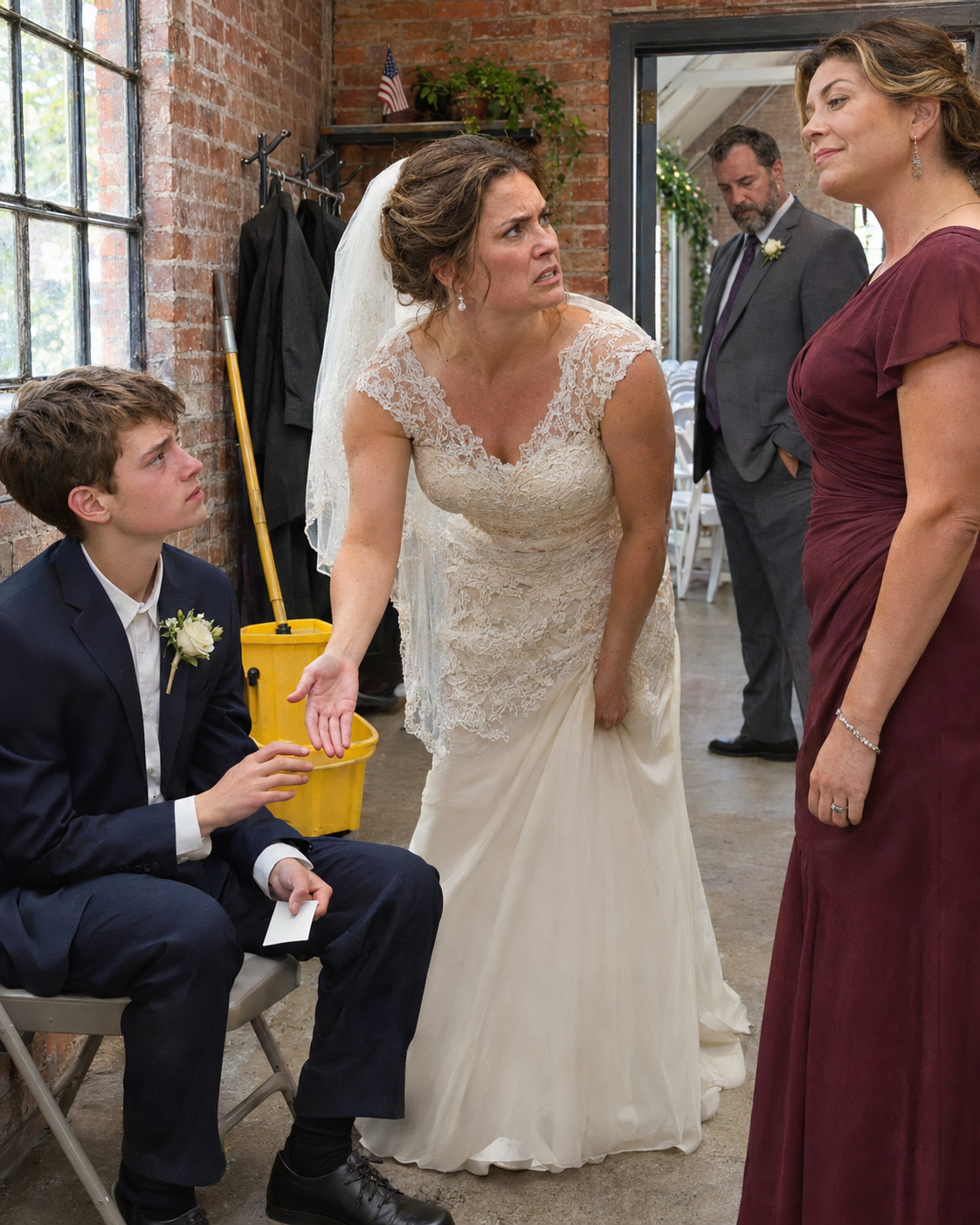
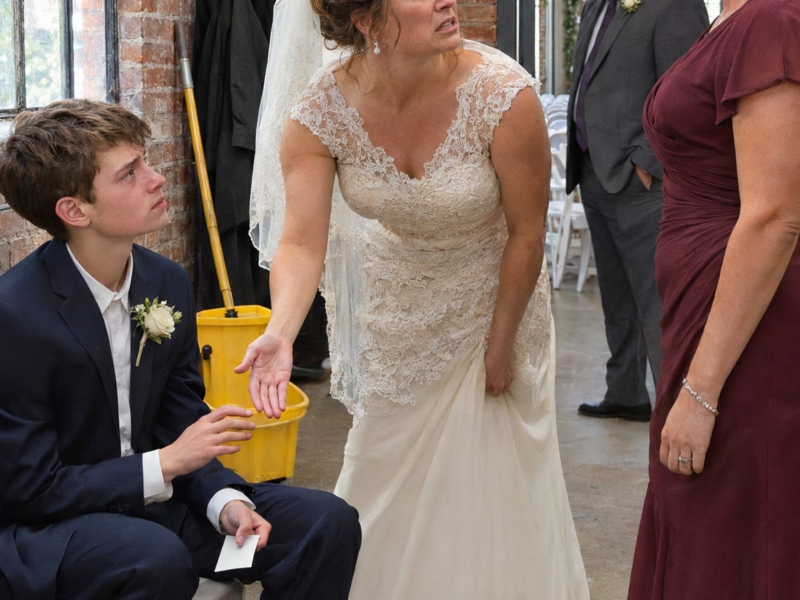
On my wedding day, I found my fifteen-year-old son sitting on a metal folding chair beside a coat rack and a yellow mop bucket. His jacket was buttoned. The white rose he had practiced pinning on himself was still on his lapel.
Through the open doors, I could see the front row of the ceremony hall. That morning, I had put a little white card on the first chair on my side. Eli, in my handwriting.
Now Greg’s three children and his sister’s twins occupied that row. A photographer knelt in front of them. My son’s card was gone.
Tasha came around the corner carrying her clipboard. When I asked why Eli had been moved, she glanced at him, then back at me.
“He’s not family yet.”
Greg stood by the side entrance in the gray suit we had picked out together. I looked straight at him.
“Is she right?”
He looked at his mother. Then he nodded.
“Let’s just get through today, babe.”
I had seen that nod before. Thirty years earlier, I had been the child waiting for my mother to say something.
She had nodded, too.
I was eleven when my mother took me to Thanksgiving at her new mother-in-law’s house in Muncie. She had married Ray Kowalski the previous year. I wore a green dress and had spent the drive practicing, “Thank you for having me,” because my mother wanted everything to go well.
The dining room table had a lace runner and handwritten cards at every plate. I walked around it twice looking for mine.
Mrs. Kowalski came out of the kitchen with a card table. She unfolded it in the doorway, opened one metal chair, and patted the seat.
“Until you’re really family, sweetheart. This is just easier.”
I looked at my mother. She was passing the mashed potatoes. For a moment, our eyes met, and I waited for her to put the bowl down.
Instead, she gave that small nod.
I sat where I was told. The chair was cold through my tights. When the people at the big table laughed, I laughed a moment later, although I usually hadn’t heard the joke.
After dinner, I offered to wash dishes. Standing at the sink felt better than sitting where everyone could see I had been left out.
The same table appeared the following Thanksgiving and the one after that. When I was fourteen, I said I had a stomachache and stayed home. Nobody tried very hard to change my mind.
My mother never called it unkind. She called it keeping the peace, and for years I accepted that description because I didn’t have another one that would let me keep loving her.
By nineteen, I was typing at a small law office and going to court reporting school at night. I earned my certification at twenty-two. The work suited me. I liked having a record that people couldn’t improve afterward simply because they wished they had said something else.
I married Mark Dunn at twenty-four. Eli was born two years later. When our son was four, Mark moved to Columbus, Ohio, and started another life. He called on birthdays and usually sent his checks on time. I handled the rest.
For years, my days were measured in school pickups and courthouse calendars. At night, after Eli fell asleep, I finished rush transcripts at the kitchen table. When he was eight, I bought a small brick house on the south side of Fort Wayne. My name was the only one on the deed.
We ate pizza on the empty dining room floor the first night. Eli used a moving box as a table for our paper cups and told me it was the best night of his life.
I promised myself he would always have a place there.
Then I went back to being the woman who said yes to extra work, brought something to every gathering, and apologized when other people bumped into her. Having a house of my own had changed our circumstances. It hadn’t changed every habit I carried into it.
I met Greg two winters before the wedding, when our furnace stopped working in the middle of a January night. It was eleven degrees outside. By dawn, I had called every emergency number I could find. One company offered to send someone around noon. Then a truck with Albright Heating and Air on the door pulled into my driveway.
Greg came in with frost in his beard and apologized for taking so long. It wasn’t even his shift. The dispatcher had mentioned a mother and a kid without heat, and he had come himself.
Forty minutes later, the furnace was running. Instead of packing up immediately, he called Eli over and showed him how to change the filter.
“You’re my assistant now,” he said. “This thing gives you trouble, you call me first.”
Eli was thirteen, standing there with a blanket over his shoulders. He asked two questions. Greg answered both without looking at his watch.
He waived the overnight fee and came back the next week to check a furnace that was working perfectly. After that, he asked me to dinner.
His ex-wife, Kristen, had moved to Phoenix three years earlier, leaving him with Brody, Ava, and Lily. His mother, Darlene, had helped him keep his job and get the children where they needed to be.
“I don’t know what I would’ve done without her,” he told me.
I understood that kind of gratitude. I also understood sitting across from someone who knew why you kept checking your phone during dinner.
Greg made room for Eli from the beginning. He taught him to solder a wire. He let him practice backing the truck in an empty parking lot. He listened when Eli talked about orchestra, even when the explanation involved more about cello bows than either of us could follow.
My son laughed around him. That mattered more to me than flowers or dinner reservations.
A month later, Greg took us to Sunday dinner at Darlene’s house in New Haven. I brought an apple pie I had made that morning. She thanked me and put it on top of the refrigerator.
Her daughter, Tasha, was already there with her husband and their twins. Tasha sold real estate and had a way of talking about any room as if she were deciding what ought to be removed from it.
There was a place for me beside Greg at the dining table. Darlene guided Eli toward a folding table in the living room, where two little children from a cousin’s family were eating beside the television.
“He can fit beside me,” I said. “I don’t mind moving over.”
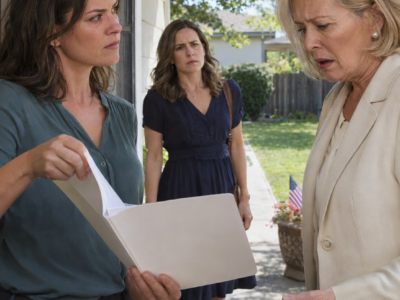
Tasha buttered a roll. “He’s fine there. He’s not family yet.”
I waited for a laugh or an explanation that would make the sentence less ugly. Darlene passed the green beans. Greg gave a small shrug.
Tasha’s twins were at the big table. One of them was asking for more bread.
I should have stood up. Instead, I sat beside Greg and tried to follow a conversation about somebody’s new roof. Through the doorway, I could see Eli cutting chicken into smaller pieces for one of the toddlers.
When dinner ended, he cleared their dishes without being asked. Darlene patted his arm and called him a good little helper. He smiled politely. He was already taller than she was.
Before we left, I asked for my pie. Darlene took it down from the refrigerator with the plastic wrap still pulled tight over the crust.
Greg watched me carry it to the car.
“Mom’s old-fashioned,” he said on the drive home. “Tasha gets that from her. Give them a little time.”
“Time for what?”
“To get used to us. They’ll come around.”
From the backseat, Eli said, “It’s fine, Mom. The little kids were funny.”
I turned toward him. He was looking out the window, and I wanted to believe him. The alternative meant admitting that I had sat at a comfortable table while my son learned to be agreeable in another room.
That night, we cut the pie at our own kitchen counter. Eli ate two pieces. I asked about the toddlers instead of asking whether his feelings had been hurt.
I could remember every word Tasha had said. Remembering wasn’t the part I had trouble with.
By the following Christmas Eve, there was a stocking with my name on it at Darlene’s house.
It hung at the end of a row of red felt stockings for Greg, his children, Tasha’s family, and everyone else expected that night. Eli stood beside me with a present he had spent two weeks making in art class: a wooden picture frame with pine trees burned into the corners.
There wasn’t a stocking for him.
“I ran out of felt,” Darlene said when she saw me looking. “Next year, honey.”
Later, Tasha passed me in the kitchen carrying plates. “Not family yet,” she said quietly. “You get it.”
Eli gave Darlene the frame anyway. She thanked him and put it on a side table. When she needed room for cookies, she laid it facedown beneath the edge of the tray.
I moved the tray enough to uncover it. That was the extent of my courage that evening.
At home, I added extra things to Eli’s stocking: candy, gift cards, a new set of cello strings. I wanted him to wake up feeling loved. I didn’t want to have the conversation that might make Greg angry with his mother or disappointed in me.
Greg proposed in February at the Italian restaurant where we had eaten our first dinner. I said yes before he finished asking.
There were good days in that house, and I need to be fair about them. Lily would fall asleep against Eli on the couch. Brody asked him for help with schoolwork. Greg cooked when I had a transcript deadline and remembered how I liked my coffee. I wasn’t pretending every part of our life together was good. Enough of it was good that I kept making excuses for the rest.
The one thing I knew about the wedding was that Eli would walk me down the aisle.
I asked him in the car one Sunday in March. For a while, he didn’t answer. Then he looked over at me.
“Yeah,” he said. “I’d like that.”
A few nights later, I caught him walking slowly down our front hallway, counting under his breath. He said he was working out the pace so I wouldn’t trip on my dress.
At a planning lunch in April, Darlene suggested Greg’s uncle Ron instead. “A boy walking his mother is a little unusual, Joanna. Ron would be happy to. It would look more like family.”
“Eli’s walking me.”
Greg looked at me, then lowered his eyes to the menu.
“That part isn’t changing,” I said.
Darlene smiled. “Of course. It’s your day.”
Tasha offered to handle the seating and place cards. She did staging all the time, she said. It would be one less thing for me to worry about.
I accepted. I was so relieved to have defended Eli’s place in the ceremony that I didn’t think much about handing her control of where everyone would sit afterward.
Meanwhile, we were making room for Greg’s family at my house. There were three bedrooms: mine, Eli’s at the back, and a small front room I used as an office. Brody would get the office. A contractor was finishing the basement family room for Ava and Lily. Eli would keep his room.
We agreed on it at my kitchen table, with the arrangement drawn on a legal pad.
In August, I moved my desk into my bedroom and painted the front room pale blue. Eli did the edges with a small brush. He hung a baseball pennant over the window for Brody.
I asked how he felt about having three more children living with us.
“It’ll be loud,” he said. “But Lily’s cool. And I still have my room.”
“Of course you do.”
When Darlene came to see the work, she paused in Eli’s doorway. His music stand was beside the window overlooking the yard.
“Big room,” she said. “For one boy.”
I told her it had been his since we moved in. She nodded and asked to see the basement.
The night before the wedding, we had our rehearsal dinner in the back room of a restaurant on Broadway. Greg’s relatives filled most of the long table. On my side were Eli, a few courthouse friends, and Judge Roberta Haynes, who would perform the ceremony.
Greg stood to make a toast. He thanked his mother for holding the family together. He thanked Tasha for doing a hundred things nobody had asked her to do. Then he said he couldn’t wait for Brody, Ava, and Lily to have a real home again.
He raised his glass to me.
He never said Eli’s name.
Beside me, my son laid down his fork very carefully. Later, while dessert was being served, I heard Tasha say, “After Christmas, sweetie,” at the far end of the table. Ava let out a happy squeal. I couldn’t hear the rest.
Eli wanted to go straight to bed when we got home. He said he needed to be rested for the big day.
I texted Greg: You forgot Eli in your toast.
He answered almost immediately.
Babe, I was so nervous I forgot my own name. I’ll make it up to him tomorrow. Promise.
I read that last word twice before I put down my phone.
At six-fifteen the next morning, I found Eli at the ironing board in his socks. He had watched a video so he could press his own dress shirt. He was working on a sleeve with the concentration he usually saved for a difficult piece of music.
“You’re up early,” I said.
“Didn’t want to rush.”
His jacket hung on the back of a kitchen chair. Beside the toaster sat the box from the florist, with the white rose inside. There was already a tiny pinhole in his lapel.
“Practicing?” I asked.
“Making sure I don’t stab myself in front of everybody.”
I laughed. He gave me a quick smile and went back to his shirt.
The wedding was at four-forty-five. There would be a hundred and forty people, and Eli was a quiet kid who preferred sitting behind his cello to being watched. I assumed that explained the careful way he was moving, the way he seemed to be concentrating on doing everything right.
“Are you okay?”
“I’m good, Mom. It’s your day.”
I knew that answer. I had used it for years. Still, I kissed the top of his head and told him the shirt looked wonderful.
When he went to get his shoes, the garage door stuck. I followed him out to help.
About thirty boxes lined the walls. Greg’s lease ended on October thirty-first, and he had been bringing things over a carload at a time. He and the children were still sleeping at his place, but almost everything they didn’t need daily was now in my garage.
Eli found the shoebox he wanted. On the stack beside it sat a carton labeled in Tasha’s tall, slanted capitals:
AVA — BACK BEDROOM.
My son saw it. He looked down at his shoes, then went into the house.
I called Greg.
“Hey, beautiful. Aren’t we supposed to avoid each other until the ceremony?”
I told him what the box said.
“Tasha labeled a bunch of them,” he answered. “She doesn’t know your layout.”
“She’s been through the house.”
“Jo, it’s a label. We know where everybody’s going. Don’t let it ruin your morning.”
I stood there with the phone against my ear while he told me he loved me. Then I said it back, hung up, and turned the box so the writing faced the wall.
Later that morning, I checked the ceremony room at The Foundry, the old brick building by the river where we were getting married. Tall windows lit the rows of white chairs. Greenery curved over the arch at the front.
I straightened the card on Eli’s seat. After walking me in, he would sit there, close enough that I could look at him without turning all the way around.
Judge Haynes stopped in to look at the setup. I had been her court reporter for eleven years. She knew Eli from school concerts I had mentioned and afternoons when he waited outside her courtroom for me to finish work.
When I had asked her to marry us, she had said she would be honored.
I had watched her perform plenty of courthouse weddings. Once, a bride had gone silent when asked whether she took the man beside her. The groom started explaining that she was nervous. Judge Haynes gently stopped him.
“I ask once, and I listen to the answer,” she had said. “Take the time you need.”
She had closed her binder. The couple left together, still unmarried.
That morning, she looked at Eli’s name card and nodded.
“How’s he doing with all of this?”
“He’s walking me in,” I said.
It wasn’t what she had asked.
Before I could say more, Tasha arrived with a shoebox full of cards and told me she had the seating handled. Someone needed me upstairs. I left Eli’s card where I had put it and went to get ready.
That afternoon, after the makeup artist left, my phone buzzed on the vanity in the bridal suite.
The message was from Mark.
Congrats today, Jo. Seriously. You deserve good things.
I was typing a thank-you when another message appeared.
Darlene called me two weeks ago about Eli moving here in January. She said you were on board. I told her I needed to hear it from you. I don’t want him blindsided.
I stopped typing.
Outside the door, somebody laughed. A cart rattled down the hall. I could hear a woman asking where the extra tablecloths had gone.
I read the message again, holding the phone closer as if that might change it.
Then I locked the door and called my son’s father. “Tell me what she said,” I told him. “As close as you can remember.”
Mark took a breath. In the background, one of his little girls was asking for help finding a shoe.
“She said she was helping with the transition. That the house would be crowded with Greg’s kids moving in. She said Eli was almost grown and a boy needs his dad.”
“Did she say I agreed?”
“Yes. She said you thought it was best, and Greg knew about it. She asked whether I knew how to enroll him here for the second semester.”
I sat on the small bench in front of the mirror.
The room in my house. The label on the box. Tasha’s voice at the rehearsal dinner saying, “After Christmas.”
“Why didn’t you call me?”
“I thought you were going to call. She made it sound like you were figuring out dates.” His voice changed. “I should’ve checked sooner. I know that. It kept bothering me, and I didn’t want to wait until you were married to find out what was happening.”
“Nothing is happening. I never agreed to this. Nobody asked me.”
He was quiet for a moment.
“I’d like more time with him, Jo. I haven’t done enough. But I don’t want him sent here because somebody needs his room.”
“Neither do I.”
“Then we’re clear. I haven’t arranged anything.”
I pressed my free hand flat against my knee. Mark and I had disappointed each other in plenty of ways. In that conversation, he was doing what I needed him to do.
“Thank you for telling me.”
“Is Eli okay?”
I thought about the ironing board and the shoebox under his arm. I had been in the kitchen with him that morning. I had kissed his head. I couldn’t answer the question.
“I’m going to find out,” I said.
Before we hung up, I asked what day Darlene had called. It had been a Tuesday evening.
I opened my messages with Greg and scrolled back to that night. At nine-forty, he had sent a question I barely remembered.
Has Eli ever talked about wanting to live with his dad?
I had answered: Not really. Why?
Just curious. Love you.
There was a heart after it.
I kept looking at the exchange. He had asked the question, received an answer, and left me believing there was nothing else to discuss. Meanwhile, his mother had been talking about school enrollment in another state.
I put the phone down and got into my dress. The small buttons were difficult with my hands shaking, but working them gave me something to do. I had spent months preparing to stand beside Greg. I needed a few minutes to understand that I might not.
When Darlene knocked, I was standing in front of the mirror.
“I’m here to help with your veil,” she called.
I let her in. She was dressed in pale blue, with a corsage on her wrist. She took the veil out of its box and stood behind me, lifting a section of my hair with the confidence of someone who had already decided how it should look.
“Greg’s going to cry,” she said. “He always does at things like this.”
I watched her reflection. “Did you call Mark about Eli moving to Columbus?”
Her fingers kept working. “Somebody had to think practically, honey. Four children in that house? You’d be on top of one another.”
“We already worked out the rooms.”
“The girls ought to have a real bedroom. Not a basement.”
“You saw the room. It’s finished.”
She slid a pin into place. “Eli could have more time with his father. The girls would be upstairs. It makes sense for everybody.”
“You told Mark I had agreed.”
For the first time, she met my eyes in the mirror. “I told him what you’d agree to once you thought about it. You’re a sensible woman, Joanna.”
I turned around. One side of the veil slipped off my shoulder.
“You don’t get to tell anyone what I’ve agreed to. And you don’t get to decide where my son lives.”
Her expression tightened, then softened into something almost sorrowful.
“Lily calls you Mama. Did you know that? She told her teacher she was getting a new mama on Saturday.”
I knew Lily was excited. She was six. She held my hand in parking lots and had recently asked whether I would braid her hair every morning once she lived with us.
“Are you going to take that away from her over a bedroom?” Darlene asked.
For a terrible few seconds, I tried to find a way to make her proposal harmless. Mark loved Eli. Columbus wasn’t the other side of the world. Perhaps more time with his father would be good for him.
Then I remembered that Eli hadn’t asked for any of this. He had helped paint Brody’s walls. He had made room for the other children while trusting that his own place was safe.
“Lily can come into this house without Eli leaving it,” I said. “That was always the plan.”
Darlene reached to straighten the veil. I stepped back.
“Did Greg agree to this?”
She lowered her hand. “Ask him yourself. He’s a grown man.”
She left the room with the empty veil box under her arm. There was no apology, no surprise that I was upset, no question about what Eli wanted.
I texted Greg to come upstairs and speak to me through the door.
At four-fifteen, I heard his uneven footsteps in the hall, the old knee injury making one step heavier than the next.
“I’m not looking,” he said through the wood. “We’re not risking bad luck now.”
“Did you tell your mother Eli could move to Ohio?”
He didn’t answer immediately. I stood with my hand on the doorknob and waited.
“It was a conversation, Jo. She brought it up. I said maybe more time with Mark could be good for him.”
“Did you agree?”
“I said it might make sense. Down the road.”
“January is down the road?”
“We were going to talk after the honeymoon.”
“Your mother has already called his father.”
“She got ahead of things. You know how she is.”
I rested my forehead against the door. Downstairs, somebody tested a microphone. There was a brief squeal, then a low murmur of voices.
“I gave up my office,” I said. “We finished the basement. We made a plan. When were you going to tell me you were discussing a different one?”
“There wasn’t a different plan. There was an idea.”
“Then tell me Eli’s room is his room.”
“Babe, please. Can we get married first?”
I took my hand off the knob. He had an answer for why his mother had called, why I hadn’t been told, why today was the wrong time. He couldn’t give me the simple answer I had asked for.
“I need to see my son.”
“He’s downstairs. Tasha has everybody ready.” He paused. “Are we okay?”
I didn’t say we were.
Eventually, he walked away. I stayed beside the door long enough to stop shaking, then gathered the front of my dress and went down the back stairs.
Part of me still wanted Greg to follow me and say he had handled everything badly, that of course Eli was staying, that we would talk to him together. I hadn’t stopped loving Greg in the time it took to read a text message.
But I was finished taking anyone else’s word for how my son was doing.
The stairs ended in a service hallway behind the ceremony room. There were restroom doors, the coat rack, cleaning supplies pushed against the wall, and Eli on that gray folding chair.
He started to stand when he saw me, then sat again.
“Mom, you’re not supposed to be down here yet.”
“Why are you sitting out here?”
“Tasha said they needed the front row for the family pictures. I’m supposed to wait until it’s time to walk you in.” He tugged at one cuff. “It’s fine. I’m only here until January anyway.”
I stopped beside his chair. “Who told you that?”
He looked toward the open doors. In the first row, Brody was sitting where I had left Eli’s card that morning. The photographer asked the children to lean closer together.
“I heard Tasha last night,” Eli said. “When I came back from the bathroom. She told Ava she was getting my room after Christmas because I was going to Dad’s.”
He rubbed a spot on his trouser leg with his thumb. “She told her not to tell me yet.”
I lowered myself as far as the dress would allow and put a hand on his knee.
“Listen to me. You are not moving out. I never agreed to it, and your dad hasn’t arranged anything. Your room is yours.”
He looked at my face carefully.
“You didn’t know?”
“Not until today.”
His eyes filled, although he kept his mouth steady. I moved closer so people passing the hall wouldn’t have a clear view of him.
“I thought maybe you wanted to tell me after,” he said.
“Oh, honey.”
“You’ve been so happy. I didn’t want to mess it up.”
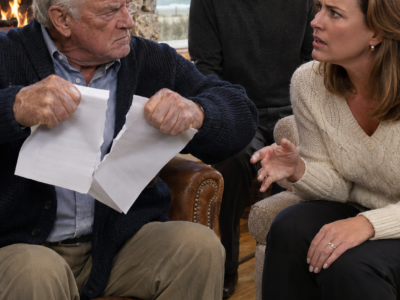
He reached into the inside pocket of his jacket and brought out a small white card. One corner was bent. I recognized my own handwriting before he turned it fully toward me.
Eli.
“It was in the trash by the gift table,” he said. “I didn’t want it to get thrown out for real.”
I touched the bent corner with my finger.
My son had seen his name in the garbage, picked it out, and put it in the good jacket he was wearing for me. He had been willing to walk me down the aisle while believing I was about to give his room away.
I wanted to say he should have told me. But I had watched him being left out before, then brought him home and tried to make up for it quietly. I had shown him that keeping everyone comfortable meant swallowing his own hurt. He had been paying attention.
“You don’t have to keep me happy by letting people hurt you,” I said. “I’m sorry I made you think you did.”
He looked down at the card. I kept my hand on his knee until he looked at me again.
That was when Tasha came around the corner, with Darlene close behind her.
“Jo, they’re about to cue the music. You need to be upstairs.”
I stood. “Why did you take my son’s seat?”
Darlene answered before Tasha could.
“The photographer wanted the grandchildren together. It’s one afternoon, Joanna. Nobody’s trying to hurt anybody.”
“He had a seat. I put his name on it.”
Tasha let out a breath, glanced at Eli, and said what she had said at her mother’s dinner table and again at Christmas.
“He’s not family yet.”
Then Greg appeared at the side entrance, and I asked him whether she was right.
He looked at Darlene. She lifted her eyebrows just a little. He nodded and asked me to get through the day. We could fix everything tomorrow.
Eli was watching me now. Not Greg. Me.
I could remember exactly how my mother’s nod had felt. I could also see how easy it would be to give one of my own. There were guests waiting, flowers paid for, three children I loved, a dress I had struggled to button. Every practical reason pointed toward being agreeable for a little longer.
My son was sitting beside a mop bucket with his name in his hand.
I held out my palm.
“You’re still walking me in,” I told him. “That part hasn’t changed.”
He slipped the card into his pocket, took my hand, and stood.
The music began as we entered through the side doors at the back of the room. People turned, then rose from their chairs. Someone whispered that it was sweet to have my son walking me.
Eli counted under his breath. One, two, three, four. The same slow pace he had practiced in our front hall.
I held his arm. My other hand gripped the skirt of my dress too tightly, and halfway down the aisle I made myself loosen it. Greg had hurried back under the arch. Judge Haynes stood beside him with her black binder open.
When we reached the front, Greg held out his hands.
I didn’t take them.
Beside the arch was the microphone set up for the readings. I lifted it from its stand and turned toward the room. Eli stayed next to me.
I was used to speaking in rooms where people listened closely. That didn’t make this easy. My mouth was dry, and I could see Lily smoothing her dress in the front row, waiting for something happy to happen.
I took a breath.
“Greg’s sister just told my son he isn’t family yet, and Greg agreed with her. So let’s make it official. He never will be, and neither will I.”
The musicians stopped. A chair creaked somewhere near the back.
“Daddy?” Lily said. “What does that mean?”
Greg took a step toward me.
“Jo. Please. Not here.”
Behind him, Judge Haynes closed her binder. The small sound carried in the quiet room. She stepped beside me, and I handed her the microphone.
“I was asked to perform this ceremony,” she said. “I ask once, and I listen to the answer. I’ve heard Joanna’s answer. There will be no wedding today.”
She didn’t invite discussion. She set the microphone back in its stand and stayed beside us.
Darlene stood so quickly her purse slid from her lap.
“You’re humiliating my son in front of everyone over a chair?”
“Not over a chair,” I said. “Over a nod.”
Tasha got to her feet.
“Oh, please. He was going to sit somewhere. This is ridiculous.”
My voice was steadier when I answered her.
“In February of last year, at your mother’s table, you said, ‘He’s fine there. He’s not family yet.’ At Christmas, you said, ‘Not family yet. You get it.’ A few minutes ago, in the hall, you said it again.”
She opened her mouth, then looked at the people watching her.
“I’m not being dramatic, Tasha. I’m being accurate.”
I didn’t tell the room about Ohio. Eli was already standing in front of a hundred and forty people while the adults responsible for this argued around him. He didn’t need his bedroom and his father discussed into a microphone, too.
Greg moved close enough to speak quietly. “We need to talk in private.”
“You had two years of private, Greg.”
He stared at me. Then his eyes moved to Eli, who was standing straight beside me, no longer looking at the floor.
For a moment, I thought Greg might say something to him. Instead, he turned toward the front row and began gathering his children.
Brody went rigid and silent. Ava looked from one adult to another. Lily started crying when Greg picked her up. As he carried her down the aisle, she reached over his shoulder toward me.
I nearly moved after her. My whole body wanted to go to that little girl.
But Eli’s hand was still in mine, and Greg was already taking Lily through the doors. I stood there while the sound of her crying grew farther away.
Darlene and Tasha followed them. Then other people began collecting coats and bags. Greg’s cousin Dale, who had been hired as the DJ, went into the reception room and started packing his equipment.
There was no applause. People whispered. A few looked at me with sympathy, and others plainly wished they were somewhere else. I understood. Until that afternoon, I would have wanted to be somewhere else, too.
Through the open doors beyond the ceremony room, I could see the reception tables, the candles, and the three-tier cake. The venue and dinner had cost me $11,600. It was paid for. There was no getting it back because I had finally said something I should have said sooner.
Eli looked at the tables, then at me.
“What do we do now?”
I wiped under one eye with my finger and looked toward the catering staff waiting by the kitchen.
“Well,” I said, “we’re not wasting the chicken.”
He gave a startled laugh. It was the first unguarded sound I had heard from him all day.
I turned to the people still in the room.
“Dinner’s paid for,” I said. “If you came here for me and Eli, I’d be glad if you stayed and ate with us.”
About sixty people did. My courthouse friends, our neighbors, Eli’s orchestra teacher, two of his friends and their parents. Judge Haynes’s husband, Walt, came forward to help move people into the reception room.
A few of Greg’s relatives stayed, too. His aunt Marjorie squeezed my arm as she passed.
“Somebody should have said that a long time ago,” she told me.
At the center of the head table were two cards: Joanna and Greg. I picked up Greg’s and put it in my purse. Then I held out my hand to Eli.
He knew what I wanted. He took the bent card out of his jacket. I set it beside mine and pulled out the chair.
“This one’s yours.”
He sat slowly. He rested his fingertips on the card for a moment before putting his hands in his lap.
The servers began bringing salads. People found seats closer together, leaving the empty tables at the far end of the room. Without the DJ, it was quiet until someone from the venue helped Eli connect his phone to the house sound system.
He chose a cello recording we used to play on long car rides when he was little. I recognized it before the first phrase ended.
“You still have that?” I asked.
“Yeah.” He checked the volume. “Is it too loud?”
“It’s fine.” I caught myself and smiled at him. “Actually fine.”
He smiled back.
Conversation picked up. Someone asked for another basket of rolls. Eli’s friends pulled their chairs closer and talked to him about school. Nobody asked him to get up or make room for somebody more entitled to be there.
When the chicken arrived, I discovered I was hungry. I hadn’t eaten since a piece of toast that morning.
Judge Haynes stood with her wineglass. “I’d like to offer a toast,” she said. “To Eli. We’re very glad to be here with you tonight.”
People lifted their glasses and said his name. He turned red, glanced down at his plate, and tried unsuccessfully to hide his smile.
Later, he asked me to dance. We moved in a slow circle on the mostly empty floor, my dress brushing against his carefully pressed trousers.
“You didn’t have to do all that,” he said.
“Yes, I did.”
“But the wedding. All the money.”
I stopped moving long enough to look at him. “None of that was your fault. None of it was your responsibility.”
He swallowed and nodded. Then we started moving again. For the rest of the song, he let me rest my head against his shoulder.
At ten that night, I was on our couch with my shoes off, still wearing the dress. Eli had gone upstairs. The house was quiet except for the furnace switching on.
Headlights moved across the curtains. Greg’s truck stopped in front of the house. Darlene was in the passenger seat. She stayed there while he came to the porch.
I went outside and closed the door behind me.
His tie was gone. His face looked older than it had that morning.
“I told Mom Ohio’s off,” he said. “Completely. It was never really going to happen.”
“Greg.”
“We can go to the courthouse next week. Just us. Nobody else gets involved.”
From the porch, I could see his mother sitting with her arms folded, watching the house.
“My lease is up on the thirty-first,” he added. “Everything’s here. The kids will have to go to Mom’s basement.”
I held the porch rail. I didn’t enjoy hearing that. Brody’s room was painted. The girls’ room was ready. Their things were already stacked a few feet away in my garage.
Greg took a folded sheet of paper from his pocket. “Lily made this. She wanted you to have it.”
It was a crayon drawing of a house under a big yellow sun. Six people stood in front of it holding hands. Above the tallest child, she had written Eli’s name, with the E backward.
I held the paper with both hands. She had included him without a second thought.
For a moment, I wanted to say yes to everything Greg was offering. A courthouse wedding. A quiet start. A chance to keep Lily close enough to braid her hair before school.
I loved those children. I loved parts of the man standing below the porch steps. Saying no did not make either of those things stop being true.
“Why did you nod?” I asked him.
He rubbed his face. “You don’t know what Mom did after Kristen left. I could barely get through a day. She picked up the kids. She fed them. She kept everything going.”
“I know she helped you.”
“Then you understand. I couldn’t stand there, in front of everyone, and turn on her. Not at my wedding.”
“You could have said my son was family.”
He looked down at the steps.
I waited. I wanted him to understand the difference without my having to explain it again.
“If you couldn’t stand up for him today, with both of us right there,” I said, “what was going to happen on an ordinary Tuesday when I wasn’t in the room?”
“I can do better.”
I folded Lily’s drawing along its original crease. “Come back tomorrow at noon,” I said. “Bring a trailer.”
He stayed at the bottom of the steps for a while. Then he turned and went to the truck. I watched the taillights until they disappeared around the corner.
When I went inside, I stood at the foot of the stairs and listened. There was no sound from Eli’s room. I hoped he was asleep, but I didn’t go up to ask him to make me feel better.
I went to my own room and took off the dress.
At seven the next morning, I opened the garage and began carrying boxes down the driveway. Eli came out in sweatpants, his hair sticking up on one side, and lifted a carton from the stack.
“You don’t have to help with this,” I told him.
“That one’s heavy,” he said. “Get the other end.”
We worked without talking much. I kept the boxes together near the curb, clear of the sidewalk. The carton marked for Ava went on top of the last stack. This time, I left the label facing out.
Inside, I taped a piece of paper to the small front room’s door. Office. I would move my desk back that afternoon.
Greg arrived at noon with a borrowed trailer and Brody. He stopped when he saw everything waiting outside. I handed him the small velvet box with the ring inside.
“Jo,” he said. “Two years.”
“I know.”
“That can’t just mean nothing.”
“It doesn’t. But I spent my childhood waiting to be family. I won’t ask Eli to do the same.”
Brody stood beside the trailer, staring at the ground. I wanted to tell him the blue room hadn’t been a lie, that I had been looking forward to knowing him better. But he was a child watching another plan fall apart. He didn’t owe me a conversation that would make it easier for me.
I handed Greg Lily’s drawing. “Give this back to her. Tell her none of this was her fault. Please make sure she knows that.”
He put it carefully in his jacket.
Eli helped with the heavy boxes. When the last one was loaded, Greg stood in front of him.
“I’m sorry, buddy.”
Eli nodded once. He didn’t say it was fine.
Before they left, I told Greg I was changing the garage code at six. If we had missed anything, he could call me and we would arrange to get it to him.
At six, I changed it. Then I called Mark. “Eli’s staying here,” I said. “If you two want more time together, I’ll help arrange it. But that has to be something he wants.”
“Fair,” Mark said. “Tell him I’ll call Wednesday.”
After I hung up, Eli appeared in the kitchen doorway.
“Want pancakes?”
“For dinner?”
“It’s been a weird weekend.”
I laughed and took the mixing bowl out of the cabinet. “What kind?”
He thought about it. He didn’t ask what I wanted first. “Chocolate chip.”
We ate them at the kitchen table with the syrup bottle between us. My wedding shoes were still by the couch, and the flowers someone had sent home with us stood in the sink. I hadn’t figured out what to do with any of it yet. For that evening, we had dinner.
The weeks afterward were harder than that Sunday night made them look.
Tasha posted on Facebook about people who would humiliate an entire family over a seating chart. She didn’t use my name. She didn’t need to. Three people who had been at Darlene’s Christmas Eve gathering sent private messages saying they remembered what had happened and were sorry they hadn’t spoken up.
I thanked them. I didn’t answer Tasha’s post.
Greg and the children moved into Darlene’s basement. She left one voicemail that began, “I hope you’re proud of yourself.” I deleted it.
I missed Lily. I missed having someone ask whether I wanted coffee. Sometimes, when a truck slowed outside, I looked toward the window before I could stop myself.
The $11,600 was gone. I sat in my restored office one evening and went through the receipts. It was money I had worked hard for, and losing it hurt. I could admit that without deciding I should have gone through with the marriage.
Down the hall, Eli was practicing. When he reached a difficult passage, he stopped and began again. I listened while I put the receipts in a folder and closed the drawer.
In November, he came into my room while I was folding laundry and sat on the end of the bed.
“Can I ask you something?”
“Always.”
“Why was the chair such a big deal? For you, I mean. You looked like you’d seen a ghost.”
I put down the towel in my hands and told him about Muncie. The green dress, the card table, my mother passing the potatoes. I told him about pretending to be sick so I wouldn’t have to go back.
He listened without interrupting.
“That’s messed up,” he said finally.
“Yes. It was.”
“And nobody said anything?”
“No.”
He looked toward the hallway, thinking.
“So when I kept saying it was fine…”
“That’s what I used to say.”
“Did you believe me?”
I could have made myself sound better. I had spent enough time doing that.
“Sometimes. Other times, I wanted to believe you because it made things easier. I’m sorry.”
He picked at a loose thread on the blanket. I let him have the silence.
“I really did like Greg,” he said.
“I know. So did I.”
“I don’t want you to think I hated everything.”
“You don’t have to hate him to be hurt by what he did.”
He nodded. I moved the laundry basket so there was room to sit beside him.
“From now on, when something’s wrong, tell me. Even if you think I’m having the best day of my life.”
He considered that, then looked at me. “Same goes for you.”
“Deal.”
The following weekend, he visited his dad in Columbus. It was his idea. He came home with headphones his little half sisters had helped pick out and stories about a game they had taught him.
“It was nice,” he said, putting his bag down inside the door. Then he looked around our living room. “It’s nice to be home, too.”
In early December, I bought an oak dining table at a secondhand store on Coliseum Boulevard. It had a scratch across one end, but it was solid. I found six comfortable chairs to go with it. None of them matched.
Eli helped me carry them inside. We tried each one before deciding where it belonged. Later that week, I donated an old card table that had been folded in the basement for years.
On Christmas Eve, Judge Haynes and Walt arrived with a pecan pie and wine. Mrs. Okafor from next door brought jollof rice. Eli invited Marcus, a boy from orchestra whose parents were both working night shifts at the hospital. He had been planning to spend the evening alone with a frozen pizza.
Eli made the name cards. He put Marcus beside him and mine at the end where I liked to sit, near the kitchen.
Two stockings hung by the window. Joanna and Eli. I had sewn his from red felt and bought an extra yard, although there was plenty left over.
When I brought in the last serving dish, Marcus was standing in the doorway, looking uncertainly at the table.
“Do you need me to grab another chair from somewhere?” he asked.
Eli looked up from pouring water. “We’ve got real ones,” he said. “Everybody here’s family already.”
Marcus smiled and pulled out his chair. Walt passed him the rolls. Mrs. Okafor started telling a story about her grandson, and Judge Haynes leaned closer so she wouldn’t miss it.
I stood for a moment with my hands on the back of my chair. There was my name, in my son’s careful handwriting. Beside it, he had set a folded napkin and the good silverware.
“Mom,” Eli said, “sit down. You’re going to let everything get cold.”
So I did.