My Mother Cut Me Off for Marrying a Landscaper’s Son. Then She Read About His $60 Million Deal.
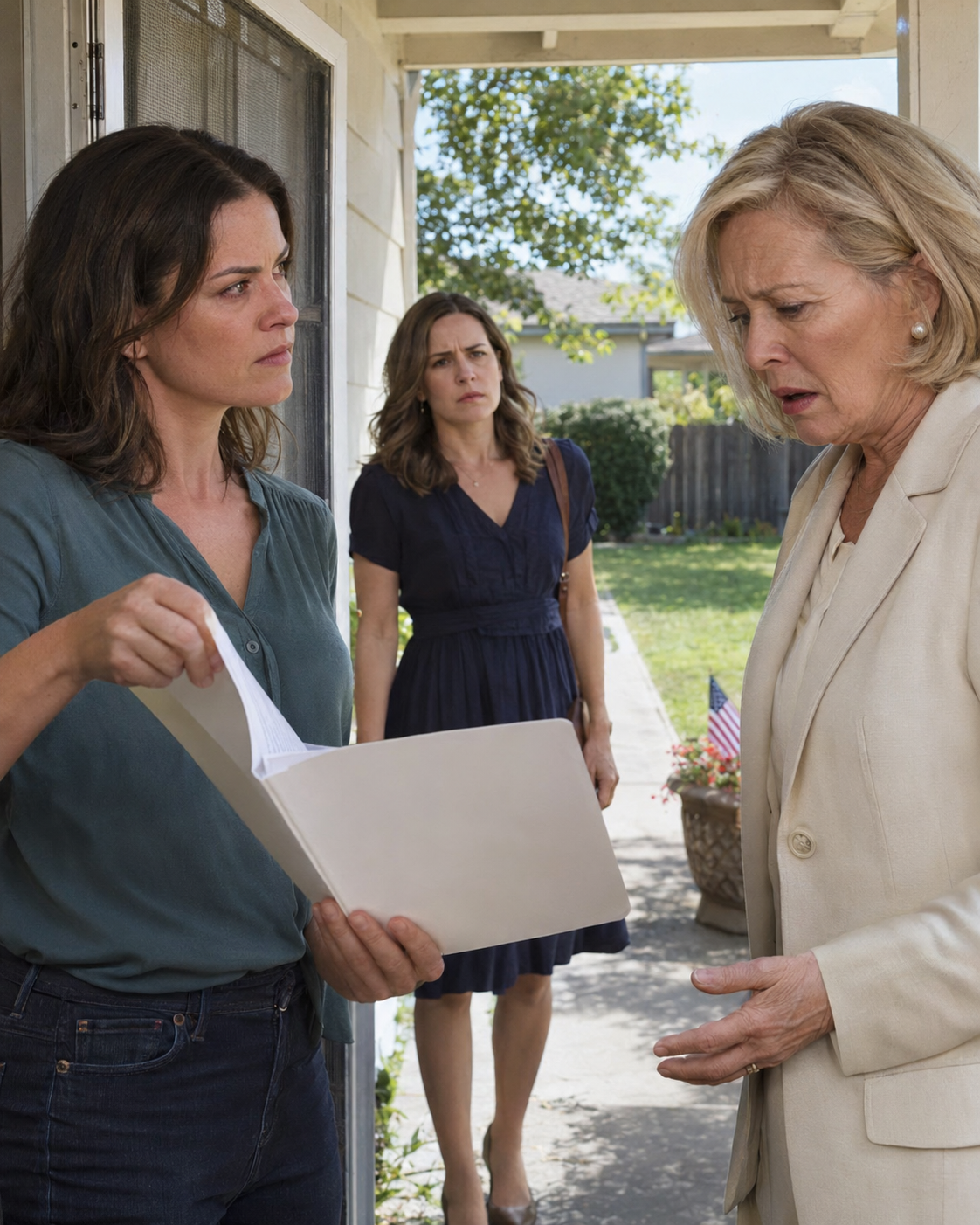
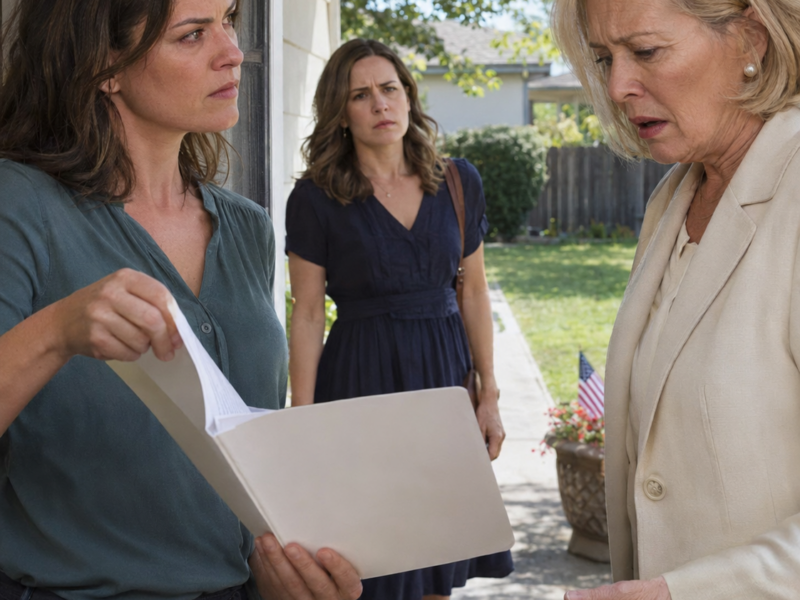
On a Tuesday in September, my mother rang my doorbell for the first time in twelve years. She handed me a folded newspaper article with a yellow sticky note pressed across the top.
WE FORGIVE YOU.
Underneath, someone had highlighted the words $60 million.
Twelve years earlier, she had told me not to expect her at my wedding because the man I was marrying was beneath our family. Until that month, there had been no phone calls, no Christmas cards, and nothing for my twin daughters. They were nine now, and she had never met them. She didn’t ask where they were.
“We’ve decided to forgive you,” she said. “All of it.”
My father sat in the passenger seat of the silver Lexus at the curb. The engine was running. He looked toward the house, then down at his hands.
I peeled the note from the article. My mother waited for me to thank her. When I didn’t, she adjusted the strap of her purse and said, “You’ve had your little life, Claire. Now the girls get a real one.” I set the article on the porch chair, beside a folder she hadn’t noticed.
For twenty days, I had wondered what I would do if she came. There had been mornings when I wanted to call her myself, just to hear whether she could say my husband’s name without finding something wrong with it. Now she was standing in front of me, and the number she’d highlighted was showing through the folded paper.
The article had appeared on Wednesday, September 2, a little after nine. I was at my desk at Meridian Title in Modesto, sorting closing packages, when Tasha came around the partition with her tablet.
“Claire. It’s up.”
The headline announced that Northgate Foods had agreed to buy Coldline in a $60 million deal. Under it was a photograph of Matteo in front of a company truck, wearing the blue shirt I’d told him would look better than the gray one. He had asked me three times whether his smile looked strange. In the picture, he wasn’t smiling at all.
Tasha read aloud about the founder, the son of a Modesto landscaper, who had started the business in 2016 with a used truck and a $40,000 startup loan secured by his savings. “A landscaper,” she said, grinning. “And now this.”
“I know.”
Farther down, the reporter had named Matteo’s wife: Claire Ashford Reyes. I hadn’t asked him to include my maiden name. Seeing it beside my husband’s photograph made me put down my coffee.
My phone began filling with messages. An old classmate. My piano teacher. A couple whose escrow I’d handled five years earlier. People who had watched Matteo work out of that truck, and people who had barely known he owned a business. His message came between two others.
It’s out. You okay?
I sent him a photograph of the files stacked on my desk. He sent back a laughing face and told me to eat lunch this time.
Then I scrolled through the names on my phone. I did it slowly, twice, though there was no reason to check again.
Nobody named Ashford. Not my mother. Not my father. Not my sister.
I put the phone facedown and went back to work. A young couple was buying their first house on Coffee Road. They had brought their toddler, who spent most of the appointment trying to climb into his father’s lap. When I slid their papers across the table, the mother asked whether she should use her full middle name. I answered her. I found the page they needed. For forty minutes, there was something in front of me I knew how to do.
At 4:52, an unfamiliar local number called my cell. Two rings, then nothing. No message. I watched the screen go dark and didn’t call back.
That evening, Matteo and I sat on the back steps while the girls argued over the tablet inside. The lawn had been mowed that afternoon. He still had his work boots on, and there was a grass clipping stuck to one lace. I told him about the number.
“If they want to talk to you, they can leave a message,” he said.
“I know.”
He waited. We’d been together long enough for him to recognize when I hadn’t finished.
“Every year on the girls’ birthday, I check the mailbox before they wake up.”
He looked at me.
“Before six sometimes. The mail doesn’t come then. I know that. I just go out and open it.” I rubbed my thumb along the edge of the step. “Nine birthdays. Nothing from any of them. Then I come back inside and make pancakes.”
Matteo rested his forearms on his knees. “I’ve seen you,” he said. “From the kitchen window. I didn’t know whether you wanted me to say anything.”
I tried to laugh, but it caught in my throat. “I think I kept believing that if we did well enough, they’d come back. And if they came back, maybe it would mean they’d finally understood.”
“Understood what?”
I looked at him then. At his boots, his tired face, the little crease beside his mouth that had been there before I married him. “That I didn’t make a mistake.”
He didn’t rush to comfort me. He put his hand beside mine on the step, close enough that I could take it. “What do you want to happen if they call?”
Before I could find an answer, June shouted that Ada had used up her turn. Matteo got up to settle it, and I stayed outside another minute.
When I’d told my parents we were getting married, I had been twenty-six. It was September 2014, a Friday evening. My mother’s kitchen had yellow notes on the refrigerator, the calendar, even the cabinet above the coffeemaker. One said DO NOT MOVE. I never knew what she meant by it, but nobody moved anything.
My father was rinsing a pan at the sink. Brooke, who was twenty-two, sat at the island with her phone. She had already told my mother why I was coming. I put my hand on the counter so they could see the ring. Matteo had bought it with three months of overtime. The diamond wasn’t large, and I couldn’t stop looking at it.
“We’re getting married in March,” I said. “I wanted to check the date with you before we set it.”
My mother looked at my hand without touching it. “Don’t expect us at the wedding. He’s beneath this family.”
The water kept running. That’s what stayed with me afterward, the sound of it hitting the pan while I stood there waiting for someone to speak.
“Mom,” Brooke said.
My mother glanced at her. Brooke looked down at her phone.
“Dad?”
He turned off the faucet, dried his hands, and folded the towel over the oven handle. Then he walked out the back door.
I picked up my purse. Nobody followed me. I made it to Matteo’s apartment before I cried, and even then I waited until I had parked and turned off the engine.
I mailed an invitation anyway. A week later, it came back unopened with a yellow note on the corner.
RETURN TO SENDER. L.
I kept it in a shoebox. Later, the girls’ hospital bracelets went into that same box, along with the tiny shoes Rosa insisted they’d worn even though I couldn’t remember their feet ever being that small.
We married the following March. I didn’t change my number afterward. We stayed in Modesto. When the girls were born, I made sure the news reached my family. I didn’t want anyone to be able to say they hadn’t known. By the time the article appeared, I had spent twelve years making myself easy to find.
On Friday morning, Tasha came to my desk again. This time, she put her phone down without smiling. My sister had shared Matteo’s photograph on Instagram the previous day.
So proud of my brother-in-law. Family is everything.
There was a yellow heart and a tag for Coldline. Beneath the post, women I recognized from my mother’s club had written how happy they were for our family. Brooke hadn’t been in a room with Matteo since 2014. She had never met our daughters. Yet there she was, accepting congratulations from people who assumed she’d been beside us all along.
I took a screenshot, making sure the date showed, then called Matteo. “Has Brooke contacted you?”
He paused. “Twice. Yesterday.”
I was holding a closing statement. I set it down before I could put my signature where the buyer’s belonged. “Were you going to tell me?”
“Yes.”
“When?”
“Claire, come by the office.”
Coldline occupied a metal building near the airport, with a glass front Matteo had added when the business finally needed more than a desk and a place to park his truck. Priya, his assistant, had a sheet waiting when I arrived at lunch.
Two calls, both on September 3. Brooke Ashford Hail. One at 10:12 a.m., one at 2:40 p.m. Both marked personal, family.
Coldline logged every call because a refrigeration problem at two in the morning could become a customer claiming nobody had answered. Matteo had kept those records when he was the one answering, driving, and doing the repair. Now Priya kept them. I took the sheet into his office and closed the door. “Why keep this from me?”
He stayed behind his desk for a moment, then came around it. “Because I thought you’d call her back before you had time to think.”
“That wasn’t your decision.”
“I know.” He glanced at the paper in my hand. “I don’t want them doing this to you again.”
I believed him. I was still angry. There were too many people in my family who thought loving someone meant deciding what they could handle. “Next time, tell me.”
“All right.”
Then he explained another complication. Northgate had asked him to avoid public disputes while the sale was pending. The closing was scheduled for October 15. Its executives wanted customers hearing about refrigeration services and continuity, not the founder’s estranged relatives.
“I can refuse their calls,” he said. “I can’t stop them posting pictures of me.”
Priya knocked before I could answer. Lorraine Ashford was on the phone, introducing herself as his mother-in-law. Matteo looked at me. For one shameful second, I wanted him to take it. I wanted her to say congratulations, ask how he was, make my sister’s post into something true. “Tell her he’s unavailable,” I said.
Priya nodded and left. I folded the call log carefully enough to line up the corners.
“That’s different from telling her not to call,” Matteo said quietly.
“I know.”
The last time my mother had spoken to him face-to-face was a Sunday brunch at Lakeview Club, five months before our engagement. I’d persuaded him to come. He bought a new shirt and scrubbed his hands twice, though a thin line of grease remained under one thumbnail.
My mother sat at the head of the table. My father was beside her. Aunt Carol was there, and Brooke with Preston, who was already talking about the day he would run the family insurance agency. My mother asked Matteo about his parents. He said his father was a landscaper, mostly residential work, with a few commercial properties.
She put down her fork. “His father cut our lawn, Claire.”
She said it as though I had brought someone to the wrong entrance. Matteo stood. I thought he was leaving, but he walked around the table and offered my father his hand. “He did, sir. Eleven years. Every Thursday.”
My father shook it because it was there.
“You had a valley oak by the driveway that died in 2007,” Matteo said. “Dad took it out. I helped carry the branches.”
“I remember that tree,” my father said.
Matteo returned to his seat, took cash from his wallet, and left enough for the whole table’s tip. “Ready?” he asked me.
I was. But later, in the car, I apologized for them so many times that he finally asked me to stop. “I’m not embarrassed by my father, Claire.”
“Neither am I.”
He looked at me until I understood that he needed me to mean it when my mother was in the room, too.
On Saturday morning, with the girls watching cartoons and Matteo at the office, I opened the county recorder’s public search on my laptop. I used it constantly at work, following recorded documents until a property’s history made sense. In fourteen years at Meridian, I had never searched my grandfather’s building. I typed in 210 Main Street.
Ashford Financial and Insurance had occupied it since 1961. I could picture the gold lettering on the front window and the office where my grandfather had kept a jar of peppermints that tasted faintly of his desk drawer.
There was the original deed. A loan recorded in 2019, around the time Preston took over running the agency. A document showing that loan had been paid off, followed by a larger loan in 2023 with Lakeshore Bank.
Then, recorded July 14 of that year, a notice of default.
I read it without reacting at first. That’s a habit from work. You find the names, the dates, the property description. You make certain you’re looking at the right parcel before you let yourself think about the people involved. The payment they hadn’t made was the balloon payment due July 1.
I went back to the top and read it again. This had happened seven weeks before the article. Whatever trouble they were in, it had been there while my phone stayed silent, while my mother went to the club, while Brooke let another birthday pass without asking about her nieces.
I couldn’t tell from those pages what had gone wrong inside the agency. I could tell that the building was in trouble and that, if it wasn’t resolved, the next records would be worse.
I searched my parents’ house, too. A home equity line had been recorded in 2024. I stared at that entry, then closed the search. I’d told myself I would look at the building and nothing else. I had already gone farther than I’d meant to. I printed the building records and put them in a plain white folder.
On my phone, an email from Sylvan Elementary reminded parents to review the authorized pickup list. Mine showed Matteo, Rosa, and me. There was a place to add restrictions or other information the office needed. I opened it, held my thumb over the blank space, and closed it again.
On Labor Day, the girls and I went to Rosa’s. Matteo had paperwork to finish at the office, and his mother had bought enough corn for a neighborhood, though there were only five of us coming for supper.
She lived in the same house where he had grown up. On the refrigerator was a photograph of Ernesto leaning against his truck in 1998. Every fall, Rosa put the girls’ school pictures beside it, under a magnet shaped like a chili pepper.
Ada and June took the corn onto the back step. Within minutes, husks covered half the yard. Rosa watched them through the screen and shook her head without telling them to stop. “Your mother will come,” she said.
I looked up from the kitchen table.
“Mine did. The year Ernesto bought that truck.” She nodded at the photograph. “She arrived from Delano with a suitcase. Before that, she told anybody who would listen I’d married a man who would never own anything.”
“What did you do?”
“Gave her lunch.” Rosa wiped her hands. “Didn’t give her the guest room.”
I smiled, then told her about the records, Brooke’s post, and the mailbox. She listened without interrupting. When I finished, she sat down across from me. “You can want your mother,” she said. “That doesn’t mean you have to give her everything she wants.”
Outside, June was trying to persuade Ada that all the corn silk belonged in one pile. Ada disagreed. They sounded so certain of their right to argue that I almost laughed.
I opened the school form again. In the space for restrictions, I wrote Lorraine Ashford. Walter Ashford. Brooke Hail. I stated that none had permission to collect or visit the girls at school. My thumb stayed over my father’s name longer than the others. Then I submitted the form.
Rosa got up to straighten the new photographs beside Ernesto’s. She didn’t congratulate me or tell me it was about time. She asked whether I’d eat a tortilla before dinner, and I said yes.
My phone buzzed against the table. The number was the same one that had rung twice on Wednesday.
This is Brooke. Mom doesn’t know I’m texting. Please answer.
I didn’t answer that evening. By Tuesday afternoon, four more messages had arrived. Mom was ready to forgive. Mom was planning something. Please don’t embarrass her. Then: Preston sent Matteo something. It’s a good thing for the girls.
I read that one in the parking lot at Meridian. I had never told Brooke which girl needed glasses, which one hated being late, or which one cried when her father traveled overnight. Now she was telling me what was good for them.
What did Preston send? I wrote.
Ask Matteo.
That night, after the girls went to bed, he brought in a navy folder that had arrived at Coldline by courier. He’d intended to show me when we had time to sit down together. This time, I believed him. The cover read ASHFORD–REYES LEGACY FUND in gold lettering.
Priya had added the delivery to the call log. There was another entry, too: Uncle Gary, on September 5, just wanting to congratulate Matteo. Gary had once described him as a nice enough boy “for what he was.”
Inside the folder was a proposal for a $3.5 million capital partnership in Ashford Financial and Insurance. A rendering showed my grandfather’s building with new lettering across the front: ASHFORD REYES.
Another page described an education trust for Ada and June. It was to be administered by family. The person named to administer it was Preston. I read that paragraph twice. My daughters’ names were spelled correctly. The man offering to manage their future had never asked what grade they were in.
On the final page, inside a neat gold box, was a deadline.
Capital needed by October 10.
I fetched my white folder and set the notice of default beside it. One document described a family opportunity. The other described the payment they hadn’t made in July.
“The sale doesn’t close until the fifteenth,” Matteo said.
“I know.”
“That headline isn’t a checking account.”
I looked again at the page with the girls’ names. “They’ve already decided it’s theirs to plan around.”
He pushed the proposal away. “I’m not putting money into this.”
“Neither am I.”
Saying it was easier than I expected. What hurt was seeing how carefully they had dressed up the request. They knew I still loved the building. They knew I wanted my daughters to have more family. They had put both things on the same page and left a space for us to agree.
I wrote October 10 on the kitchen calendar. Not because I meant to meet it. I wanted to remember that their sudden interest had a deadline.
Over the next week, Brooke kept texting. I stopped opening each message as it arrived. Matteo asked Priya to keep the family calls together and tell him about every one. We went to work, packed lunches, and helped the girls start a solar-system project that seemed to require every flat surface in the house.
For several days, nothing happened in person. I began to wonder whether the school form had been an overreaction.
Then, on Thursday, September 17, the school called. “Mrs. Reyes? This is Mrs. Delgado in the front office. I have a Mrs. Ashford asking to take Ada and June to lunch. She says she’s their grandmother.”
I stood so fast my chair rolled into the partition. “Please don’t release them.”
“We haven’t. She’s not authorized. The girls are in class.”
“Don’t bring them to the office. I’m coming.”
Tasha took one look at me and reached for the file in my hand. I drove with the radio off, repeating the same sentence to myself: They are in class. They are in class.
My mother was gone by the time I arrived. Mrs. Delgado met me at the counter with a legal pad.
Lorraine had introduced herself as a grandmother who simply hadn’t been added to the list yet. When that hadn’t worked, she had asked that the girls at least be brought out to see her.
“I explained that we needed a parent’s authorization for that, too,” Mrs. Delgado said.
“What did she say?”
She looked down at her notes. “‘Their mother isn’t in a position to decide that.’ Those were her words.”
Another parent had been at the counter, collecting a sick child. My mother had said it in front of both women, in the same pleasant voice she used when correcting a restaurant bill.
“You did exactly the right thing,” I told Mrs. Delgado. “Thank you.”
She slid over a gift bag my mother had left and asked me to sign the incident form. Notes would go into both girls’ files. I checked that their classroom teachers would know, too, then carried the bag outside.
In my car, I opened two small jewelry boxes. Each held a gold name bracelet, sized for a child. ADA. JUNE. The cards were signed Grandma Ashford.
Until that month, she had never sent a birthday card to our house. Now her first gifts had arrived at a school office while she tried to take my daughters somewhere without asking me.
I kept looking at June’s bracelet. My mother had written her own mother’s name on the card. She had known for years what we’d named our daughter, and this was how she had chosen to acknowledge it.
A yellow note was stuck to the bag’s handle.
SATURDAY THE 26TH. 6 P.M. LAKEVIEW. FAMILY.
My hands shook. I put the boxes back in the bag and waited until I could hold the steering wheel properly. Then I drove to work and finished the two files that had to close that afternoon.
I didn’t tell the girls about the bracelets. They hadn’t seen my mother, and I wasn’t going to introduce her to them through a present she’d left behind after ignoring our rules.
When Matteo came home, the boxes and the note were waiting on the kitchen table. He read the note, then showed me an email from Dana Whitcomb, Northgate’s regional vice president. She had received an invitation from my mother to a dinner at Lakeview on the twenty-sixth. The invitation called it a welcome for the Reyes family. Dana was looking forward to meeting the family behind the founder. Two Northgate executives had been invited, along with the editor of the business journal.
“We weren’t invited until today,” I said.
“I know.”
My mother had arranged the room, the guests, and the occasion before asking whether we would come. If we refused, she could stand beside the empty places and tell everyone how hard she had tried.
Matteo put his phone on the table. “I’ll call Dana. But there’s something else you need to know first. Your father called me last Wednesday.”
I looked up.
“September ninth. From his car. He asked me to let him tell you himself. I gave him time, but this has gone too far.”
“What did he say?”
Matteo hesitated, and I felt the old anger coming back.
“Don’t do that. Not tonight.”
“He told me not to give them money. I should have told you when he called.”
For a moment, neither of us spoke. I could hear the girls opening and closing a drawer down the hall, searching for something they were supposed to have found before bedtime. “I’ll see him tomorrow,” I said. “At the office.”
On Fridays, my mother played bridge from three until six. I had known that schedule since I was ten. At five the next afternoon, I parked behind 210 Main Street. There were six parking spaces and a dumpster. The back sign was missing letters. Along the fence, a narrow strip of grass had been freshly cut.
My father came out with his keys in his hand. He stopped when he saw me. I had to get out and walk over to him. “How’s Rosa?” he asked.
“She’s well.”
He nodded. Up close, he looked older than I expected. I knew twelve years had passed for him, too, but some part of me had kept him standing at that kitchen sink.
“Matteo told me you called.”
He looked toward the building. “I told him not to give her a dollar. Not a loan, not a trust, not his name on the window. Preston took on that debt. You didn’t. Your girls didn’t.”
“Have you told Mom?”
He turned his keys over in his palm. “She doesn’t know I called.”
“That’s not what I asked.”
“I’m not going to stand in the kitchen and have that fight, Claire.”
I looked at the back door. For a few seconds, hearing him speak against her had made me feel ten years old, waiting for him to come home and make something right. Now he was telling me what I could expect, and it was a telephone call made where she couldn’t hear.
“Then why tell Matteo?”
“Because he deserved a warning.”
He looked at me when he said it. I let that much stand. Before he left, he told me my mother planned to visit Rosa on Sunday. She wanted things settled before the dinner. And she would bring my grandmother’s sapphire ring when she came to see me.
“Don’t take it,” he said. “She knows what it means to you.”
I had been looking at his keys. Now I looked at his face. “How do you know what she’s planning?”
“She writes it on the calendar.”
He started toward his car, and I asked the question I’d meant to ask before any of the others. “Why didn’t you call me? All those years. Just once.”
He stood with his hand on the door. “Because she’d have known.”
I waited. There wasn’t anything I could say that would make that answer smaller.
“I should have,” he added. “I know.”
He didn’t hug me. I didn’t ask him to. I watched him back out, then sat in my own car and searched for my grandmother’s obituary.
June Ellen Whitaker. Eighty-nine. It had appeared on a Wednesday in March 2022. I found it during lunch at work, with a sandwich in my hand.
Services were held Saturday. Four days earlier.
Grandma had taught me to make pie crust with a fork. When I was twelve, she showed me a sapphire ring in a blue velvet box and said it would be mine one day. I remembered her hand over mine, turning it so I could see the stone catch the light.
The last three years of her life, she lived in memory care. My letters came back marked Not accepting. My mother handled her paperwork. I never learned whether Grandma knew I was writing.
The obituary listed her daughter, Lorraine Ashford, and her granddaughter, Brooke Hail. It didn’t mention me. It didn’t mention either great-granddaughter, including the little girl who had carried her name from the day she was born.
That afternoon in 2022, I’d bought flowers at a gas station and found her grave by the fresh dirt. There was already a large arrangement from the club. I stood there and told her about June. About her stubborn chin and the way she planted her feet when she’d made up her mind. I told her about Ada, too. I didn’t know what else to do with all the things nobody had given me a chance to say.
Now my mother meant to bring me the ring. She had been able to find me to offer a piece of my grandmother’s life. She hadn’t found me when there was still time to say goodbye. I put my phone away and drove home.
On Saturday evening, Matteo and I sat at the kitchen table with the navy proposal, the white folder, and the shoebox from our closet.
He had called Dana that afternoon. He told her we had been estranged from the Ashfords since 2014, had not authorized the dinner, and would appreciate Northgate declining the invitation. Dana had said, “Understood.” Later, the communications person called to ask that we handle the matter privately while the sale was pending. That was fine with me. I wanted the invitation corrected. I didn’t want to spend another week explaining my mother to people who had never met her.
We couldn’t cancel a dinner booked by someone else, but we could refuse to attend. We could decline the proposal. And we could make sure our daughters weren’t at home when my mother arrived to discuss either one.
“She’ll want to do this in person,” I said. “She’ll want me looking at her when she says it.”
“Where do you want me?”
“Stay nearby. I’ll handle her unless I need you.” He nodded.
I took the returned wedding invitation out of the shoebox. The yellow note was still attached. I considered adding it to my folder, then put it back beside the hospital bracelets. I didn’t need to bring the whole twelve years onto the porch. I needed to be clear about what happened next.
On Sunday, I was at Rosa’s with the girls, helping them glue a foam Saturn onto poster board. I had told her what my father said. She asked me to keep the children in the back bedroom if Lorraine came.
“I can answer my own door,” she said.
At 4:20, I heard the bell. Rosa opened the door without inviting anyone in. My mother’s heels crossed the kitchen anyway, followed by Brooke’s lighter steps. Something rustled and landed on the table. A gift basket, I learned later, full of cheese and crackers from the club shop.
My mother greeted Rosa in the careful voice she used with people she considered easily impressed. “You did your best, Rosa. Now they’ll have a real family.”
I started to stand. June caught my sleeve, looking toward the bedroom door. I stayed beside her. Through the narrow opening, I could see the refrigerator. My mother’s hand reached into view and removed Ada’s school photograph. The chili pepper magnet hit the floor. “I’ll need this for the card,” she said. “We do a Christmas card.”
“Put that back,” Rosa said.
There was a pause. Then Brooke stepped into view, took the picture from our mother, and bent to pick up the magnet. She put the photograph back crookedly. My mother pulled a pad from her purse. I could hear the paper tear as she peeled off a note and pressed it beside the picture. “Saturday the twenty-sixth. Six o’clock. Lakeview. Bring the girls.”
Neither woman answered. My mother left the basket, and a few moments later I heard the front door close.
“Was that your mom?” June whispered.
“Yes.”
“Why don’t we know her?”
Ada had stopped working, too. She was holding the bottle of glue with both hands.
“We haven’t seen each other in a long time,” I said. “The grown-ups have things to work out. You haven’t done anything wrong.”
June leaned against me. I kept my arm around her until the car pulled away. When we came out, Rosa stood at the refrigerator, looking at the note. “She wrote on my refrigerator,” she said.
I peeled it off and straightened the photograph. Rosa picked up the basket and moved it away from the place where we were about to eat.
Later, while the girls washed their hands, I asked whether she would be comfortable having Brooke visit there sometime, without my mother.
“If she comes to know those children, yes,” Rosa said. “If she comes to talk you into something, she can leave.”
I helped set the table. There was no reason for the girls’ supper to get cold because my mother had come and gone.
On Tuesday, the girls went straight to Rosa’s after school. Matteo came home early. I put both folders on the porch chair, the white one beneath a magazine, the navy one underneath it. I wasn’t certain my mother would come that day. I knew she would want everything settled before Saturday, and she had never liked giving people time to think after she’d made an offer.
At 4:40, the Lexus pulled up. My father remained in the passenger seat while she came up the walk. Then the doorbell. The article. The note. We forgive you.
She had an entire evening planned. Dana Whitcomb was coming. The editor was coming. We’d be at the head table. The girls should wear navy, preferably something that matched. She said their names easily, as though she’d been helping them choose clothes for years. I let her finish. “Who asked you to come here today?” I said.
She gave a small, surprised laugh. “Nobody tells me what to do, Claire.”
“Then I should tell you something. You aren’t the first one who’s approached Matteo since the article.”
Her eyes moved toward the chair.
“Brooke called him twice on September third. Uncle Gary called on the fifth. Preston sent a proposal by courier on the eighth.”
A white SUV pulled in behind the Lexus. Brooke got out wearing a good dress and carrying only her phone. My mother turned before I finished speaking. “You called him?”
Brooke stopped halfway up the walk. “You said you’d handle it. That was two weeks ago.” She looked from our mother to me. “You told me to come for a picture.”
My mother had been so certain everyone would wait for her that she’d invited my sister to photograph the result. “It doesn’t matter who called first,” she said. “We’re here now. We’re trying.”
I picked up the white folder. The magazine slid onto the seat, and I had to bend to keep the papers from slipping out. My mother watched me straighten them. I could feel her waiting for me to lose my place.
“Grandpa’s building is in default,” I said. “The notice was recorded July fourteenth. The payment was due July first.”
I turned the folder so she could see the page. “There was a loan in 2019 and a larger one in 2023. Now Preston wants three and a half million dollars by October tenth.”
“Business financing isn’t something you can understand from a few papers.”
“I understand what a missed payment is.”
She looked at the notice without taking it.
“I read deeds for a living, Mom. I read yours.”
For the first time, she glanced back at the car. My father was still inside, but he had raised his head.
“That building is your inheritance,” she said. “Your grandfather worked his whole life for it. You think he would want strangers walking through those doors?”
I could remember standing behind his desk, my feet not touching the floor. I could remember the peppermints. She knew that, too. “I’d hate to see it sold,” I said.
Her shoulders relaxed a fraction. “Then you understand. Half could be yours. The girls would have a place in it. Ashford Reyes on the front of the building.” She lowered her voice. “Do you understand what that name would mean in this town?”
Brooke came closer to the bottom step. “Mom, you said Preston had it handled.”
My mother ignored her and reached into her jacket pocket. The blue velvet box was worn pale at the corners. I knew it before she opened it. For a moment, I wasn’t on my own porch. I was twelve, with my grandmother’s hand resting over mine. The sapphire caught the afternoon light.
“This was meant for you,” my mother said. “Someday it will be the girls’. Your grandmother would have wanted her family together.”
I looked at it too long. I wish I could say I felt nothing, but my hand moved before I stopped it. There were things in that box I couldn’t replace, no matter what Matteo’s company sold for. My mother’s fingers shifted, ready to put it in my palm.
“You didn’t tell me she died.”
She held the box still.
“I found the obituary four days after you buried her. You left my name out. You left out her great-grandchildren.”
“Claire, don’t do this here.”
“You brought her here.” I looked at the ring. “You brought the one thing you knew I would want.”
The lid lowered halfway. “You chose him over this family.”
I looked through the screen door. Matteo was standing in the hallway, where he had said he would be. He hadn’t moved. “Twelve years ago, he was beneath you,” I said. “Now you want his name on the building. What changed? Him or the number?”
She didn’t answer. She looked at Brooke, then at the papers in my hand, then past me into the house. “You’ve had your little life. Now the girls get a real one.”
The screen door opened. Matteo stepped out beside me.
“They have one,” he said.
He didn’t raise his voice. He stood close enough that his sleeve brushed my arm, and for the first time since she arrived, I stopped holding the folder so tightly.
At the curb, the passenger door opened. My father got out and stood beside the car.
“There was another call,” I said. “Dad spoke to Matteo on the ninth.”
My mother turned toward him.
“I did,” he said. “I told him not to give you a dollar.”
“Walter.”
He looked at her, and I waited for him to look away. He didn’t. “His father did honest work for us for eleven years,” he said. “I sat at that table and let you talk about him like that.”
My mother stared at him. So did I.
“Get in the car, Lorraine.”
Brooke was crying now. She wiped under one eye with her finger, trying not to smear her makeup. “You told us not to call,” she said. “You said you’d do it right. You said it would be family.”
My mother looked at all of us. She closed the velvet box and put it back in her pocket. I watched it go. I didn’t ask for it.
The yellow note was still in my hand, its edge sticking to my palm. I bent and unfolded the article on the chair. Then I pressed her note over the highlighted number, smoothed it with my thumb, and folded the paper again. WE FORGIVE YOU was all that showed. I held it out.
“You forgave the number, Mom. I’m not in it.”
She took the paper automatically. For a second, she seemed unsure what she was holding.
“You told me not to expect you,” I said. “I learned. Don’t expect us on Saturday.”
She looked down at her handwriting. “Brooke, get the folder.”
My sister didn’t move. The navy folder stayed where it was. My mother went down the steps. At the car, my father held the passenger door for her, then walked around and took the driver’s seat. Neither of them looked back as they pulled away.
Brooke remained on the walk. She opened her mouth, but I shook my head.
“Not today.”
I went inside and closed the door. My hand began shaking again. Matteo brought me water and waited while I drank it. There were things I could have said about my parents’ house. Questions I could have asked in front of Brooke that would have made the afternoon worse for everyone. I hadn’t needed them to make my answer clear.
For a while, I stood in my hallway, holding an ordinary glass, feeling how much it had cost me to say no. Matteo took the folder when I handed it to him. Neither of us went out for the navy one until morning.
Brooke returned Wednesday at seven-thirty. No dress, no gift bag. She held a paper cup of coffee with both hands. Behind me, the girls were eating cereal while Matteo searched for their shoes. I stepped onto the porch and pulled the door almost closed.
“Just a loan,” Brooke said. “Not the fund. Not putting your name on anything. Mom and Dad have a line on their house, too. They could lose both.”
“I know about the house.”
She looked startled, then relieved, as though knowing would make the answer easier. “You were always the one who could calm her down. She listened to you more than she listened to me.”
I almost laughed at that. Then I saw that she believed it. Brooke had spent her whole life mistaking the person who gave in first for the person our mother listened to.
“Please, Claire.”
My hand tightened on the door. I wanted to let her in, sit her down, start asking how much and how soon. I knew exactly how that morning would go if I did.
“I spent enough years trying to keep her happy,” I said. “I’m not starting again. No loan. No trust. No name on the building.”
I went inside for the navy folder. On its cover, I had put a yellow note from the pad in my kitchen drawer.
Declined. Do not contact Coldline again. C. Reyes.
“We’re sending the same answer to the agency by certified mail,” I said. “Matteo and I both signed it.”
She took the folder and held it against her chest. “Dad isn’t speaking to Mom. She’s at Aunt Carol’s.”
I waited without asking what she expected me to do about that.
“What am I supposed to tell her?”
“That we’re not coming Saturday. The dinner is hers to cancel.”
Brooke nodded, looking down at the note. I let her look. Then I told her the other thing I’d decided. “If you want to know Ada and June, Rosa has said you can come on Sunday afternoons. Four o’clock. Come alone. Don’t bring presents. And if you’re going to start, show up more than once.”
She looked toward the narrow opening behind me. One of the girls was telling Matteo her other shoe was under the table. “What do I tell them?”
“Tell them you’re their aunt.”
My voice caught a little, and I waited until I could finish. “Then be one.”
She walked back to the SUV without promising anything. I preferred that to hearing another plan.
Later that morning, we mailed the letter. On Friday evening, Brooke texted that Dad had canceled the club reservation, which was in his name. Mom was still at Aunt Carol’s. The next morning, Dana’s assistant emailed Matteo to say there were no worries about the canceled event. They would see him at the closing.
At five past four on Sunday, Brooke stood at Rosa’s gate with her hands empty. Rosa opened the door and waved her in. My sister got the girls’ names right. Ada was the one with the glasses. June wanted to know whether she had known me when I was little. “I did,” Brooke said. “Your mom taught me how to ride a bike.” I had forgotten that. My sister hadn’t.
The next Sunday, she came again. I didn’t decide that two visits erased twelve years. I watched her sit at the table while June explained the rings around Saturn, and I let that afternoon be enough.
On October 15, the sale closed. The money arrived according to the agreement, which was a good deal more complicated than the newspaper headline. We didn’t buy anything that week.
The building was not saved. In November, a trustee’s deed for 210 Main Street appeared among the records at work. A dental group from Fresno had bought it at the foreclosure sale. I read the names and the date, then sat for a moment remembering the peppermints in my grandfather’s drawer. I stamped the page and moved to the next file. My mother didn’t call. By then, I had stopped expecting her to.
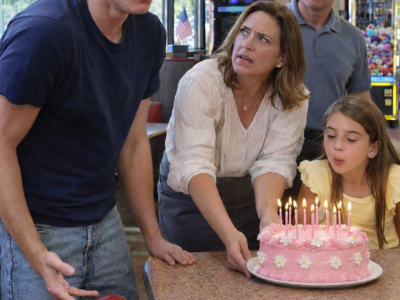
When I think of that fall, though, I usually remember the girls’ tenth birthday, two days after the closing. It was a Saturday. Rosa brought a tres leches cake at noon. Six children arrived by one, and Matteo worked the grill while the girls tried to organize a game that seemed to involve every towel we owned.
At ten that morning, standing at the counter cutting watermelon, I had realized I hadn’t checked the mailbox. After nine birthdays of checking, I hadn’t gone outside before the girls woke up. I hadn’t made a rule or talked myself out of it. I had simply gotten up, made pancakes, and started cutting fruit.
Around eleven, June brought in the mail. On top was an envelope addressed in handwriting that shook a little.
Ada and June Reyes.
Inside was a drugstore birthday card with balloons on the front. Beneath the printed greeting, my father had written:
I’m sorry it’s the first. Grandpa Walt.
No other name. No yellow note. Nothing tucked inside for me to sign or agree to.
“Is this your dad?” Ada asked.
“Yes.”
She read the message again, then handed it to her sister. I didn’t try to tell them how they should feel about it. I put it on the refrigerator beside their school pictures, using the chili pepper magnet Rosa had given me.
I didn’t call him. He knew where we were. He could send another card, or call, or ask to come. This was something he had chosen to do, and I let it stay his.
Brooke arrived at two with two books she’d loved as a child. Her name was still inside the covers. She sat on the floor with the girls and showed them where she’d drawn a horse in the margin, a horse June thought looked more like a dog. My sister laughed. I heard it from the kitchen, the way she used to laugh before checking whether our mother thought something was funny.
Ada found the yellow sticky notes in the drawer and wrote BIRTHDAY GIRLS. HONK! She stuck the note on the mailbox, and cars honked throughout the afternoon.
Late in the day, I stepped onto the porch. Children’s shoes were scattered beside the chair where my folders had been. There was cake on the top step. Out front, a car honked, and both girls shouted thank you, though its windows were closed. I stood there listening until Matteo called to ask where we kept the extra plates.
It was a little life. It still is. It’s ours.