My Son Shut Me Out on Christmas Morning, With His Mother’s Turkey Still Warm in My Arms
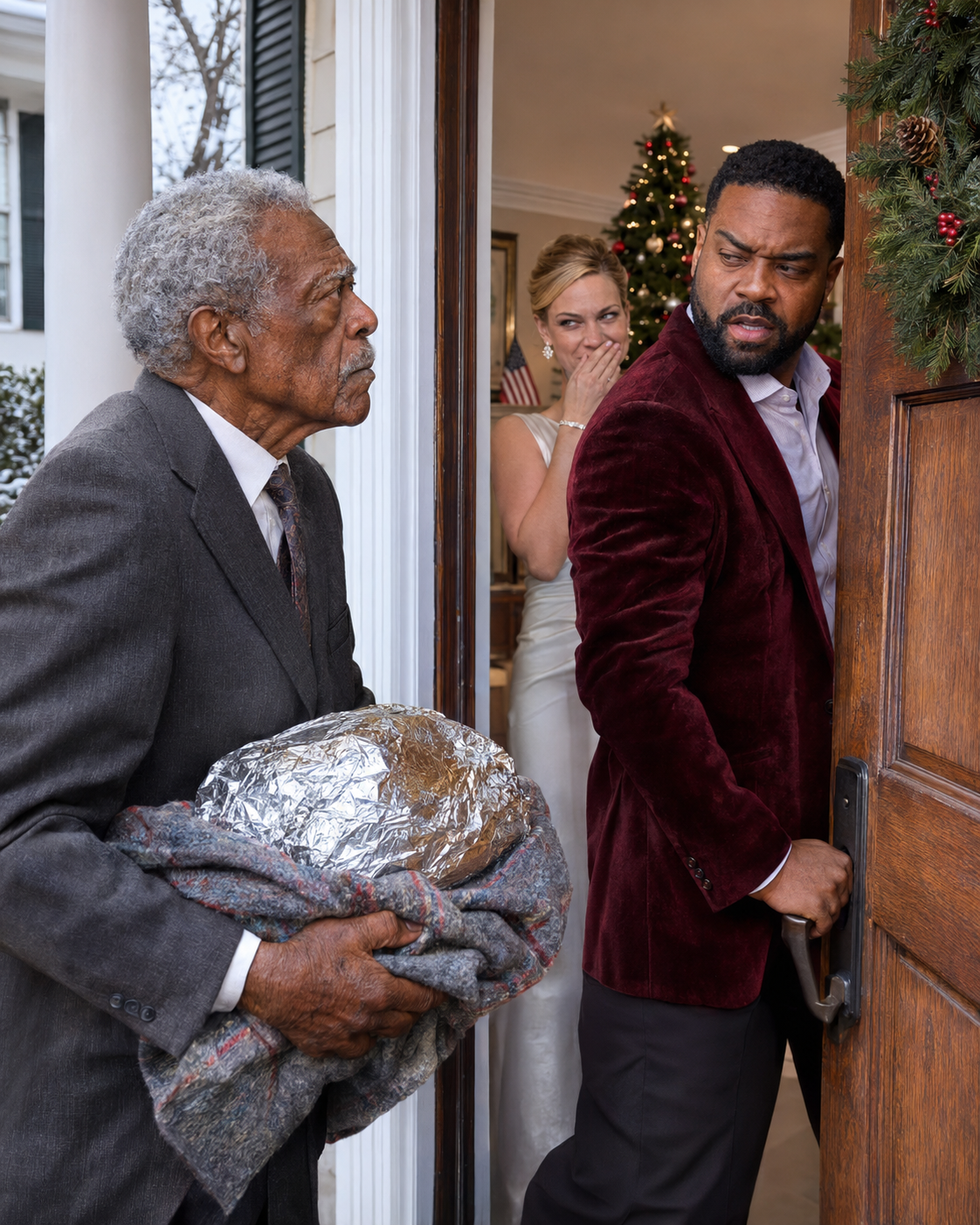
“You are not our family anymore,” my son said. “Go away.”
I was standing on his porch with an eighteen-pound turkey in my arms. It was ten o’clock on Christmas morning, and I had been up since before dawn following the recipe his mother had written on a yellow index card. Devlin hadn’t even let me set the pan down.
Behind him, his wife covered her mouth. For a moment I thought Lacey was embarrassed for me. Then I saw her shoulders move and understood she was laughing.
I looked at my son’s hand on the door. The little finger was crooked from a baseball injury when he was eleven. I had held that same hand in the emergency room while he tried to be brave. Now he was using it to keep me outside.
“You asked me to bring the turkey,” I said.
“Plans changed, Dad.”
Through the opening I could see Lacey’s parents, Clifton and Nadine Davenport, standing near the fireplace with drinks. There were other people, too, people I didn’t recognize. Someone was playing Christmas music. The table was already set.
“Nobody called me.”
Devlin stepped onto the porch and pulled the door almost shut behind him. He had on a burgundy velvet jacket. I was wearing my good gray suit, the one Loretta had helped me choose years earlier. It pulled across my shoulders, but it was clean. So were my hands, though fifty years of working with pipe and steel had left marks soap couldn’t remove.
“Clifton is introducing me to some people,” he said. “This is a different kind of gathering.” His eyes went past me to my old Ford at the curb. “I need you to understand that.”
“I understand there are people here. I still thought I was invited.”
He sighed as though I were making something simple difficult. “You come in, you start talking about boilers and construction jobs. Everybody has to be polite. Lacey’s parents aren’t used to that.”
Warm air escaped through the doorway. I could smell the pine wreath, but the thyme and garlic rising from the pan were stronger. Loretta had used that seasoning every Christmas of our marriage. After she died, I kept making the turkey because I couldn’t bear to lose one more thing.
“Your mother used to say Christmas was the one day nobody needed an invitation.”
“Please don’t start with Mom.”
Lacey opened the door farther. She was wearing white silk and the impatient expression she used when a restaurant table wasn’t ready. “Devlin, they’re waiting.”
“I know. Dad’s leaving.”
I waited for him to look at me. When he finally did, I asked him one more time.
“You really mean to turn your father away?”
That was when he told me I wasn’t family anymore. He said it quietly, close to my face, so there could be no mistake about who it was meant for. Then he went inside and closed the door.
My name is Cornelius Wyatt. I was seventy years old that morning. I had been turned away from jobs, loan offices, and neighborhoods where a Black man in work clothes was presumed to have come around to the wrong entrance. None of that had prepared me for my own son.
I carried the turkey back down the steps. My forearms were trembling from the weight. Beside the driveway stood a metal trash bin. I lifted its lid and lowered the whole covered pan inside.
I have regretted wasting that food. There were people who would have welcomed it, and throwing it away did nothing to punish the people in that house. But at that moment, I couldn’t put it beside me on the seat and drive home smelling Loretta’s Christmas dinner.
I got into the truck. On the other side of the windshield was 17 Briarwood Court, a large brick house with white columns and a roof I had personally inspected before buying it through my company three years earlier.
Devlin didn’t own it. CRW Holdings did.
He lived there under a lease that charged him one dollar a month. Fitzgerald Holt, my attorney, had arranged the paperwork. Devlin preferred to believe a business connection had recognized his potential and offered him an extraordinary opportunity. I had let him believe it. I told myself I was protecting his pride, though the truth was less flattering: it was easier than admitting how much help he still needed.
The BMW in the driveway belonged to the company, too. So did Lacey’s Escalade. Devlin knew I had helped arrange the cars. He apparently believed that using something long enough made it his.
I took out my phone and called Fitz.
He answered with Christmas greetings, then stopped when I didn’t return them. We had known each other since our Army days. He could hear when something was wrong.
“I need to end the support,” I said. “The cards, the cars, all the extra payments. Start whatever notices we need for the house.”
“What happened?”
I told him. Saying it aloud was worse than hearing it on the porch. I had to stop halfway through and swallow before I could finish.
Fitz was quiet for a moment. “I can help you stop paying, Cornelius. The house takes a proper process. Nobody gets put on the street this morning.”
“I’m not asking for that.”
“And you’re sure about the rest?”
Through the window, I could see Devlin laughing at something Clifton had said. I had spent years making certain my son never felt poor. I had somehow taught him to be ashamed of the man who had been.
“Yes,” I said. “I’m sure.”
I stayed in the truck while Fitz contacted Earl, who managed the company’s vehicles. Earl had keys, signed vehicle-use agreements, and a towing crew available through our fleet contractor. He had known Devlin since he was a boy. I was glad I didn’t have to make that call myself.
The first trouble appeared before the trucks arrived. A caterer came onto the porch holding a card reader and a phone. He looked up and down the street, went back inside, and came out again with Devlin.
My son was pointing at the reader. The caterer shook his head.
Then two flatbeds turned into Briarwood Court.
Earl walked to the door with a folder. I couldn’t hear the first exchange, but I knew the moment Devlin understood it. He glanced toward the BMW, then across the street at me. He came down the steps without a coat.
“Dad. What is this?”
I rolled down my window. “The company is taking its cars back.”
“Tell him to leave. We have people here.”
“I saw them.”
Lacey hurried outside. “Those cars were gifts.”
“The registrations are in the folder,” Earl said. “You can take your belongings out. We’ll wait.”
Devlin looked from Earl to me, trying to find the person who would turn this into a misunderstanding. Behind him, guests were gathering at the front windows.
“You can’t do this on Christmas.”
“It was Christmas when you shut the door, too.”
I regretted the satisfaction I felt saying it almost as soon as the words left my mouth. This was still my child, standing in the cold. But I did not tell Earl to stop.
Lacey called the police. When an officer arrived, he looked over the documents and spoke to both sides. Earl kept the trucks still. Eventually Devlin went inside and returned with the keys. He set them on the hood instead of handing them to Earl.
Clifton followed him down the walk. “You told us you owned these outright.”
“It’s a company arrangement,” Devlin said.
“Whose company?”
My son looked at me. He had seen the same name on the lease, the car paperwork, and the payments supporting his business. For the first time, he was putting them together.
“Mine,” I said.
While the drivers loaded the cars, Lacey carried shopping bags out of the Escalade. A few minutes later, the caterers began carrying out unopened supplies. Guests collected their coats. One woman put a hand on Devlin’s sleeve, said something brief, and left without looking back.
Lucien, who owned the catering company, called me that afternoon. His kitchen was in a building I owned, and he knew whose account had backed the cards.
“There’s a fourteen-thousand-eight-hundred-dollar balance,” he said. “Your son told me you’d clear it up.”
I closed my eyes. Even after everything outside the house, Devlin had promised someone else my money.
“I didn’t order that party, Lucien.”
“Then I’ll deal with the person who did.” He sounded tired. “I wish he’d been straight with me before I brought my people in on Christmas.”
Before we hung up, I asked whether Clifton had offered to pay.
“Nobody offered anything,” Lucien said.
By then I was home, in the modest duplex where Loretta and I had spent most of our marriage. Her covered-bridge painting hung above my desk. Behind it was a wall safe containing deeds, insurance papers, and a ledger in which I still wrote figures by hand.
I liked records I could hold. A small voice recorder lived beside my notebooks for jobsite measurements and meetings. Devlin used to tell me my phone could do all of that. I preferred the recorder’s big buttons and the notebooks I could write in with gloves on.
I opened the ledger to the pages about him. College expenses came first, then help with a business, then cars, housing costs, and transfers that had become ordinary simply because they happened every month. Over the past decade, the support amounted to roughly two and a half million dollars.
I sat with that number for a long time. Some of it had helped him. Some of it had helped me avoid telling him no. I could no longer pretend those were the same thing.
I had a sandwich for Christmas dinner. At one point I reached for my phone to call him, then remembered there was nothing I could say that he hadn’t already heard.
The next morning, he arrived with Lacey.
“You need to fix this,” he said before I had the door fully open.
They came into the living room carrying the cold with them. Lacey stood beside the table where Loretta used to sort library books for repair. Devlin paced across the rug.
“People are talking, Dad. Clifton thinks I’ve lied about everything.”
“Have you?”
He stopped. “I don’t need a lecture. That money isn’t all yours anyway. Mom left it for me.”
I stared at him. “What money?”
“The trust. The distributions. Don’t act like you don’t know.”
I had called the transfers distributions because that was how the office recorded them. He had turned the word into an inheritance, and I had been too willing to leave the misunderstanding alone.
I took Loretta’s probate file from the safe and laid it on the table. Her separate account had held twenty-four hundred dollars. There was no large trust in Devlin’s name, no fund I was keeping from him. Our business interests and the property I owned were another matter entirely.
“Your mother was a school librarian,” I said. “She worked hard. So did I. We built what we could. But those payments came from me.”
“You fix pipes.”
“I started out fixing pipes. Then I hired people. Then I bought the building we worked out of. You used to come with me on Saturdays, Devlin. This wasn’t hidden from you.”
He looked around at the old furniture, unable to make the room fit what I was telling him.
Lacey picked up the probate papers. “You told me your mother had family money.”
“I said there were family assets.”
“You said you inherited them.”
He snatched the file from her and dropped it on the table. “Whatever you want to call it, you can afford to help us.”
That was the first honest thing he had said since arriving.
I told them to leave. Devlin sat in my chair instead, and Lacey announced that they would stay until I turned the cards back on.
What I did next was foolish. There was a hose attached to the utility sink in the laundry room, where I had been washing out equipment. I pulled it into the hall and sprayed them. One angry burst, then another when Devlin stood and shouted. They stumbled toward the open door, soaked, while water spread across my floor.
I stopped as soon as they were outside. My hands were shaking. I had imagined making them leave would bring relief; instead I was looking at wet carpet and the place where my own temper had taken over.
When Fitz arrived, I told him exactly what I had done.
“You can’t do that again,” he said.
“I know.”
“Even if they’re wrong. Even if they refuse to go.”
“I said I know.”
He helped me move a damp chair away from the wall. For a while we worked without talking.
Devlin returned that afternoon with an attorney named Dustin Prudhomme. This time Fitz answered the door. Dustin raised the hose incident, then claimed I had withheld money and taken back property that belonged to his client.
Fitz listened. He did not pretend I had behaved well that morning. But when the discussion turned to ownership, he laid out the vehicle agreements and the lease.
“Did you review these before coming?” he asked Dustin.
The younger attorney studied the papers. “My client described the house as a gift.”
“The company owns it. His tenancy is documented.”
Devlin leaned forward. “Dad bought it for me.”
“I bought you somewhere to live,” I said. “I never signed it over.”
Fitz gave Dustin the housing notice and an offer for a new arrangement after the required notice period. Continuing there would mean paying eight thousand dollars a month, plus the expenses I had been covering. Otherwise, they would need to move. There would be time to make arrangements, and the paperwork set out the dates.
Lacey looked at the amount, then at her husband. “You said we didn’t have housing costs.”
“We didn’t,” he said.
“You mean your father did.”
For once, she had nothing to say to me.
After they left, Fitz showed me the contracts supporting Devlin’s position at Visionary Strategies. Five years earlier, I had backed the firm and steered work to it so he could establish himself. He had acquired a title and a respectable income without ever bringing in enough business to sustain either one.
I authorized the end of that support under the contracts. The company would have to make its own decisions. A few days later, Devlin lost the position he had told everyone he built alone.
By then, Lacey had gone online.
She filmed herself in a motel room with Devlin beside her. They had left Briarwood Court on their own, well before the date in the notice, but she told her followers I had made them homeless on Christmas. She said I had frozen their money because I couldn’t bear to see my son happy with her.
“He kept showing up,” she said. “He made me feel unsafe. When my husband finally stood up for me, he took everything.”
Devlin stared at his hands, then nodded. I watched the video twice, waiting for him to correct even one thing.
Someone posted my address.
At two the following morning, a rock came through my front window. I was asleep in the chair and woke with glass across my blanket. A note had been wrapped around the rock. It told me to stay away from her.
I called the police. While I waited, I sat at the kitchen table with my shoes on because there were shards all through the carpet. By daylight, somebody had painted PREDATOR across my garage door.
The word frightened me more than the broken window. I knew what strangers might hear in a young white woman saying an older Black man made her feel unsafe. I also knew my son understood it. He had watched the video go up and helped it stay there.
Fitz preserved the posts and contacted their lawyer. I had the windows repaired, the locks reinforced, and cameras installed by the doors and inside the front room. Having spent years around industrial fire protection, I also paid a contractor to add a foam suppression line over the entry. I hoped I was spending money on precautions I would never need. None of it made it easy to sleep.
I kept wondering about the Davenports. Clifton had talked for years about a vineyard, investments, and people who owed him favors. Yet when his daughter needed somebody to pay a bill, he had kept his hands in his pockets.
I asked Calhoun, a former detective who did investigative work for Fitz, to look into the public records. He came back with bankruptcy filings, a foreclosure, and employment information that didn’t match Clifton’s stories. There had been substantial debts. Clifton had managed a tasting room; he had never owned the vineyard. He and Nadine were living in a rental.
Payments in my own records showed Devlin had been helping them. He had been taking money from the father he considered embarrassing and giving it to the parents whose approval he wanted.
Calhoun was still at my kitchen table when Devlin knocked.
This time he was alone. He wore jeans and a sweatshirt. Without the suit and the careful hair, he looked painfully familiar.
“Can I come in?”
I let him stand in the hall. He saw the new glass and the paint supplies near the garage door. His eyes moved past them.
“Lacey shouldn’t have posted that,” he said.
“You were sitting beside her.”
He rubbed his hands together. “I know.”
I wanted those two words to be the beginning of something. I was tired enough to want it very badly.
He reached into his pocket. “Things are different now, Dad. We found out something.”
He handed me an ultrasound picture.
“Eight weeks,” he said. “You’re going to be a grandfather.”
I took the paper. There was a small pale shape in the middle of all that gray, and suddenly I was remembering the weight of Devlin asleep against my shoulder. Loretta used to laugh because I would stay in the chair until my arm went numb rather than put him down.
“Is she all right?” I asked.
“She’s scared. We both are.”
He watched me look at the picture. “I know I don’t deserve help. But this isn’t just about me anymore.”
I went to the desk. My checkbook was in the drawer where it had always been. I opened it, then stopped with my thumb between the pages.
“Who is her doctor?”
“Whitfield. At Riverside.”
“All right. I’ll help with the care. Have her call the office and authorize them to discuss payment with me. We can arrange it together.”
“Just give us a check, Dad. We have other expenses.”
“We can talk about those. First let’s make sure she has what she needs.”
He reached for the picture. “You’re making it complicated.”
I kept hold of it. There was no clinic name across the top, only a line of generic numbers and a date. The picture didn’t prove anything by itself. I wanted to believe him, but I had just spent days watching the consequences of doing that without asking questions.
“When was the appointment?”
“Yesterday.”
“Did you go with her?”
“Of course I did. Why are you interrogating me?”
I sat at the computer. It took less than a minute to find the image. The same pale shape, the same marks along the edge, appeared on a page explaining early pregnancy scans.
I turned the monitor toward him.
He looked at it and then at the checkbook still open on the desk. He did not ask me what I thought I had found.
“Was this your idea?” I asked.
“We were desperate.”
“Is there a baby?”
He wouldn’t answer. I asked again, and he shook his head.
I put down the picture carefully. There was something almost shameful about how happy I had been for those few minutes. I had already begun making room in my life for a child who didn’t exist.
“You could have asked me for groceries,” I said. “You could have asked me to help you look for work.”
“And you would have made me beg.”
“You came here and put a grandchild in my hands.”
His face hardened. “You have money you’ll never spend. We’re falling apart, and you’re acting like writing one check would kill you.”
I closed the checkbook. “Leave.”
He stood there another moment, waiting for the word to change. Then he went out. I heard his footsteps on the walk, and after they stopped, I was still holding the picture.
Calhoun came into the hall. He didn’t offer advice. He picked up my cold coffee and asked whether I wanted a fresh cup.
The next development came from Prescott, who handled commercial acquisitions for CRW. Clifton had approached him about a quick sale of five acres on the north side of town. The land was worth around half a million dollars. They were offering it for a fraction of that.
Prescott knew the parcel. He had helped me evaluate it years earlier.
“They sent a deed with your signature,” he told me. “Then Devlin said you were too ill to handle the closing and he had authority to act for you.”
I asked him to send the papers to Fitz.
That afternoon, I sat across from Prescott and studied my name on the document. The capital C was wrong, but the rest was close. My son had watched me sign school forms, birthday checks, and payments to his creditors. He had had years to learn it.
“Did any money change hands?” I asked.
“No. I told them the ownership and authority had to be verified. Clifton kept saying fifty thousand cash would settle it today.”
Fifty thousand for land worth ten times that. They weren’t making a business decision. They were grabbing for whatever would get them through the next few weeks.
Prescott had kept the emails and the documents they supplied. Fitz took them to investigators. He also arranged for the appropriate warnings to be placed with the people handling my property, so another attempted sale wouldn’t go unnoticed.
I went home and moved the deeds out of the wall safe. The ledger stayed. So did Loretta’s papers. For the first time, I found myself wondering what else Devlin remembered about my house.
Then a process server arrived with a petition accusing me of advanced cognitive decline.
Devlin was asking the court to put someone else in control of my affairs. He proposed himself.
The petition described my old truck, my modest home, and my refusal to give him money as evidence that I could no longer make reasonable decisions. It included the hose incident. That part had happened, and I would have to answer for it. Other parts had been carefully made to look like things they weren’t.
There was a video of me breaking up an old toilet during a bathroom renovation. The beginning had been removed, so nobody watching knew why I was swinging a sledgehammer. In another clip, my voice from a football game played over footage of me alone in the living room.
I had shouted at a missed tackle. On the screen, I appeared to be shouting at someone who wasn’t there.
Fitz watched it at my kitchen table. He asked for dates, for the names of the people who had worked on the bathroom, for anything that would put the footage back in its proper setting. I answered him, but my mind kept returning to the person holding the camera.
Devlin had filmed those moments while visiting me. I had thought we were spending time together.
Before the petition could be fully contested, officers arrived with an order for an emergency evaluation. Devlin had alleged threats and immediate danger. A woman from the transport service stood behind them, holding a bag for my belongings.
I read the order. I called Fitz. He asked to speak to an officer, took down the destination, and told me he would meet me as soon as he could arrange access.
Then I put on my coat and locked my door.
At Covenant Ridge, the intake nurse asked whether I knew where I was and why I had been brought there. I told her. She spoke kindly to me. I remember that because it was the last ordinary conversation I had for some time.
Dr. Alan Greer came in with the petition already open on his clipboard.
“Your son is concerned about aggression and paranoia,” he said.
“My son tried to sell land I own. The documents are with my attorney.”
His pen moved. I asked what he was writing.
“Your concerns about family members stealing from you.”
“They aren’t just concerns. There’s a deed with a forged signature.”
“You’re very focused on money, Mr. Wyatt.”
I sat back. It was a peculiar kind of fear, realizing that the clearer I tried to be, the more material I seemed to give him.
He asked about the hose, and I told him I had lost my temper. I told him I regretted it. He asked whether I regretted taking the cars back, too.
“Those are different things,” I said.
“Your family experiences them as the same pattern.”
I asked to call Fitz again. Greer said we would discuss that after I settled down.
I wasn’t shouting. My hands were folded in my lap. Still, after he left, I found myself examining every movement I made. Would standing by the door look aggressive? Would asking twice for the telephone be written down as agitation? I hated how quickly I began to watch myself through his eyes.
My recorder was in the inside pocket of the coat I had worn to the meeting with Prescott. When I changed for the night, I took it out with my notebook. I wanted a record of what Greer actually asked and what I actually answered. I no longer trusted his notes to reflect the conversation.
I switched it on when he returned that evening. He talked about easing the burden on me, about allowing Devlin to manage things temporarily. I asked what that would mean for my home and my right to make decisions. He kept returning to how much less stressful cooperation would be.
After he left, I lay down with the recorder still running beside the bed. An evening nurse had offered medication to help me sleep. I had declined it. There was no way I could have slept, anyway.
Later, I heard the door open again.
“He’s asleep,” Greer said.
I kept my eyes closed. I recognized the other footsteps before I heard my son’s voice.
“How long can you keep him here?” Devlin asked.
“That depends on the review.”
“Then your report has to be clear. He can’t go in there and talk everybody around.”
There was a pause. I could hear the ventilation fan and a cart moving somewhere down the hall. I waited for Greer to tell him that wasn’t how an evaluation worked.
Instead, the doctor said, “You understand what you’re asking me to risk.”
“I told you. Twenty thousand when I have access.”
I lay so still my hip began to ache. For a moment I thought I must have misunderstood the number or the reason for it.
“Thirty,” Greer said. “And I’m not waiting indefinitely.”
“Fine. Just make sure the report says he can’t manage the accounts. Lacey and I can’t keep living like this.”
That was how my son discussed taking away my freedom. He used the same impatient voice he had used when asking me to pay for a better car.
He came closer to the bed. I could feel him standing there, and I fought the urge to open my eyes and make him look at me.
“You could have made this easy, Dad,” he said.
Then they left.
I didn’t feel victorious. I didn’t know whether the recorder had caught their words clearly, whether anyone would believe me, or whether I would be allowed to see my own lawyer. I sat on the bed until morning, afraid to let that little machine out of my hand.
Fitz reached me the next day. There were arguments in the hall before they let him in. When I saw him, I began to stand, then sat down again because my legs felt unreliable.
He pulled a chair close. “Tell me what happened.”
I gave him the recorder.
He listened with headphones. His expression changed, but he didn’t interrupt. When he finished, he put a hand on my shoulder and said, “You’re not facing this by yourself.”
An independent evaluation and a review of the grounds for holding me followed. By the time I went home, I had spent two nights away from everything familiar. Fitz took the recording to investigators and continued fighting the guardianship petition until it was dismissed. Greer’s communications with Devlin became part of the inquiry, and the doctor later faced charges.
For several days after my return, I woke whenever headlights crossed the bedroom wall. I would sit up and listen for a knock. I had believed there were limits my son would observe even while furious with me. I no longer knew where those limits were.
Chief Aldous Beaumont, an old friend, came by to check on me. He looked at the damaged garage door and told me to report every threat, even the ones I wanted to dismiss because Devlin was my son.
“You’re allowed to be frightened of someone you love,” he said.
I didn’t answer. I wasn’t ready to say that was what I was.
A few weeks later, a camera alert woke me shortly after two in the morning. Devlin was at the front door. He had a bottle in one hand and a long kitchen knife in the other.
I called the police and moved into the back bedroom, where I could lock the door. Through the camera feed, I watched him try the front lock. Then he broke the narrow pane beside it and reached inside.
I heard the door hit the wall.
“Dad!” he shouted. “I know you’re here.”
He went straight to Loretta’s painting. He tore it away from the safe so hard the frame split. On the small screen, I saw the painted bridge fold across the middle.
I nearly opened the bedroom door. That was the worst of it, how quickly an ordinary attachment could make me forget the knife. I had watched Loretta work on that painting at the kitchen table, moving it every evening so we could eat.
The dispatcher was still talking to me. I stayed where I was.
Devlin turned the safe’s dial, pulled at the handle, and struck it with the heel of his hand. When it wouldn’t open, he swept books off a shelf and drove the knife into the sofa.
“Where’s the money?”
I told him through the closed door there was no cash in the safe.
“Liar. Open it.”
“Devlin, put the knife down.”
He came along the hall. I could hear his breathing on the other side of the door.
“They’re going to hurt me if I don’t pay them,” he said. “Do you understand that? I need the money.”
I wanted to ask who. I wanted to tell him we could call someone. Even then, with the knife outside my bedroom, some part of me was reaching for the next problem I could solve for him.
Then he hit the door.
“Open it, or I’ll make you.”
The officers arrived while he was in the hallway. I heard their commands, then the knife striking the floor. I stayed in the bedroom until an officer identified herself and told me it was safe to come out.
Devlin was handcuffed. He had a cut on his hand from the window, and his face was wet. When he saw me, he began talking fast.
“Tell them, Dad. Tell them I wasn’t going to hurt you.”
I looked at the open front door, the broken glass, and the knife an officer was securing. Then I looked at my son.
“I don’t know that,” I said.
He cried out when they led him away. I followed them as far as the porch, but I did not ask them to bring him back.
Afterward, I picked up Loretta’s painting. I tried to fit the broken frame together, and my hands wouldn’t stay steady. The officer taking my statement waited while I put it on the table. She asked whether I had someone who could stay with me.
I called Fitz.
Lacey came several nights later, after Devlin had been taken into custody. The camera caught her crossing the lawn with a red gasoline can.
By then I had stopped trying to convince myself each new threat would be the last. I called for help immediately. I switched on the exterior lights and spoke through the camera’s speaker.
“Lacey. Put the can down. The police are coming.”
She looked up at the lens. Then she tipped the can over the porch steps.
I activated the porch suppression system. Foam washed over the steps as she fumbled with a lighter. Through the camera I could see it spreading across the welcome mat, the same mat I had stood on while talking to the officers after Devlin’s arrest.
She jumped back, dropped it, and shouted toward the windows. I could hear her even over the alarm. She said I had taken everything. She wanted me to come out and look at her.
I stayed inside.
The police found her near the walk, with the can beside the steps and gasoline soaking the wood beneath the suppressant. The cameras had recorded her arrival and what she had done. Firefighters checked the house and kept me outside while they made sure it was safe.
I stood on the sidewalk in my coat, watching them work. A neighbor brought me a chair. I thanked her and couldn’t think of anything else to say.
There was no pleasure in seeing Lacey arrested. I wanted my porch back. I wanted one night when a car stopping outside meant a visitor, not another reason to call for help.
The cases moved slowly after that. Statements were taken. Recordings were copied and examined. Fitz kept a folder for each part of it because I could no longer bear seeing everything spread across my kitchen table.
When Devlin asked to see me, I agreed. His lawyer arranged the meeting and sat with him. My son wore jail clothes and kept rubbing the place where his wedding ring had been.
“Lacey’s father put the land deal together,” he said. “He told me there was no other way.”
“Did he sign my name?”
Devlin looked down. “No.”
“Did he go into my bedroom with a knife?”
“I wasn’t in your bedroom.”
That small correction wore me out. He was still looking for a few inches of space in which he might be less responsible.
His lawyer spoke quietly to him, then explained that discussions with the prosecutor were continuing. Cooperation about the forged sale and Clifton’s involvement could be part of an agreement. There was talk of a two-year sentence, subject to the court’s approval. Nobody at that table could guarantee the outcome.
Devlin turned to me. “You could tell them you don’t want this.”
“I don’t want any of it.”
“Then help me.”
I put my hands on the table so he could see they were steady. “I’m going to tell the truth about what happened. Your lawyer will do his job. I won’t pay anyone to make a different story.”
“You always used to help.”
“Yes,” I said. “I did.”
He waited for more, for the old explanation about how things would be worked out. I had nothing useful to add. When I stood, he asked whether I still loved him.
“I do,” I said. It hurt to say it and know it changed nothing about what had to happen next.
Months passed before the final hearing in his case. During that time, investigators pursued the evidence against Clifton and Greer. Lacey’s arson case followed its own course. The story they had posted online was no longer the only account people could find.
That did not put everything right. Strangers who had been certain I was cruel did not come back to apologize. Some simply moved on. I tried to do the same, though I still checked the front camera before answering a knock.
At Devlin’s hearing, his attorney described the collapse of his marriage, his debts, and the financial dependence that had left him unprepared to support himself. He also said I had contributed to that dependence.
I didn’t argue with that part.
When I was called to speak, I explained how the support had grown. I had wanted my son to have opportunities. After Loretta died, helping him had also given me a reason to feel needed. I kept paying bills instead of asking why there were always more of them.
“Were you unable to continue providing assistance?” the prosecutor asked.
“No.”
“You made a choice to stop?”
“Yes.”
Questions about the company and the scale of its assets followed. The financial records were already part of the case, but Devlin had never heard the full valuation spoken aloud.
“Approximately sixty-two million dollars,” I said.
My son raised his head. His attorney touched his sleeve, but he kept looking at me.
I explained that the number included commercial buildings, industrial property, and other business holdings. It was the result of decades of work and purchases made a little at a time. Most of it had never been money sitting in a checking account.
Devlin leaned toward his lawyer and said something. He looked past me, then back again, as though he were reconsidering every conversation we had ever had.
I knew what my truck looked like. I knew the couch had needed replacing long before he cut it open. Those things had become evidence, in his mind, that I could not possibly have built anything important.
I wished I had told him more about the business when he was willing to listen. I wished he had asked. Neither wish explained away the choices he had made.
The prosecutor asked about changes to my estate plans. Fitz had helped me complete them during the months of preparation for the hearing.
“Fifty million dollars in cash and property has been committed to the Cornelius and Loretta Wyatt scholarship fund,” I said. “The transfers are documented. The fund will help young people attend college who couldn’t otherwise afford it.”
Devlin’s face changed. He had been staring at the size of the fortune. Now he understood that most of it would never become his.
He shook his head. His lawyer spoke to him again.
I had imagined that moment while signing the papers. I had expected anger from him, perhaps a public accusation. What I had not prepared for was the grief I felt seeing him understand that I had made plans beyond him.
For most of his life, he had been the center of every plan I made.
When I was allowed to finish my statement, I looked at him instead of the papers in my hands.
“I should have stopped making your decisions easier a long time ago. I should have told you when I was worried, instead of writing another check and hoping you’d grow into the life you wanted. I’m sorry for that.”
He sat very still.
“But you frightened me, Devlin. You made it unsafe for me to stay in my own home. I need you to understand that, whether or not you’re angry about the money.”
It was the hardest thing I said in that room. Harder than the numbers. Harder than explaining how my own son had tried to have me declared incapable of managing my life.
I had kept enough to live comfortably and meet my responsibilities. I did not have to give away everything to decide what the rest was for. Loretta had spent thirty years helping children find books that made the world feel bigger. A scholarship fund bearing her name seemed like something she would recognize.
The court accepted Devlin’s guilty plea to forgery under the negotiated agreement. His sentence was two years, and he was required to cooperate in the case against Clifton. He listened with his hands clasped in front of him.
As he was led out, he turned toward where I sat. I raised my eyes to him. There was no final speech between us. I watched until the door closed, then asked Fitz to take me home.
That evening, I found Loretta’s recipe card in the kitchen drawer. There was a grease mark across the corner and a small instruction squeezed between two lines: let it rest before carving.
I stood there reading the handwriting. I had missed her through all of it, but that night I missed having one person who knew both the man my son had become and the little boy he had once been.
The following Christmas, I drove the Ford back to Briarwood Court with another eighteen-pound turkey beside me.
The house had changed. After the tenancy ended and the necessary approvals and renovations were completed, it became the Loretta Wyatt Community Center. Scholarship students used it for meetings and study sessions. That Christmas, it was open to students and families who needed somewhere to gather.
A wooden sign stood near the walk. Paper snowflakes filled the front windows. Somebody had hung the wreath a little crooked.
I parked in the same place and sat for a moment with my hands on the steering wheel. I had thought I was ready to come back for Christmas. My body remembered that porch before I could remind myself who was waiting inside.
Then the front door opened.
A boy named Deven, twelve years old and all elbows, came out without a coat. His older sister was one of the scholarship students.
“Mr. Wyatt’s here!” he shouted over his shoulder. “He brought the turkey!”
“Get back inside before you freeze,” I told him.
He held the door wide and waited while I carried the pan up the steps. I didn’t have to ring the bell. I didn’t have to explain why I had come.
There were about thirty people in the dining room and the rooms around it. Folding tables extended the big mahogany table. A grandmother was directing someone carrying macaroni and cheese, and two students were arguing over whether the cornbread needed to go back into the oven.
Fitz stood near the kitchen in a Santa hat. He had flour on his sleeve.
“Don’t ask,” he said when he saw me looking at it.
“I wasn’t going to.”
“You were thinking it.”
I set the pan on the counter. When I peeled back the foil, the smell of thyme and garlic filled the kitchen. For a moment I could almost hear Loretta telling everybody to get out of her way so she could finish.
Zara, an engineering student at the state university, had saved a chair for me. She was the first in her family to attend college and had spent the fall working harder than anyone should have to in order to pass a class she insisted she hated.
“How did the exam go?” I asked.
“I passed. Please don’t ask by how much.”
“Passing counts.”
She smiled and handed me a serving spoon. “Then you can tell my mother.”
We ate. People asked for seconds and reached over one another for butter. Fitz told an Army story that had become less accurate with every year, and I corrected him while everyone laughed. One student wanted to know how I had started buying property. Another asked about pipefitting because his brother was considering an apprenticeship.
I answered their questions. Nobody seemed disappointed by the parts involving work.
Later, while the table was being cleared, I stepped into the living room. A fire was burning in the fireplace. From my coat pocket I took the envelope that had arrived the previous afternoon.
It was from Devlin.
I had read it at home. I had brought it with me without being sure why. Perhaps I wanted to read it once in a room where I could hear other people nearby.
Dad, he had written. I hope you are doing okay. I have a job in the laundry. I make fourteen cents an hour. My hands hurt. I think about you a lot. I think about the truck. I think about the turkey.
Then, farther down: I am sorry. I know that doesn’t mean much coming from me. I never understood what I had. Merry Christmas.
There was no request for money. No explanation about Lacey or Clifton. For once, the page contained only what he had done and what he felt about it.
I wanted that to mean something. I also knew a letter could not tell me what kind of man would eventually walk out of prison. There was time ahead of him, and work I could not do in his place.
I sat by the fire until the paper had warmed between my hands. I still loved him. I still remembered the boy who had needed me to stay beside him in the emergency room. But I remembered the bedroom door, too, and how hard I had worked to keep my voice steady for the dispatcher.
I wasn’t ready to answer.
After a while, I folded the letter and laid it on the fire. I watched the pencil marks darken and disappear. Then I stayed another minute, listening to the voices from the dining room.
Fitz came to the doorway with two small glasses of cognac. He glanced at the fireplace, then handed me one.
“You all right?”
“I will be.”
He sat beside me. We didn’t discuss the letter. From the kitchen, somebody called that dessert was ready, and Deven appeared in the doorway asking whether I would cut the pie.
“I’ll come help,” I said.
I set down my glass and followed him. There were plates to fill, coffee to pour, and room for me at the table.