My Father Offered Me $15 an Hour to Work for My Sister. Then Her Phone Lit Up.
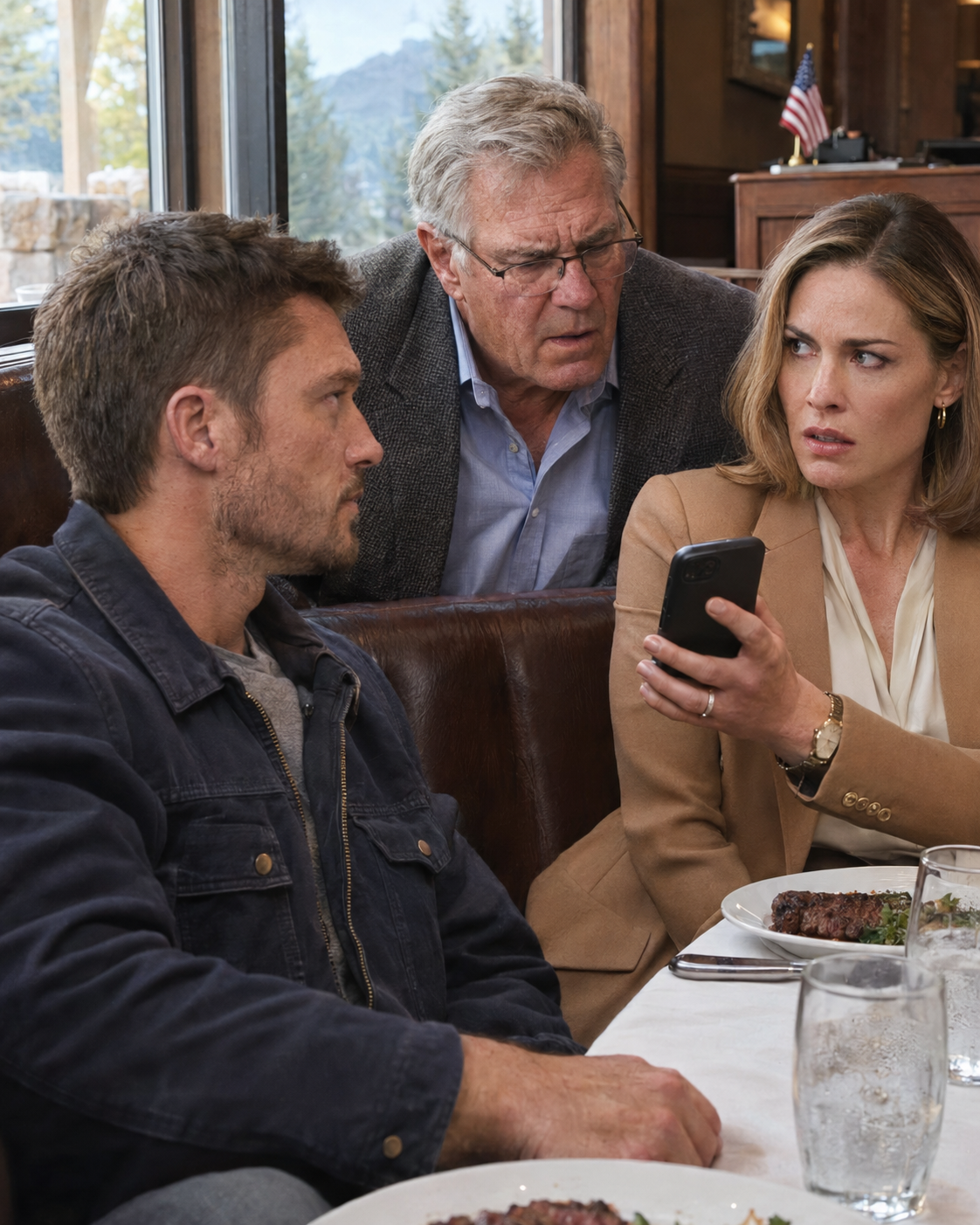
My father slid a job application across the white tablecloth, nudging the bread basket aside to make room.
“Your sister needs a receptionist,” he said. “It’s time you found real work.”
Vesper laughed before I could answer. Beside her plate, her phone lay facedown, quiet for the moment. I looked at the application, then at the three people who had invited me to dinner to discuss my future. Under the company name, Ashford Freight Lines, my sister had attached a yellow note in her tidy handwriting. Start immediately. Dental after 90 days.
I was thirty-eight years old. I owned a diesel repair and fleet maintenance shop in Missoula, Montana, with three bays and eleven employees. That morning, I’d approved payroll, helped diagnose a fuel problem on a grain hauler, and eaten a sandwich standing beside a parts washer. Now I was being offered a desk in the business I’d left twelve years earlier.
“Fifteen dollars an hour,” Vesper said. “There’s a probationary period, of course.”
My mother adjusted the napkin in her lap. “It would be steady, honey. That’s what we’re thinking about.”
I had come straight from work. My jacket was clean, but a faint smell of diesel stayed with me no matter how hard I scrubbed. Mom had noticed it when she hugged me. My father had noticed my boots. Neither had asked how the shop was doing.
“I have steady work,” I said.
Dad leaned back against the booth. Kavanaugh Ashford was sixty-six, broad through the shoulders, with hands that still looked capable of lifting an engine even though he hadn’t worked on one in years. He had started Ashford Freight with two used trucks and a loan from a man who trusted him. I knew that story better than I knew most of my own.
“You have a garage,” he said. “Your sister runs a company.”
Vesper was forty-one, president of that company, and accustomed to being introduced that way. She picked up her water glass and watched me over the rim.
“It’s answering phones, greeting visitors, helping with schedules,” she said. “You’d have benefits. A lanyard with your name on it.”
“My name’s already on a building.”
That was when she laughed again, loudly enough for a woman at the next table to turn.
“Sterling. You know what he means.”
I knew exactly what he meant. There was nothing wrong with answering phones. Someone good at it could keep a whole operation from coming apart before lunch. What hurt was that my family had decided I needed rescuing without ever looking at the life I’d built.
I pushed the application back an inch. “I’m not looking for a job.”
“You walked away from a future here once,” Dad said. “We’re giving you another chance.”
Mom looked down at the bread basket. My appetite went with her eyes.
“I walked away from an inspection sheet you wanted me to sign.”
“Here we go,” Vesper said.
“The brakes weren’t safe.”
Dad lowered his voice. “That truck made the run.”
“That doesn’t mean it was safe.”
He glanced toward the neighboring table, irritated that I’d made something unpleasant audible. “You always did think you were the only person in the place with standards.”
The waiter arrived with our steaks, and everyone sat back. Dad thanked him in the pleasant voice he used with people who hadn’t disappointed him. My mother cut into her filet. Vesper checked the time. I had almost declined the invitation. My wife, Mirabel, had asked why I wanted to go, and I hadn’t had an answer that sounded sensible. Mom had said please. That was most of it.
Then Dad began talking about the sale. Ashford Freight had sixty-one trucks and four terminals. In three days, ownership would change hands. My parents would retire, and Vesper would stay on as president under a three-year employment agreement, with a fifteen-percent earnout if the business met the agreed conditions.
“A serious buyer,” Dad said. “People with a long-term plan.”
“Have you met them?” I asked.
“We’ve dealt through the lawyers. It’s an investment group.” He cut his steak. “They understand what the company is worth.”
I put down my knife. I was part of that investment group. I had organized it, committed my savings to it, and spent two years assembling enough financing to make the purchase possible. Our acquisition company had an ordinary name that told my family nothing about me. The final paperwork would identify me as its managing member. I had expected that disclosure to happen through the attorneys, before we sat down to close. I had not expected to be holding a receptionist application when it arrived.
Vesper’s phone buzzed beside her plate. She turned it over, opened the email, and stopped chewing. Her thumb moved once. Then she looked at me, back at the screen, and at me again.
“Please tell me this is a coincidence.”
Dad held out his hand. “What?”
She passed him the phone. He found his reading glasses in his jacket pocket, settled them on his nose, and read the purchaser information. I watched his mouth form my name.
“Sterling Ashford.” He looked up. “There must be another one.”
“Dad.”
He stared at me. I pulled the application back across the table and took the little work-order pen from my jacket. On the line marked Position Desired, I printed one word.
OWNER.
Then I slid it back. For several seconds, all I heard was silverware at the other tables.
“This isn’t funny,” Dad said.
“I know.”
Vesper set her phone down so hard that her water trembled. “You don’t have that kind of money.”
“I have partners. A lender. A business that makes a living for more people than just me.”
“You let us think—”
“You never asked.”
My mother put a hand against her throat. “You bought your father’s company?”
“The closing is in three days. Your attorneys have the final documents now.”
“Sit down,” Dad said as I started out of the booth.
I hadn’t realized I’d stood.
“You do not walk away from this family again.”
There it was. The same voice, the same assumption that leaving was something I had done to him.
“You told me that if I couldn’t sign that inspection, I wasn’t part of this family. I was twenty-six. I believed you.”
His eyes flicked toward Mom. She didn’t speak. I left enough cash beside my plate for dinner and the tip. My hands weren’t as steady as I’d wanted them to be.
“Read page forty-one,” I told him. “And call your lawyer. He can explain it.”
Outside, I sat in my old Dodge with the engine off. The passenger window had been stuck three inches from the top for four years. Cold air came through the gap, carrying the smell of wet pavement and pine. Dad called. Then Vesper. Then Mom. I let all three calls go and stayed there until I trusted myself to drive.
Mirabel was at our kitchen table when I got home, working through a stack of shift schedules. She was thirty-seven, an ER nurse, and capable of hearing what I hadn’t said while I was still choosing the words.
“They know,” I told her.
She set down her pen. “How?”
I told her about the email, the application, and the word I’d written on it. She laughed once at OWNER, then studied my face and stopped.
“Was it worth it?”
“Which part?”
“The part you’re smiling about and the part that’s making you look sick.”
I sat down across from her. “I liked seeing them have to reconsider me. I’m not proud of how much.”
She reached across the table and laid her hand on mine. We had put years of savings into this purchase. She’d worked extra shifts while I stayed late at the shop. There were numbers in our loan documents that could keep either of us awake without any help from my father.
“You can enjoy proving them wrong,” she said. “You still have to run the company in the morning.”
“I know.”
“And what happens when they realize you’re opening the records?”
I looked toward the cupboard where we kept the copies from Aisha’s box. Two years earlier, Aisha had come to my shop carrying a cardboard records box and the few things she’d been allowed to clear from her desk. She had worked in compliance at Ashford Freight. Vesper had fired her after she kept questioning maintenance records that didn’t agree with the work orders behind them.
My sister called her difficult. Aisha brought dates. She laid the papers on my parts counter, keeping a clean sheet underneath them to protect them from the grease. A truck listed as repaired on one form still had the same defect noted on another. Parts supposedly installed never appeared in the purchase records. Complaints had been marked resolved without an explanation of what anyone had done.
“I thought you should see this,” she’d said. “Barlow told me you were the one who wouldn’t sign.”
She hadn’t brought proof of every truck’s current condition. Some records were old, and the company insisted the problems had been corrected. What she had brought was enough to make the official paperwork impossible to trust. My father was preparing to sell. A new owner might accept the neatly organized files, keep Vesper in charge, and never learn what had been left out. I began asking whether I could buy the business myself.
At first, even saying it felt foolish. When I’d left at twenty-six, I had a toolbox, a pickup, and enough money to rent one bay in a building that leaked. Customers brought me trucks because they’d heard I would tell them the truth. They came back because I finished the work. By thirty, I had three bays. By thirty-five, eleven people depended on the shop for their paychecks.
The owners of the fleets we maintained knew those numbers. My family didn’t. I approached a logging operator, then a grain hauler, then other customers who understood both the business and the cost of an unreliable truck. None of them invested because they wanted to watch me settle an argument with Dad. They wanted a freight company run properly, with dependable equipment and somebody accountable for it.
My banker had financed my first compressor. This time, he wanted forecasts, collateral, and answers about what happened if repairs cost more than I expected. My lawyer wanted to know something else.
“Would you still want this business if your family never apologized?”
I had Aisha’s box at my feet. Barlow’s copied notebook pages were spread across her desk. I considered giving the answer that would make me sound better, then stopped.
“I’d like an apology,” I said. “But I can’t make the loan payments with one.”
She nodded. “Then let’s talk about the business.”
Our offer was strong, and the financing was arranged before we made it. In exchange for the price and a quick closing, the sellers accepted protections my lawyer insisted on putting in writing. They promised that the maintenance records were accurate and that serious claims had been disclosed. Of the purchase money, $2.3 million would remain in escrow for twenty-four months to cover qualifying losses. Dad personally guaranteed obligations that went beyond that amount. Vesper’s job and earnout depended on the truth of what she had certified.
Page forty-one gave us the right to an independent audit, with full access to the records and cooperation from management. Another provision addressed what we already knew or suspected. The sellers couldn’t use our earlier concerns as an excuse for giving us false information. Their attorney had negotiated the agreement. Nobody had hidden the language. Dad wanted the sale finished, and Vesper kept assuring everyone that the files would stand up to scrutiny.
My lawyer made one thing clear: a contract would give us a way to pursue losses. It wouldn’t repair a truck, erase an injury, or guarantee that we recovered every dollar.
Back at our kitchen table that night, Mirabel looked at the cupboard again.
“Keep doing what you said you’d do,” she told me. “Even when they make it personal.”
It had been personal long before I knew what escrow meant. Twelve years earlier, Barlow had found me at the start of a shift and taken me to truck number nine. He’d worked for my father since I was little. At fifteen, I’d swept his shop floor and followed him around with questions until he finally gave me something useful to do.
Now I was qualified to sign the inspections. Dad had introduced me to the drivers with his hand on my shoulder. My own son, he’d said. I carried those words around for days. Number nine was loaded and due to head over the pass. Barlow pointed out the brake problems, then waited while I checked them myself. There was a cracked drum and a leaking chamber. It needed parts and repair time, neither of which the dispatch board allowed for.
“I’ve told the office twice,” Barlow said.
I hung a red tag on the mirror. Dad arrived before I’d put my tools away. He didn’t argue in front of the crew. He walked me to his office and shut the door.
“There’s a customer waiting on that load.”
“Then we’ll have to send another truck.”
“There isn’t another truck.”
I could see the driver through the office window, standing beside the cab with a paper cup in his hand. He was waiting for somebody to tell him whether he could go home on time that night.
“It needs repairs, Dad.”
“Do you know what happens when we miss that delivery? He calls another carrier. Next week he calls them again. That’s how people here lose their jobs.”
It was an argument I understood. I’d heard customers shout. I’d watched Dad sit at the kitchen table working out which bill could wait until Friday. For a moment, I wanted to agree with him badly enough that I looked down at the inspection sheet. Then I thought about the grade beyond the pass.
“I can’t sign it.”
He pressed his palm flat against the desk. “I’m not asking you to rebuild the truck. I’m asking you to make the run possible.”
“My signature won’t fix the brakes.”
“I gave you a job here. A future.”
“I know.”
“If you can’t sign it, you’re not part of this family.”
My answer came out so quietly I wasn’t sure he’d heard it.
“Okay.”
Mom was in the hallway with her coat over her arm. She looked from me to the office door. I stopped in front of her, waiting for a word that would let me stay without signing. She looked at the floor. In the little room where I kept my things, Vesper stood beside the desk. She was twenty-nine and already moving toward the office Dad expected her to occupy.
“Are you taking the lamp?” she asked. “Because I could use it.”
I unplugged it and put it in my box. Barlow was waiting by my pickup. He lifted my toolbox into the bed and closed the tailgate. Neither of us said much. I couldn’t have managed much.
Someone else signed the inspection. Number nine made the run. It made the next one, too. Every uneventful return gave Dad another reason to believe I had been dramatic and another reason to send the next questionable truck out.
That evening, Barlow bought a spiral notebook at a gas station and wrote down the date, the truck number, and what he’d found. He kept writing for twelve years.
The morning after the steakhouse dinner, my father came to my shop for the first time.
I was underneath a truck when I heard him ask for me. By the time I rolled out, he’d walked past two occupied bays and stopped near the office. He was looking at the wall where we kept customer notes, photographs of repaired equipment, and a framed drawing one of my employees’ kids had made.
“This is bigger than I thought,” he said.
I got to my feet. “Coffee’s fresh.”
He shook his head. His eyes traveled over the shop again before he turned back to me.
“Your mother didn’t sleep.”
“Neither did I.”
“She thinks you did this to hurt us.”
I wiped my hands on a rag. Behind him, one of my techs lowered a hood and went back to his work, making an effort not to listen.
“Dad, you offered me a job making fifteen dollars an hour. You didn’t even ask whether I wanted to sell my shop.”
“It was your sister’s idea. We were trying to help.”
“Then you could have asked what I needed.”
He took a breath and changed his tone.
“Fine. You’ve done well. Better than I understood. I’ll give you that.” He stepped closer. “We can still handle this sensibly. I stay on as chairman, just for continuity. Vesper runs operations. You own your interest and let the people who know the company keep it moving.”
“I’m going to work there.”
“You already have this place.”
“I have people here who know what they’re doing. I’m going to walk the freight yard. Open the records. Make sure the equipment matches what we were told.”
His eyes stopped moving.
“What do you think you know?”
I opened the bottom drawer at the parts counter and took out a copy of Barlow’s notes. Dad recognized the handwriting before he finished the first entry.
“He gave you this?”
“Yes.”
He turned a page. There were dates, truck numbers, defects reported, names of the people notified. Beside some entries, Barlow had written No action.
“I’ll have him out of there by noon.”
“He’s on the retained-employee list in the agreement. And firing him won’t change what those pages say.”
Dad put the notebook down. “Everyone cuts corners.”
“We’re talking about brakes.”
“We’re talking about keeping a business alive. You think I had perfect equipment when I started? I had two trucks and bills. I made it work.”
“I remember. You taught me to check the oil before I was tall enough to reach the dipstick.”
For a moment, something eased in his face. I remembered sitting on his lap in a parked Peterbilt, both my small hands around the steering wheel while he reached up and pulled the air horn. Loving that man hadn’t stopped just because I had learned to disagree with him.
“Then check this,” I said, touching the notebook. “Find out whether it’s true.”
“Nothing has happened that—” He stopped.
I watched him. “That what?”
“Nothing you need to turn into a war.”
“What happened, Dad?”
He stepped back from the counter. “Call your lawyer. Have her call mine.”
Then he left. I stood with the rag in my hands until the bell over the door stopped moving.
Barlow came after the last customer had gone, carrying a thermos and holding his cap by the brim. At sixty-three, he had to ease himself into the office chair, but he still looked as if he could lift my old toolbox without noticing the weight.
“Your dad called,” he said.
“I’m sorry.”
“Wasn’t your doing.” He turned the cap in his hands. “There’s something I should’ve told you before.”
I sat on the edge of the desk.
“Three years ago. Number thirty-one. Coming down from the pass.”
He told me about the brake chambers he’d flagged a month before the accident. Vesper said the parts were backordered and the budget was tight. The driver kept reporting that the brakes didn’t feel right. Each time, he was told to keep an eye on them. On the grade, the brakes failed. The driver got the truck into a runaway ramp and survived, but his pelvis was badly injured. He spent five months in the hospital. He walked with a cane now.
“Eleven years he’d driven for us,” Barlow said. “He knew what he was feeling. They told him he was imagining it.”
“Why wasn’t it in the claims information?”
“Hensley.”
Vesper’s husband was the company’s chief financial officer. He handled budgets, insurance paperwork, and the numbers shown to prospective buyers. He and Vesper had arranged a private settlement with the driver. The records described the truck as being in for routine repair.
“His wife thought they were helping,” Barlow said. “Hospital bills coming in, nobody sure when he’d work again. They signed what was put in front of them.”
“And Dad?”
“I don’t know what they told him. I know what they told me. Keep my mouth shut if I wanted to keep my job and protect what I’d worked for.”
He set the cap on his knee and smoothed it with one large hand.
“I kept the notebook. Told myself that counted for something. But he was the one learning how to walk again.”
I wanted to absolve him. He had stood beside me when my parents wouldn’t. But I could hear that he hadn’t come for reassurance.
“Will you tell the lawyers what you just told me?”
He nodded, reached inside his coat, and took out a worn envelope. The photocopied incident report had a date, a truck number, and a description of the brake failure. Barlow had signed it. So had the driver. Vesper’s initials appeared at the bottom. I called my lawyer while Barlow was still sitting there. She had me read the report, then asked several careful questions.
“Keep the original copy safe,” she said. “We need the driver represented, and we need to handle the insurer properly. Don’t promise anybody an outcome.”
I looked at Barlow. He was watching the envelope as though he could still decide to take it back.
“All right,” I said. “Tell us what to do next.”
The night before the closing, Hensley called three times while Mirabel and I were eating dinner. Then he sent a message asking for five minutes. No lawyers. No sisters. I called him back and told him Mirabel was beside me, listening.
“Good,” he said after a pause. “Then we can all be practical.”
He wanted a side agreement limiting the sellers’ liability to the escrow and releasing him personally. In exchange, he said he could arrange a consulting payment to me: four hundred thousand dollars a year for two years.
“Consulting on what?” I asked.
“The transition. Family matters. Call it whatever makes your attorney comfortable.”
Mirabel put down her fork.
“You want me to change the agreement before we open the records.”
“I want you to understand that things can look different on paper than they did when a decision had to be made. Vesper was under pressure. She made calls quickly. You don’t want your sister’s whole life judged by a few difficult weeks.”
“What about your decisions?”
He didn’t answer immediately.
“I’m offering a way for everyone to move on.”
For a moment, I looked at the stack of bills beside the refrigerator. Eight hundred thousand dollars was an amount I understood very well. I’d spent too many nights adding columns not to understand it.
“No,” I said.
His voice cooled. “You’ve got a bank behind you, Sterling. Partners. People expecting you to make money. Be careful what you turn this into.”
“Put anything else you want to propose through my lawyer.”
After I hung up, Mirabel forwarded his messages to her while I described the call.
“Keep everything,” my lawyer said. “And don’t agree to anything outside the closing documents.”
The following afternoon, Aisha sat across from me at a conference table in a downtown law office. My banker was on my left and my lawyer on my right. I wore a clean shirt, my good boots, and a jacket Mirabel had pressed before leaving for her shift. Vesper stopped in the doorway when she saw Aisha.
“What is she doing here?”
“She’ll be heading compliance,” I said.
“I fired her.”
“I know.”
Aisha kept her hands folded on her closed laptop. Dad took the far chair without looking at either of us. Mom had come with him but stayed downstairs in the lobby. Hensley spent most of the meeting asking questions about language his attorney had already reviewed. Twice, he requested a private conversation with the sellers’ lawyer. We waited. No one forced his hand to the pen.
At 2:14, the last signature page was complete and the transfer was confirmed. Ashford Freight belonged to the company my partners and I had formed, and I was responsible for running it. Vesper straightened the papers in front of her.
“You’ll need me,” she said. “Dispatch, customers, payroll. You can’t learn this whole operation under a hood.”
“There’s plenty I have to learn.”
That seemed to surprise her more than an argument would have. My lawyer passed out the audit notices. The independent review would begin immediately. Records were to be preserved, and officers were required to cooperate.
“Immediately?” Dad asked.
“Yes.”
Vesper looked from the notice to me. “My contract is for three years.”
“Your agreement has conditions,” my lawyer said. “Your counsel can review those with you.”
Aisha opened her laptop. Outside the conference room, the audit team was waiting.
That afternoon, dispatch was told to hold the flagged trucks for inspection. The next morning, Barlow met me in the main yard with a clipboard and a heavy flashlight. Teams were checking equipment across all four terminals. By noon, fourteen trucks had been grounded. Number forty-three was the one I kept coming back to.
I lay on the gravel and aimed the light along its frame. A crack ran through the steel beneath a coat of black paint. Someone had covered it well enough that a hurried glance might miss it. Up close, there was no mistaking what it was.
“They kept sending it out,” I said.
Barlow stood beside my boots. “Yes.”
The state inspector Aisha had contacted photographed the damage and checked the other flagged equipment. She documented the restrictions. I signed what needed signing and asked what else she needed to see. While she worked, a man approached the gate carrying a cane. He wore a plaid shirt buttoned to the collar, and he moved carefully over the uneven gravel. Barlow put a hand on my arm.
“Thirty-one.”
I went to meet him.
“I heard you’d stopped them,” he said, looking past me at the tagged trucks.
“They won’t go out until they’re safe.”
He nodded, but he didn’t seem ready to believe me yet.
“I told them the brakes were wrong. Two weeks I told them. I thought maybe somebody ought to know that.”
“Barlow told me about the accident.”
“Did he tell you I complained?”
“Yes.”
His grip shifted on the cane. “My wife thought they were generous afterward. They answered the phone when she called about money. I can see why she thought that.”
I waited while he took a folded paper from his pocket. It held dates, names, and the warnings he’d given before the crash, written in careful pencil.
“I made this in case somebody asked.”
I took it. The paper was soft along the folds.
“I’d like you to talk with your own lawyer,” I said. “We’ll make the records available through counsel. You shouldn’t have to figure out what you can say all by yourself.”
“You’ll listen?”
“Yes.”
He looked toward the trucks again. This time, his shoulders lowered a little.
Inside, Aisha had found that the shared folders holding maintenance and claims information were almost empty. The files had been deleted after my conversation with Hensley. He had erased the working copies. He hadn’t erased every copy.
Before she was fired, Aisha had helped establish a separate backup system. She knew where the equipment was kept and how the older records had been retained. The examiners located it, checked what was available, and began recovering the history.
They worked under my lawyer’s direction, documenting what they found. By the time I came in from the yard, there were records on the screen that agreed with Barlow’s notebook and disagreed with the files shown during the sale. Among the recovered company communications was a conversation between Vesper and Hensley from the week of the crash.
The driver’s lawyer had asked about the insurer. Hensley proposed a quick, confidential settlement. When Vesper asked about the report and the brakes, he answered that the truck would be listed as in for routine repair. He would fix the file. Then came Barlow’s name.
“He’s got a pension riding on this,” Hensley had written. “He’ll behave.”
Vesper wanted Dad told it was a minor claim. She didn’t want him told about the brake failure because he might make her pull the other trucks.
“He won’t ask,” Hensley replied.
I read that line twice. Dad had demanded so little truth from the people who agreed with him that they had learned not to give him any. Near the end, Hensley assured Vesper that nobody would find out about number thirty-one. She asked whether it was handled. He said it was.
Aisha sat beside the examiner, looking at the screen. “The report, the payment records, and this,” she said. “They match.”
I called my lawyer. We had already contacted the insurer about Barlow’s report. Now there was corroboration, and there would be more to provide as the review continued.
“Don’t get ahead of what we’ve verified,” she told me.
I looked through the office window at the tagged trucks.
“We have enough to keep them off the road,” I said.
“Yes,” she answered. “We do.”
At the end of that day, we gathered the employees who were on-site in front of the flatbed my father had used for company announcements since I was a boy. Dispatchers came out wearing their headsets around their necks. Drivers stood with mechanics, office staff, and the men who cleaned the building after everybody else went home. Dad waited near the fence with his hands in his pockets. Vesper and Hensley stood together at the front, though neither seemed willing to look at the other.
I climbed onto the truck. From there, I could see the red and yellow tags hanging from mirrors farther down the yard.
“Most of you know the company has been sold,” I said. “My name is Sterling Ashford. Some of you remember me sweeping the shop. I’ll be running the business now.”
A few people shifted. A dispatcher folded her arms. I understood why another Ashford standing above them might not look like much of a change.
“The sale isn’t going to cost our drivers, mechanics, dispatchers, or office staff their jobs. I need the people who know this place. And I need you to tell me what’s wrong with it.”
Nobody clapped. They waited for the rest.
“Barlow has the authority to stop a truck for a safety problem. Aisha will make sure those decisions are documented and followed through. Nobody in the office gets to remove a tag because a delivery is late. Including me.”
A driver near the front raised his chin. “What happens to the man who reports it?”
“He gets heard.”
“And when the customer starts hollering?”
“I’ll answer the phone.”
There was a little movement through the crowd, people looking at one another. Barlow stood beside the truck with his thermos under one arm. He didn’t smile. He knew how much work there would be after the speech.
“Some of you said things were wrong and were told they weren’t,” I continued. “We’ve already found records showing you were right. Those concerns are going to be part of the review.”
Then I asked Vesper and Hensley to come forward. Vesper climbed onto the flatbed beside me, gripping the edge more tightly than she’d intended. My lawyer handed her the notice. Based on the verified records already recovered, she was being terminated for cause. The notice also invoked the provision forfeiting her fifteen-percent earnout.
“The full financial review is continuing,” my lawyer said. “Your attorney has the supporting material for this action.”
Vesper read the first page, then looked at the faces below us.
“You’re doing this here?”
My stomach tightened. Some part of me had wanted her to know what public humiliation felt like. Standing beside her, I could no longer pretend that part wasn’t there.
“People need to know who’s responsible for their safety now,” I said. “You’ll have the chance to respond through your lawyer.”
“I kept this place running.”
“I know you worked hard. That doesn’t change the records.”
Hensley stepped forward from the gravel, holding a sheet of paper.
“Before anyone draws conclusions, I’ve been cooperating through my own attorney. Maintenance decisions were made by the president. I signed budget documents at her direction. I had no knowledge of the settlement arrangements.”
Vesper turned toward him.
“You had no knowledge?”
“Vess, let me finish.”
“You told me it was handled.” Her voice rose. “You told me nobody would ever find—”
She stopped. Hensley lowered the paper slightly. My lawyer stepped down from the flatbed and spoke to him. She didn’t raise her voice, but the people nearest them could hear.
“Your signatures appear on the payment records and related documents. We also have the recovered communications. You should speak to your attorney before making further statements.”
He looked past her toward the office. The investigator from the insurance carrier, whose visit had been arranged after our report, was waiting there. She introduced herself and asked to speak with him. There were no handcuffs, no shouting. He folded his paper and followed her toward the building. A security employee brought out a box from Vesper’s office. Her nameplate lay on top of a framed photograph and a coffee mug. She took it in both hands.
Then she saw Aisha. Aisha had carried a box just like that into my shop two years before. She stood still while Vesper looked at her, giving my sister neither a smile nor the excuse of an insult. The crowd parted. No one jeered. My father didn’t step forward. At the gate, Vesper turned back to me.
“You think you’re different from him. You just wanted the bigger building.”
I looked toward Dad. He was watching us, his face unreadable.
“The trucks are stopped,” I said. “That’s where I’m starting.”
She left with the box pressed against her coat.
The audit lasted eleven weeks. Once the first shock passed, most days were less dramatic than that afternoon and considerably harder.
There were customers who didn’t want to hear about inspections. There were repair estimates I read twice before calling Mirabel. My partners asked reasonable questions I couldn’t always answer that morning. I kept my shop running with help from the people I’d trained, and spent evenings at the freight yard reviewing what could be repaired and what had to be replaced.
Fourteen trucks had falsified maintenance records. Eleven could be repaired. Three, including number forty-three, had to go. The hidden injury claim was documented. So were the private settlement and the altered records. A safety reserve listed in the financial statements had no actual money behind it. Receivables Hensley had presented as collectible included more than eight hundred thousand dollars that didn’t hold up under review.
The losses had to be documented, reviewed, and dealt with through the process in the agreement. My lawyer was careful about every demand. Anger wasn’t an invoice, she reminded me. The escrow went toward covered losses, repairs, replacements, and the other obligations resolved during those weeks. The driver and his wife negotiated a proper settlement with independent counsel representing them. I paid attention to whether they had the help they needed, not whether they thanked me.
By the ninth week, the $2.3 million was exhausted. There were still substantial losses to address under Dad’s guarantee. When the final accounting was settled, my parents had to sell the house and some land. Money they’d counted on for retirement went toward the obligations. They weren’t left without a place to live, but the retirement they’d expected after the sale was gone.
Dad came to my lawyer’s office to sign the papers on a gray afternoon. Through the glass wall, I watched him read slowly, touching the small diamond in his wedding ring with his thumb. Mom had bought that ring when a stone that size was something they had to save for. I waited near the elevator afterward.
“Your mother and I have to leave the house,” he said.
“I know.”
“She’s lived there since she was thirty.”
I remembered the unfinished stairs when we moved in, Dad showing me where not to step, Mom carrying a lamp from room to room because the overhead lights weren’t all installed. I knew what the house meant.
“You could have taken less,” he said.
“The losses are real, Dad. The driver is real. I can’t put them back on the people who already paid for them.”
“I’m your father.”
“I know that, too.”
The elevator opened. Neither of us moved toward it.
“When I asked you to look at those records in my shop, you wanted Barlow fired,” I said. “You still hadn’t asked whether he was telling the truth.”
Dad looked down at his hands. For twelve years, I’d imagined an apology from him. Sometimes it was a speech. Sometimes it was only my name and a hand on my shoulder. Standing there, I understood how many decisions I’d made while leaving a place for that moment.
“I did love you,” he said finally. “In my way.”
“I know you did.”
He waited, perhaps for me to make it easier. I didn’t know how to do that without pretending we had resolved something we hadn’t. The doors started to close. He caught them with his hand, stepped inside, and turned around. I stayed where I was until they shut.
The first meeting of our safety board took place around a folding table, with a coffee urn on a cabinet and a stack of old complaints in the middle.
There were five members: Barlow, Aisha, a dispatcher who’d spent twenty years listening to drivers, a woman who hauled the long routes, and the man who had survived the accident in thirty-one. He lowered himself into his chair and hooked his cane over the table’s edge.
“I’ve never done anything like this,” he said.
“You know what happens when a warning doesn’t get heard,” I told him. “That’s why we asked.”
I took a chair along the wall and opened a notebook. Barlow began with the inspection procedure. Repairs needed a qualified signoff, and drivers needed a way to confirm that their concerns had actually been addressed. If a driver still believed the truck was unsafe, it stayed until the concern was checked.
The dispatcher raised a hand. “Even if we’re going to lose the load?”
“Even then,” I said.
“That’s going to happen.”
“I know.”
She considered me for a moment, then wrote it down. We worked through the old complaints. The driver with the cane read some aloud, pausing over the handwriting. On the third page, he stopped.
“This is mine.”
He laid it flat on the table. Brakes feel soft. Please check. Attached was the office response. Driver to monitor. He read those words once, then looked at Barlow.
“I monitored it all the way down the mountain.”
Nobody hurried to fill the silence. He needed several seconds before he could continue, and we gave him those seconds. Finally, he asked whether the page could go on the wall in dispatch. He wanted the original response left visible, including Vesper’s initials.
“So whoever answers next time understands,” he said.
We agreed. Later, a section of the cracked frame from number forty-three was mounted near the front desk. Barlow painted a different reminder on the shop wall in letters large enough to read from the yard.
EVERY TRUCK. EVERY DAY. EVERY TIME.
I held the light while he finished the last word. When he stepped back, he wiped a spot of paint from his wrist and looked at it for a long time.
“Now we have to do it,” he said.
By the first snow, eleven of the grounded trucks were back in service, repaired and properly signed off. Three replacements were taking the routes of the ones we couldn’t save. There were still fines, insurance matters, and legal bills to work through. Hensley had lawyers of his own. I heard about his troubles mostly from people who assumed I wanted every detail.
Usually, I asked them about something else.
My parents moved into a two-bedroom condo across town. Mom called eleven times in the first month. I counted them, which told me I wasn’t as detached as I pretended to be. I didn’t answer. Then one afternoon, she came to our house.
Mirabel opened the door. I was at the kitchen table with a cup of coffee and an injector-pump manual spread in front of me. I could see Mom standing on the porch, her silver hair pinned neatly and her hands folded over the clasp of her purse.
“I’d like to see Sterling.”
“He knows you’re here,” Mirabel said.
Mom looked past her. “Please, honey.”
I stood and walked far enough that she didn’t have to speak through my wife. At sixty-four, she looked tired in a way I hadn’t noticed before. I wanted to take her coat and put the kettle on. I also knew how easily we could drink tea without saying anything that mattered.
“At the restaurant,” I said, “when Dad handed me the application, what did you say?”
She looked confused. “That it was a good opportunity.”
“And when I left his office twelve years ago?”
Her fingers tightened around the purse clasp.
“I was afraid of him.”
“I was, too.”
Tears collected in her eyes. “I thought he’d calm down. I thought you would both get over it.”
“I was your son, Mom. I needed you to ask what happened. You didn’t have to fix Dad. You could have called me.”
She lowered her head. For once, I didn’t rush to give her an explanation that would make her feel better.
“What do you want me to do?” she asked.
“Give me some space. I can’t have an ordinary visit today.”
She stood there a little longer, then nodded. Mirabel said goodbye and closed the door gently. I listened until Mom’s footsteps had gone down the porch stairs.
“You okay?” Mirabel asked.
“No.”
She put her arm around my waist. We stood there until I was ready to move.
Three weeks later, I was passing through the freight office lobby when Vesper came in out of the snow. Our new receptionist, a retired schoolteacher who had already reorganized the phone system, looked up from her computer. She recognized my sister, glanced at me, and found a reason to step into the supply room, taking the cordless handset with her.
Vesper held a manila folder against her coat. Her hair was tied back, and melting flakes dotted her shoulders. She looked at the piece of frame mounted near the desk, then away.
“Can we talk?”
“Yes.”
She glanced toward the hallway. “Here?”
“We can talk here.”
For a few moments, she rubbed her thumb along the folder’s edge.
“Hensley and I aren’t together,” she said. “I’ve been applying everywhere. Logistics companies. Brokers. Dispatch offices. Everybody knows what happened.”
I waited.
“I’ve got a lease. A lawyer. I need work.”
She held out the folder. Inside was an application for employment at Ashford Freight Lines, filled in with the same tidy handwriting I’d seen on the yellow note at dinner. On the Position Desired line, she had written Receptionist. I looked at that word for a long time.
“I know the office,” she said. “I know the customers. I can answer a phone.”
“The position’s been filled.”
“There’s other work. Anything.” Her voice tightened. “I’m asking you, Sterling.”
I could see that it cost her to stand there. The woman who had laughed across the table was still my sister, but she was also cold and frightened, holding an application she might have rewritten several times before bringing it in. I didn’t enjoy seeing her that way. It would have been easier if I had.
“I can’t bring you back into this company,” I said.
“Because of what I said at dinner?”
“Because drivers call that desk when something’s wrong. Because people here need to believe that what they report will reach somebody who takes it seriously.”
“I wouldn’t be in charge of anything.”
“They’d still have to trust you.”
She looked at the floor. Behind the desk, the phone rang once before the receptionist picked it up in the supply room. Her voice came clearly through the open doorway, calm and attentive. I took the pen from my jacket. The same little pen I’d used at the restaurant. Beneath Vesper’s requested position, I wrote FILLED, closed the folder, and handed it back.
“She’s good at the job,” I said. “It matters who does it.”
Vesper’s eyes filled. She pressed the folder against her chest.
“I’m your sister.”
“Yes.”
I couldn’t make that word mean less than it did. I couldn’t make it answer for the driver, either.
“I don’t think I’ll ever forgive you,” she said.
“I can’t decide that for you.”
She waited as though there ought to be another sentence. There wasn’t one that would change my answer. Finally, she turned and went back out into the snow. I watched until she’d reached her car. Then I went to my office, called a customer back, and worked through the rest of the afternoon.
At five, I walked out to my pickup and opened the passenger door. For four years, I’d meant to fix the window. There was always another customer’s truck, another bill, another reason it could wait.
I went back for my tools. The motor was fine. The track was bent just enough to bind. With the door panel off, I could finally see the problem clearly. Twenty minutes later, I had it straightened and everything back where it belonged. I pressed the switch. The window went down. I pressed it again, and the glass rose all the way into the seal.
I did it twice more, grinning by myself in the cab. Mirabel called while I was putting the tools away.
“Coming home?”
“On my way. I fixed the window.”
“That window?”
“That window.”
She laughed. “Four years, Sterling.”
“I know.”
Across the yard, Barlow stood in the shop doorway with his thermos. He lifted a hand as I started the engine. Behind him, the white letters on the shop wall caught the light. I waved back and put the truck in gear. For once, the cab held the heat all the way home.