I Funded Her Children’s College. Then My Sister-in-Law Expected a $35,000 Birthday Vacation.

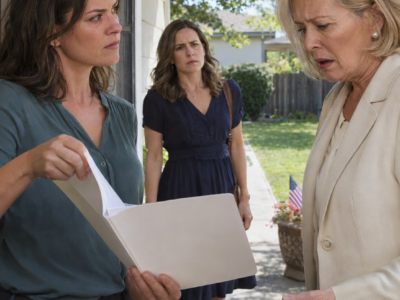
“We thought you’d pay for it,” my sister-in-law said, sliding her phone across the patio table.
The resort looked beautiful: an all-inclusive place overseas with pools, a water park, a spa, and a beach so white it barely seemed real. The price for her family of seven was thirty-five thousand dollars.
My husband, Mark, laughed. He thought Denise was kidding. I looked at the birthday card beside her elbow, the one containing the generous gift certificate we had brought, and waited for her to laugh, too. She didn’t.
“For my birthday,” she explained, as though that settled the matter. “You have the money.”
Behind her, our nephew Caleb stopped helping my youngest with a toy. Two of his sisters looked over. The party was for Denise and Caleb, whose birthdays fell close together, and until that moment the afternoon had been perfectly ordinary. There were paper plates on the table and cake waiting in the kitchen. My father-in-law sat a few feet away, holding a glass of iced tea.
“Denise,” Mark said, still wearing the last of his smile. “That’s thirty-five thousand dollars.”
“I know what it says.” She turned to me. “You wouldn’t even miss it.”
I had paid off most of the mortgage on the house behind her. I had set aside college money for all five of her children. We had already taken her family on a vacation we paid for ourselves.
Yet I was sitting there trying to work out how to say no without ruining a birthday party.
That embarrassed me later. Not her request, which was hers to be embarrassed about, but the way my first instinct was to manage everyone else’s feelings. I knew the answer. I was just looking at Caleb and wondering whether I could give it without hurting him.
“We’ve already told the kids,” Denise added. “They’re so excited.”
Caleb lowered his eyes. He was our godson, and I knew him well enough to recognize that expression. He wanted to be somewhere else.
“You told them we were paying?” Mark asked.
“I told them we’d work something out.”
Her husband, Paul, came over from the other end of the patio and stood behind her chair. He didn’t look surprised by any of this.
I was forty-six, with three children of my own. Money had been comfortable for us for about ten years, but I could still remember taking things out of a grocery cart because the total was getting too high. Having money hadn’t erased that memory. If anything, it had made me more determined that the people I loved should have fewer mornings like that.
My work paid well, and some investments I had made paid off better than we had expected. I kept working, kept investing, and over time we accumulated far more than we needed for our regular lives. There had been long hours and sacrifices, but there had been good timing, too. I never confused being fortunate with being better than anyone else.
Mark called it my money because the earnings and investments had come through me. I appreciated what he meant, although he had been the one getting dinner on the table plenty of nights when I was still working. We made our big decisions together.
The first decisions were things we had talked about for years. We paid off our mortgage. I replaced a car that had become unreliable. We bought a house in a place we loved visiting, using it for part of the year and renting it to a local family for much of the rest.
Then we made plans for the children. I wanted our three to have enough for college without starting adult life buried in debt. We set aside equal amounts, enough to cover about five years of education. I would receive the cost information and make sure the bills were paid. Whatever remained afterward could help with a down payment on a home.
That arrangement mattered to me. I wasn’t handing a teenager a large account and hoping for the best. I was promising an education and, if things worked out that way, a little help getting established.
Once our own children were taken care of, Mark and I looked at the other kids around our table at holidays. My brother had two. Denise had five. Mark’s other sister didn’t have children, but there were other ways we could help her.
“If we do this,” I told Mark, “I want the same arrangement for all the kids.”
He agreed. We knew too many families where one child spent a lifetime knowing the others had been given more.
Denise’s oldest daughter had already started college. I reimbursed her parents for the expenses they had covered so that she wouldn’t be at a disadvantage simply because she was older. She finished in four years and had money remaining toward a place of her own. I was proud of her. Watching her get through school had given me more pleasure than anything I could have bought for myself.
An accountant who was also a close friend helped me work through how to assist my brother and Denise with their mortgages. We paid down most of both balances. My parents’ house was already paid for, so we sent them on a trip. Mark’s parents and his other sister rented, and we gave them money that would let them save what they otherwise would have spent on rent.
We also gave to charities and created education funds for some children of close friends and relatives. Those were private decisions made over time, involving people who were part of our lives. There was never a family application process. I had never announced that everyone related to us was entitled to the same arrangement.
The big vacation came later. We invited members of both sides of our family and paid for the trip. It was the sort of thing Mark and I had once talked about while driving home from work, when being able to buy everyone dinner still seemed like a distant possibility.
I remembered Denise on that trip, sitting beside the pool with her shoes off, laughing at something one of the kids had said. She had hugged me before we went home. At the time, I thought we had finally settled into an easier relationship.
Our relationship had never been openly hostile. Denise could be warm and funny, especially when the conversation stayed on ground where she felt comfortable. She loved her children, remembered family birthdays, and could make a nervous guest feel welcome. But she also had a way of slipping an insult into a compliment so neatly that answering it made you seem unreasonable.
“It must be nice,” she once said about my work, “being able to charge that much for something people can’t even explain.”
“Which part do you want me to explain?” I asked.
She smiled. “Oh, don’t be so serious. I’m teasing.”
For years, that was how I handled her. I asked her to clarify. I let her explain what she meant by easy money, or by Mark being unusually patient with a wife like me. Usually she changed the subject before she had to say the ugly part plainly.
Mark had spoken to her about it. So had their father. Sometimes she would behave better for a while. Then another remark would arrive, soft enough to deny, sharp enough to do its work.
I put up with more of it than I should have because I loved the children. I didn’t want every cookout to become a test of who would defend whom. And, if I’m honest, I thought being generous might reassure her that my success hadn’t taken anything away from her.
Instead, after the family trip, she began mentioning resorts.
She would send me a picture of one and say the children would love it. At dinner, she would bring up a friend’s all-inclusive vacation and then glance at me. Mark and I never offered. We changed the subject or suggested something her family might enjoy within its own budget.
When the pandemic shut so much down, the hints stopped. Denise and Paul were very cautious, and travel wasn’t something any of us expected to do soon.
By the time of the birthday party, restrictions were easing enough that people were beginning to gather again. Everyone was tired. Everyone wanted something pleasant to look forward to. That part I understood completely.
We had brought Caleb a gift certificate for camping equipment because he wanted a tent. For Denise, we had put a gift certificate in a basket with sunscreen, a few drinks she liked, and some other things for a vacation. I knew she hoped to get away. I thought I was helping her do that.
Earlier in the afternoon, she had asked about our plans.
“A cabin for a week,” Mark told her. “We’re staying in the country.”
“A resort?”
“Just a cabin,” I said. “We’ll do our own cooking.”
She had made a little sympathetic face, as though I had said we were going somewhere to have a tooth pulled. Mark and I liked a quiet week with the kids. We didn’t mind buying groceries.
When she said they still hadn’t decided what to do, we suggested visiting relatives for a weekend or trying a campground with activities for children. Looking back, I could see her getting impatient. We were answering a question she hadn’t really asked.
Then the phone came out.
Now it sat between us on the patio table, with its bright blue water and its enormous price, while Denise waited for me to understand my part.
“You have the money,” she repeated.
“Yes,” I said. “I do.”
“So you can pay for it.”
“I could afford it.”
“Well, then, wonderful. We’ll have to check the dates, because—”
“I’m not paying for it, Denise.”
She stared at me. Paul pulled out the empty chair beside her but didn’t sit down.
“What do you mean?” she asked.
“I mean I’m not giving you thirty-five thousand dollars for a birthday vacation.”
The children had gone quiet. I hated that. I wished she had asked in a phone call, in a hallway, anywhere they wouldn’t have had to listen. But she had chosen the table, and I couldn’t undo that for her.
“After what we’ve all been through?” she said. “Don’t you think we deserve something nice?”
“Of course you do.”
“But you won’t help.”
I looked at the house. I shouldn’t have. Her eyes followed mine, and her expression hardened.
“You’re going to hold that over us forever?”
“No. I’ve never asked you to pay it back. But please don’t sit here and say I won’t help your family.”
Paul finally spoke. “You’re making this bigger than it needs to be.”
“You’re asking me for thirty-five thousand dollars.”
“For the whole family. Seven people. It isn’t as though she’s asking you to buy her jewelry.”
“Paul,” Mark said, “you don’t get to decide what makes that a reasonable request.”
Denise turned her attention back to me. Her eyes widened, and her voice softened. I recognized the change. She was moving from annoyed sister-in-law to wounded mother.
“It’s for the kids, too. Caleb is your godson.”
“I know who Caleb is.”
“Then why would you disappoint him?”
Caleb stood up. “Mom, I didn’t ask—”
“I’m talking to your aunt.”
“And I’m answering,” I said. “You didn’t discuss this with us before you spoke to the children. We didn’t promise them a trip.”
My hands were lying in my lap. I pressed my fingertips together to keep from picking at a loose thread on my pants. I knew what I wanted to say, but it came out less calmly than I intended.
“You’ve spent years making it clear you don’t respect my work. You don’t respect how much of my time it took, or what Mark and I gave up while I was doing it. You’ve called me names. You’ve told people he should divorce me. And now you’re telling me I owe you a vacation because I earn enough.”
“That is not true.”
“Denise.”
“I have never said that.”
Paul leaned forward. “You’re lying. Just because you don’t want to pay for a vacation, you don’t get to say something like that about my wife.”
“I’ve heard her,” my father-in-law said.
He hadn’t raised his voice, but Paul stopped speaking.
“Dad,” Denise said. “You know how she takes things.”
My father-in-law put his glass down. “I know what I heard.”
“So now everybody’s going to gang up on me at my own birthday party?”
“Nobody is ganging up on you,” Mark said. “You asked us for something. We said no.”
Paul shook his head. “My wife says she never said it.”
“Dad,” one of their daughters said quietly. “Mom has said those things.”
He turned toward her. “Stay out of this.”
Caleb was holding his phone. He looked at his sisters, then at me.
“I have it,” he said.
For a second, nobody understood him. Then he explained that he had been making a video for TikTok when his mother had started talking to someone nearby. Her voice had ended up in the recording.
“Caleb, put that away,” Denise said.
He didn’t move. His face had gone red, and his thumb hovered over the screen.
“You don’t have to do this,” I told him.
“But Dad thinks you’re making it up.”
He played only a short piece. It was enough. Denise’s voice came from the little speaker, ordinary and unmistakable, saying that all I cared about was my work and that Mark ought to divorce me.
I watched Paul’s face. He looked at the phone, then at his wife, and finally down at the table. The confidence he’d had a minute earlier was gone.
Denise reached for the phone, but Caleb pulled it back. “I wasn’t trying to record you,” he said. “You were just talking.”
“I was upset that day.”
Mark leaned forward. “About what?”
“That isn’t the point.”
“It seems like a pretty good point to me.”
I wished I could say hearing it didn’t hurt because I already knew. But knowing someone has said something and hearing her comfortable, familiar voice say it are different experiences. I had sat beside that woman at school events. I had listened to her worries about her children. I had spent years trying to make room for her in my life.
The recording ended. Caleb lowered his phone, looking miserable. I wanted to reassure him, but Denise was already speaking again.
“Fine. Forget the resort.” She pushed her own phone away. “We can do something less expensive.”
Mark stared at her. “Did you hear any of what just happened?”
“I said forget it. What else do you want?”
She turned to me. “You could at least pay for the flights and let us use your vacation house. That wouldn’t cost you anything like thirty-five thousand.”
I let out a breath so slowly that it made my chest hurt.
“There’s a family living there.”
“You don’t rent it out all year.”
“Their stay has been extended because of the pandemic. They’re there now, and they’re staying.”
“It’s your house.”
“Yes. And I’m telling you it isn’t available.”
Paul tried again, more quietly this time. “Surely there’s something you can do.”
“I gave Denise a birthday gift. There’s enough on that gift certificate to make a real contribution toward a trip. We’ve also already taken everyone on a vacation. I’m happy we did. I’m not agreeing to keep buying them.”
Denise folded her arms. “So we just don’t go anywhere.”
“That’s up to you and Paul. You have savings you no longer need to set aside for the children’s college. You have a degree. If the vacations you want cost more than your budget allows, you can look at earning more or choosing something less expensive.”
“You make that sound so easy.”
“I know it isn’t easy.” My voice shook then, and I stopped trying to hide it. “That’s part of what I’ve been trying to say to you.”
She started crying. I didn’t know whether she was hurt, embarrassed, furious, or all three. Paul put a hand on her shoulder. For a moment, the old impulse returned: say something soothing, reduce the tension, find a smaller amount that would make this stop.
Then she looked at her father.
“Dad, are you really going to let her talk to me like this?”
He rubbed a hand over his mouth. He looked tired rather than angry.
“I’ve watched both of them work for what they have,” he said. “I’ve watched them help you. You don’t have to like the answer, Denise, but you need to accept it.”
“You always take their side.”
“Today I do.”
Mark stood up. He was angry enough that he took a second before speaking.
“You don’t get to talk about my wife that way and then use our love for your children to pressure her into paying you. We’re going home.”
I gathered our things while he found the children’s shoes. Caleb followed me toward the door with his camping gift certificate in his hand.
“Thank you for this,” he said.
“You’re welcome, honey.”
“I didn’t know she was going to—”
“I know.”
He nodded, but he didn’t look convinced. I hugged him before we left. Behind him, his mother was still crying, and the birthday cake was sitting untouched on the counter.
For the first few minutes in the car, neither Mark nor I said much. Our children asked whether Caleb was in trouble. I told them I hoped not, and that the adults had disagreed about money. It sounded too small for what had happened, but it was all I wanted them carrying home.
Once they were occupied in the house, Mark found me in the kitchen. I was washing a cup that was already clean.
“You didn’t cause that,” he said.
“It was his birthday.”
“I know.”
“I should have left it at no.”
“She didn’t leave it at no.”
I turned off the water. There was no way to go back and make the afternoon pleasant for Caleb. That was what stayed with me, even more than the things Denise had said about me.
My mother-in-law called that evening. Mark answered, and I could hear enough to know Denise had already reached her. She was worried about her daughter. She was worried about the children. Denise’s family had struggled before, and perhaps, she suggested, we had forgotten what that felt like.
Mark sat down at the kitchen table.
“We remember,” he said. “That’s why we helped.”
He listened for a long time. His mother was a family-first person, and Denise was the child she most often rushed to protect. I didn’t think she understood how often making peace meant asking the same people to swallow one more thing.
“Mom, she isn’t asking for groceries,” Mark said. “She showed us a thirty-five-thousand-dollar resort package. We hadn’t agreed to anything.”
Another pause. I started to leave the room, but he reached for my hand.
“No. The college arrangements haven’t changed. Why would you think we were taking anything from the kids?”
That made me sit down.
He listened again, then explained the party from beginning to end, including the recording. He didn’t shout. He didn’t make his mother choose which child she loved. He kept bringing her back to what had actually happened.
By the end of the call, she understood why we had refused. She was still upset. So was I. Understanding something doesn’t make it easy to imagine the next family dinner.
A few days later, all five of Denise’s children came over. I saw them on the door camera, clustered together while the oldest searched for something in her purse. Caleb stood slightly apart, hands in his pockets.
I opened the door before they rang again.
“Come in,” I said. “You all look like you’re here to tell me you wrecked a car.”
Usually that would have earned a laugh. This time, I got a few uncertain smiles.
We sat in the kitchen. Their oldest daughter started to apologize for her mother, and I stopped her as gently as I could.
“You don’t owe me an apology for somebody else.”
“We just don’t want things to be different,” she said.
I looked around the table. I had known these children through missing teeth and first jobs, school disappointments and college decisions. I hated that they were trying to figure out whether an argument between adults could erase all of that.
“They aren’t different between us,” I said. “Not because of this.”
Caleb picked at the corner of a napkin. “What about coming over?”
“You’re welcome here.”
“And the college stuff?” one of his sisters asked, then immediately looked embarrassed. “I don’t mean that’s all we care about.”
“I know you don’t. And yes, those plans are still there. I made those promises to you.”
Their youngest shifted in her chair. She had been quiet, listening to the older ones, and I could see she wasn’t satisfied.
“But you could pay for the trip,” she said.
“Yes.”
“And Mom really wanted it.”
“I know she did.”
“Then why not?”
One of her sisters began to answer, a little too sharply, and I held up my hand.
“It’s all right. She can ask.”
I thought for a moment. I didn’t want to make their mother sound worse, and I didn’t want to pretend the answer was complicated just because they were young.
“There are a lot of things I could buy,” I said. “I still have to decide what I’m willing to spend money on. Helping with school was something Uncle Mark and I chose to do. This trip was something your mother decided I should pay for before she asked me.”
“She thought you’d say yes.”
“I understand that. But thinking I might say yes isn’t the same as my saying it.”
The youngest looked down. She was still disappointed. I let her be. She had imagined a water park and a beach, and now adults were explaining principles to her. I couldn’t expect her to enjoy that.
The older children understood more. They knew how much room our gifts had created in their parents’ finances. They had also heard the remarks about me. Their anger had spilled into life at home, and they began telling me how little they were speaking to their mother and father.
“Please don’t fight with them on my behalf,” I said. “Do your chores. Let them know where you are. You’re still their children, and I’m not asking you to take care of me.”
Caleb finally looked up. “Are you mad I played the video?”
“No. But I’m sorry you felt you had to.”
They stayed for dinner. I added another pot of pasta and put the bread in the oven. The children helped set the table, and after a while the conversation wandered away from the party. Someone complained about a teacher. One of our kids asked Caleb about the tent he wanted.
By the time they left, I could breathe more easily. The youngest hugged me, even though I wasn’t sure she agreed with a word I had said.
The calls from other relatives had already begun. Denise had told them we had humiliated her and refused to help her family. Some wanted to hear our side. Others seemed to have called with a verdict already prepared.
Then Caleb posted the recording on Facebook.
I hadn’t asked him to do it. I hadn’t known he was going to. The result was immediate enough that I wished, for his sake, there had been a quieter way. People who had lectured us began calling back to apologize. A few still said they could understand both sides, but they no longer insisted that I had imagined Denise’s behavior.
Some relatives stopped inviting Denise and Paul to gatherings. Their children continued doing what was expected at home but spoke to them as little as possible. None of that made me happy. I had wanted to refuse a vacation, not turn every family occasion into a negotiation over seating and loyalties.
What I didn’t yet understand was how widely Denise had described our finances while making her complaints.
People who rarely called us now knew about the education funds, the mortgage help, and the vacation house. They had compared what different branches of the family had received. Somewhere in those conversations, gifts I had chosen to make became benefits other people believed they had been denied.
The first call came while I was folding laundry.
It was one of Mark’s aunts and her husband. We heard from them at major holidays, sometimes, but they weren’t people who normally called to ask about our week. I put them on speaker so I could keep matching socks.
They asked how we were doing, how the kids were managing, whether work had settled down. I answered, pleased that somebody wanted an ordinary conversation. Mark was nearby, looking through the mail.
Then his aunt asked whether it was true that I had set up college funds for some cousins’ children.
“Yes,” I said.
“And you took your in-laws and Mark’s sisters on a vacation?”
“Yes.”
“And you own another house.”
I put down the sock I was holding. “Why are you asking?”
“We didn’t know you had that kind of money.”
“We’ve been fortunate. I’ve worked hard, and the investments have done well.”
“Well,” she said, “we’ve been discussing it.”
Her husband took over. He had always been comfortable explaining things to other people, and he used the same tone now that he might have used to describe the route to a restaurant.
They had six grandchildren. Each child would need a college fund of eight hundred thousand dollars. They also wanted a vacation home in a location they preferred. They had already found a property and would send the information. And, of course, they wanted a family trip, since other people had been given one.
Mark stopped opening the mail.
I said nothing. At first, I honestly thought I had misunderstood. Eight hundred thousand dollars for each of six children was $4.8 million, before the house or the vacation. They weren’t asking whether there might be help with a tuition bill. They were telling me what to provide.
“We’re family,” his aunt said into the silence. “It should be fair.”
“Did you say eight hundred thousand?”
“For each grandchild,” her husband clarified.
The amount wasn’t a figure I had ever offered them. Neither was the house. They had arrived at those decisions without me and were now waiting for me to arrange the money.
I started recording partway through the call. I wanted an accurate account of what was being said, because I could already imagine the version that would circulate afterward.
“Would you repeat what you’re asking for?” I said.
They did. Slowly. The college funds, the property, the trip. His aunt added that they shouldn’t have to feel like second-class members of the family.
That was when I remembered the last time money had been the subject of a serious conversation between us.
It had been before our circumstances improved, during a health scare. We were frightened and short of cash, trying to keep up with expenses while we figured out what came next. We didn’t ask anyone to pay our way permanently. We asked whether we could borrow enough to get through the tight stretch, and we promised to repay it.
Asking had been hard. I remembered writing down what we needed so I wouldn’t lose my nerve and make the amount smaller halfway through a call. Mark made some calls. I made others. We hated having people know we were struggling, but we needed help more than we needed pride.
Out of the nine aunts and uncles we approached, only three helped. We paid those loans back.
This aunt and uncle had not been among the three. They hadn’t simply said they couldn’t afford it. They had explained that we were responsible for having enough saved to care for our family, and that if we couldn’t provide for our children, we didn’t deserve them.
I had remembered that last part long after I forgot the amount we had asked to borrow.
Now I looked at our children’s clean clothes stacked beside me and listened to the same people tell me what family members owed one another.
“Are you finished?” I asked.
There was a pause. “We can send the house information tonight.”
“No. I mean, is there anything else you want to ask for?”
“That’s what we discussed.”
“Then I need you to listen. I’m not funding these requests.”
His aunt made a small sound of disbelief. Her husband began to speak, but I kept going.
“When Mark and I had a health scare and asked you for a loan, you told us it was our responsibility to have enough money for the care, well-being, and education of our family.”
Neither of them answered.
“You also told us that if we couldn’t manage that, we didn’t deserve our family. Do you remember?”
“That was a different situation.”
“It was. We were asking to borrow money we intended to repay. You’re asking me to give you millions.”
Mark came to stand beside me. I could feel how angry he was, but he let me finish.
“I’m not going to have this conversation again. Please tell anyone you’ve been discussing it with that the answer is no. Don’t call us with demands like these.”
I ended the call before they could start over.
For a moment, the house was quiet except for the dryer. Then Mark took the phone from my hand and put it on the table.
“I’m glad you said it,” he told me.
I picked up another sock. It didn’t match anything in front of me. I put it down again.
“They remembered that I own a vacation house,” I said. “They didn’t remember telling us we didn’t deserve our children.”
“They remembered.”
I looked at him.
“They just didn’t expect you to bring it up.”
Over the following weeks, other calls came. Some were awkward attempts to find out whether help might be available. Others began with variations of what the first aunt and uncle had said: somebody else had received something, and therefore they were owed something, too.
I didn’t give every caller the same speech. Most of the time I said that we weren’t opening new funds or buying properties on request. If they wanted to talk about something else, we could. If they kept pushing, I ended the conversation.
The relatives who had helped us during the health scare called for a different reason. They wanted us to know they weren’t expecting anything more. They had seen our generosity. They were happy we were doing well.
One of those conversations lasted nearly an hour because, after the first few minutes, we stopped talking about money. We talked about the children and work and how tired everyone was of worrying. When I hung up, I realized how much I had missed being asked a question whose answer wasn’t supposed to be a payment.
Then one of Mark’s cousins called about a house.
I nearly braced myself before she had finished her first sentence. I felt ashamed of that afterward, because she was careful and nervous, and her request was nothing like the others.
She and her family had saved almost enough for their down payment. They were short a thousand dollars. Could they borrow it under a written agreement, with a clear repayment schedule?
“If you don’t want to, I understand,” she said. “I know you’ve had a lot of calls.”
I asked a few questions. She answered them. She knew exactly what the money was for and how she planned to pay it back.
We agreed. The loan was put in writing, signed, and notarized. She wasn’t offended by the paperwork. She wanted it, too. It meant neither of us had to depend on an uncertain memory of what had been promised during a phone call.
By the time the next round of family complaints arrived, she had already repaid five hundred dollars.
That little loan caused a surprising amount of trouble. To some relatives, it proved I was still choosing favorites. If I could help her with a house, why couldn’t I help them? Why did she get a yes when they had received a no?
I was tired of defending separate conversations to people who hadn’t been part of them. Mark and I agreed to a Zoom call with the relatives who kept raising it. I hoped that saying the same thing to everyone at once would leave less room for retelling.
It wasn’t a pleasant evening. Faces filled the screen, some attentive, some already annoyed. A cousin kept adjusting her camera. Someone’s television played in the background until Mark asked them to turn it down.
I had written a few points on a piece of paper, and I kept it beside the computer. I didn’t trust myself to remember everything if people began interrupting.
“The money we gave before was a gift,” I said. “It wasn’t the beginning of a program every relative can enroll in.”
An aunt started to object. Mark asked her to let me finish.
“If someone has a real financial problem, you can ask us to consider helping. We’ll need to understand the situation. If it’s a loan, there will be a written agreement so everybody knows what’s expected. Asking won’t guarantee a yes.”
“But she got money for a house,” someone said.
The cousin who had borrowed the thousand dollars leaned toward her camera. She held up her copy of the agreement.
“A loan,” she said. “I borrowed a thousand dollars. I’ve already paid back half.”
“You shouldn’t have to sign papers with family.”
“I wanted to,” she answered. “It’s her money. I wanted her to know when she’d get it back.”
That quiet answer did more than another long explanation from me would have done. A few people nodded. Someone asked whether the education promises already made were changing, and I said no.
One uncle said that treating relatives like borrowers felt cold. I asked what arrangement he thought would prevent misunderstandings. He didn’t offer one. Another person wanted to know what counted as a real need, and I said we would talk about individual circumstances privately. I wasn’t going to examine everyone’s finances in front of the whole family.
“What we can’t do,” Mark said, “is have people decide what they want, tell their kids it’s coming, and then expect us to pay for it.”
Most of them accepted what we said. Some were clearly unhappy, but they stopped arguing. I didn’t need enthusiasm. I needed them to understand the answer.
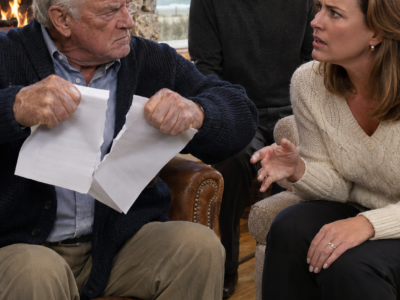
When we closed the laptop, the room seemed unusually quiet. I gathered my little page of notes and folded it in half.
“Do you think that did any good?” I asked.
Mark considered it before he answered. “For some of them.”
I decided that would have to be enough.
Not long afterward, I came home on a weekday and found cars lining both sides of our street.
Usually there were only a few parked there at that time of day. I slowed down, thinking a neighbor must be having people over. Then I saw the group in front of our house.
There were fifteen or twenty of them, aunts and uncles, cousins and spouses. Some stood on the lawn. Others were near the front walk. I recognized people from the Zoom call. A few were talking with their arms folded; one kept looking up the street.
I drove past because there was nowhere to pull in safely. My first thought was that something terrible had happened. Then one of the men saw my car and pointed, and the group turned toward me together.
I parked farther down the street and called the police nonemergency number.
I gave the dispatcher my address and explained that a group of relatives had gathered outside my home after a dispute over money. I said I was worried the situation might get out of hand. I asked for officers to come and help.
By then I was walking back toward the house.
I should have stayed in the car. I know that now. At the time, I still believed these people would step aside when I asked to get to my own front door. They had eaten in our house. I knew their children. I mistook that familiarity for a limit on what they would do.
They began calling out before I reached the walk.
“There she is.”
“We need to settle this.”
“You think you can just hang up on people?”
I stopped several feet from them. “You need to leave.”
One aunt said they had come because a conversation on a computer wasn’t good enough. A cousin said I had insulted the family. Someone behind them shouted that I was going to pay, one way or another.
I kept my phone in my hand and repeated that they needed to go.
They moved closer instead.
The noise made it difficult to pick out separate sentences. People were talking over one another, and each person seemed to believe I should answer them first. I could smell somebody’s coffee. A woman I had known for years was close enough that I could see a spot of lipstick on one of her teeth.
That tiny detail stayed with me. I was trying to understand how an ordinary face, one I recognized from family photographs, could look that angry while its owner told me I had brought this on myself.
“Back up,” I said.
Someone jabbed a finger at my shoulder. Another hand poked my chest. I moved to the side, trying to get room, and found a cousin standing in the gap.
“Don’t touch me.”
“Then listen.”
“I’m listening. I’ve told you the answer. Now leave.”
A neighbor’s front door opened across the street. I saw movement beyond the group, but I couldn’t spare much attention for it. I was trying to keep everyone in view and beginning to understand that I couldn’t.
One of Mark’s uncles pushed closer. He was about six foot three. I’m five foot two. Even before he leaned down toward me, I had to tilt my head to look at his face.
“You’ve embarrassed enough people,” he said.
“Move away from me.”
“You don’t tell me what to do.”
I stepped back. There wasn’t much room left. A car door shut out near the street, and someone at the edge of the group said the police were there.
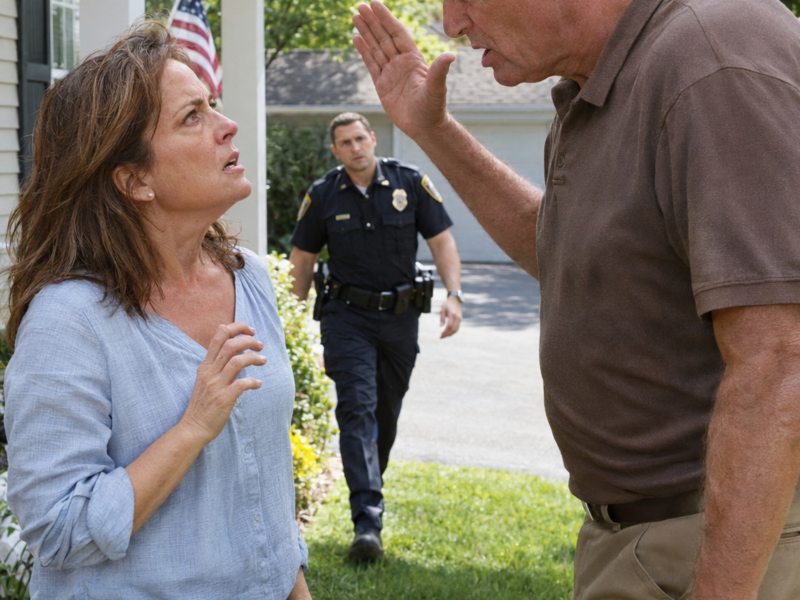
The uncle slapped me across the face.
For a moment, I heard almost nothing. My head turned with the blow, and the side of my face felt hot before it began to hurt. I still had my phone. I remember being surprised by that, as though holding on to an ordinary object meant the rest of the moment couldn’t be real.
He leaned toward me again.
“You will show some respect to your elders.”
His hand came up. An officer was shouting, but the uncle was right in front of me, and I thought he was about to hit me again.
I punched him once.
He went down. He wasn’t unconscious. He was on the ground, stunned, with one hand against his face. The whole thing, from the slap to his fall, happened in seconds.
Then the officers were between us, ordering people back.
Nobody cheered. There was nothing satisfying about it. My hand hurt. My face hurt. A man I had once greeted with a hug was sitting on my lawn, and I couldn’t stop shaking.
Several relatives began talking at once, trying to explain what had happened. The officers had seen the slap. They weren’t interested in having the group crowd around me while everyone offered a different account.
Some people hurried toward their cars and drove away. Others stayed and were questioned. I learned afterward that neighbors had called, too. What had begun as a gathering outside my house had become something the whole block could see.
An officer asked me to step away from the others. I answered questions as best I could. My words kept coming out in the wrong order. I started with the vacation, realized that made no sense without the rest, and had to begin again.
There were cameras covering the front of our home. I told the officer about them. I wanted the recordings preserved, because I no longer trusted anyone in that group to describe the afternoon honestly.
I also wanted to see whether what I remembered was what had happened. The crowding, the hands, the slap, the raised arm. My mind kept returning to each part separately, as though I could prevent the next one by noticing it sooner.
Some relatives received citations connected with the gathering restrictions still in place. The threats and the assault were a separate matter. Statements were taken, and our camera footage went to the district attorney. There was no instant conclusion announced on our front lawn.
My fingers bruised. Mark’s uncle had a broken cheekbone. I was grateful my injuries weren’t worse, but I didn’t feel victorious about his.
In the days that followed, relatives who hadn’t been there began distancing themselves from what had happened. A few of the people who had disliked my answer about money wanted to be very clear that they hadn’t approved of anyone coming to our house.
I was glad to hear it. I was also too tired to reassure them that I understood every distinction they wanted to make.
Mark kept telling me I had done nothing to justify being threatened or hit. I believed him when he said it. Then I would think of his parents trying to speak to their daughter, their siblings, their grandchildren, and the guilt would work its way back in.
His mother had spent her life trying to keep people together. Now even an ordinary family invitation carried questions. Who was going? Would we come? Would Denise? Was somebody still angry about the video? Had another cousin stopped speaking to an aunt?
I hated imagining her sitting with all of that. I hated that the children knew adults they loved could behave this way. And I hated the thought that, somewhere in the middle of the shouting, the real relationships had become difficult to separate from the money.
One evening, I sat with Mark after the children had left the kitchen. My fingers were still tender. I was holding a cold pack against them and staring at the small amount of water it had left on the table.
“I keep thinking about the other kids,” I said.
He waited.
“The ones who don’t have college funds. None of this is their fault.”
“No,” he said. “It isn’t.”
“Maybe I should set something aside for them. Quietly. Something for later.”
He pulled out the chair beside me.
“Is that something you want to do?”
“I don’t know anymore.”
It was the most honest thing I had said all day. Before this happened, I knew what giving felt like. I had enjoyed imagining a niece opening an acceptance letter without worrying about whether she could go. I had enjoyed knowing my brother could breathe more easily when he looked at his bills.
Now, whenever I considered helping another child, I heard the people on the lawn. I worried that refusing would punish someone innocent. I worried that giving would tell their parents the threats had worked. I couldn’t reach the decision itself without first pushing through everybody else’s behavior.
“Then don’t decide tonight,” Mark said.
“It feels like I’m making the family split worse.”
He looked at my hand, then back at me.
“You said no to a vacation. They made decisions after that. You don’t have to pay for all of those decisions.”
I sat with that for a while. The dishwasher was running. Upstairs, one of our children laughed at something. For the first time that evening, I noticed how quiet the rest of the house was.
I still haven’t decided whether there will be more education funds. I can care about those children without making a promise while I’m frightened of what their parents will do next. The promises I already made remain. Caleb and his sisters haven’t lost their place in our lives, and I won’t use their futures to settle an argument with their mother.
The legal questions aren’t finished, either. The footage is with the people responsible for reviewing it. I won’t pretend a phone call or a recording has neatly repaired a family that was willing to gather on my lawn and threaten me.
There are people I miss. There are calls I hesitate to answer. I’m still angry with Denise, and I’m still sorry her children had to hear that recording at Caleb’s birthday party.
A few evenings after that conversation with Mark, I opened the notes I had started making about possible college funds. I read them, added nothing, and closed them again. Nobody needed an answer that night. No deadline existed except the one I had been carrying around in my head.
From the kitchen, Mark called that dinner was ready. One of the kids asked whether I was coming, and I said yes.
There were five places set at the table. I left my phone on the counter, went in, and sat down while the food was still warm.